Module Launch going over the elements within the module, two main aspects will be:-
(1) Body of work
(2) Presentation (10 minutes documenting the planning, development, design and initiation of a project brief relevant to your practice.
Transdisciplinary thinking, towards a process of social unlearning. How I move my practice through a Transdisciplinary model.
(1) Relate it back
(2) Experiment
(3) Blue sky research create new work
(4) Learning Plans
We were taken through a power point presentation which covered every aspect of the module, teaching hours, raising questions, who we should aim to work with, aim to broaden our scope of research area, what is our individual passions, blue sky thinking, will it be a physically tested out project or will it be a proposal for a project with tested out elements.
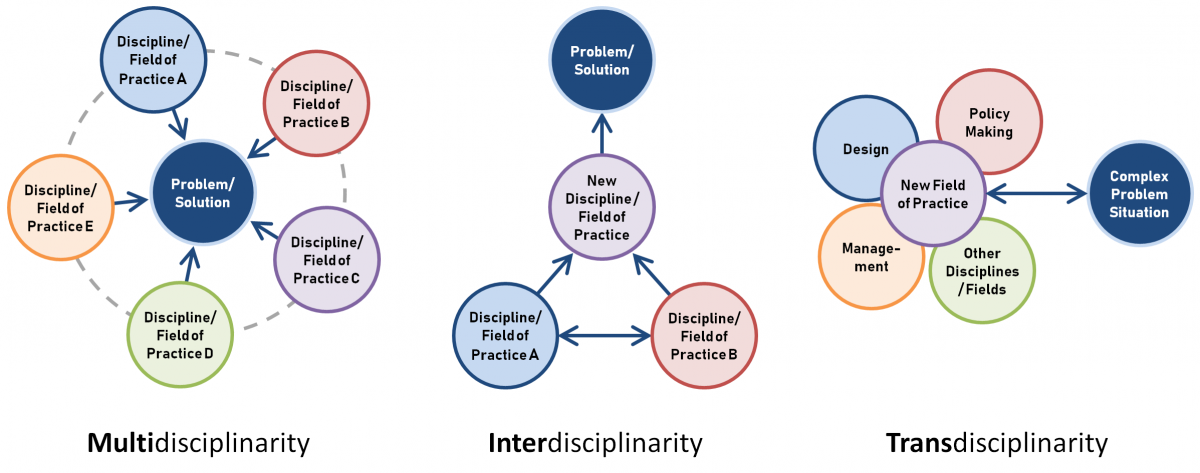
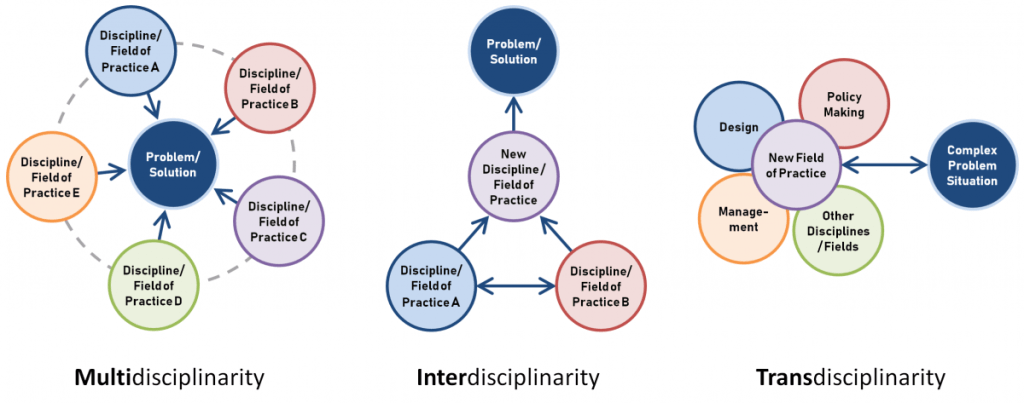
Multidisciplinary, Interdisciplinary and Transdisciplinary
Multidisciplinary we can see that there is one problem to look for a solution, this model is used widely in the social care sector for example, whilst dealing with a complex client that needs to be admitted to hospital, this individual may be involved with several services, such as social worker, family members, GP, police, and the individual if they have capacity, to be able to give the correct solution, many considerations may need to be taken to arrive at an agreed plan of action with risk assessments agreed before the decisions have been made.
Interdisciplinary practice is applied within training and education pedagogies that describes working with several established discipline’s or traditional methods or modes of enquiry, such as research, technology, printmaking, fine art, textiles, in the pursuit of a common goal, in the diagram in the middle below Discipline field of practice A (pale blue) and B (peach) could be using traditional printing methods, with a textile sculptural practice to develop a new discipline and solve a problem in an interdisciplinary method of inquiry, this may lead to new hypothesis and lines of inquiry.
Transdisciplinary approach is a holistic approach to solve a complex problem using theories and concepts from several different disciplines, such as art and science, architect, biologist, environmentalist, historian, what I find exciting about this method, is that as an artist working within my own field I am limited to solving a problem from an artistic perspective, the visual, however, by working with another discipline, I am able to gain insight into a different dimension, the scientist would also gain visual interpretation of their research and working together to solve a complex problem or come up with new hypothesis for further research.
The diagram below explains the complex ways that different groups of specialist disciplines can work together to solve problems, to possibly come up with new plans, new hypothesis.
“Figure 1. A comparison of multidisciplinary, interdisciplinary, and transdisciplinary approaches to innovation”.
Integrate Ideas for an Interdisciplinary Outcome
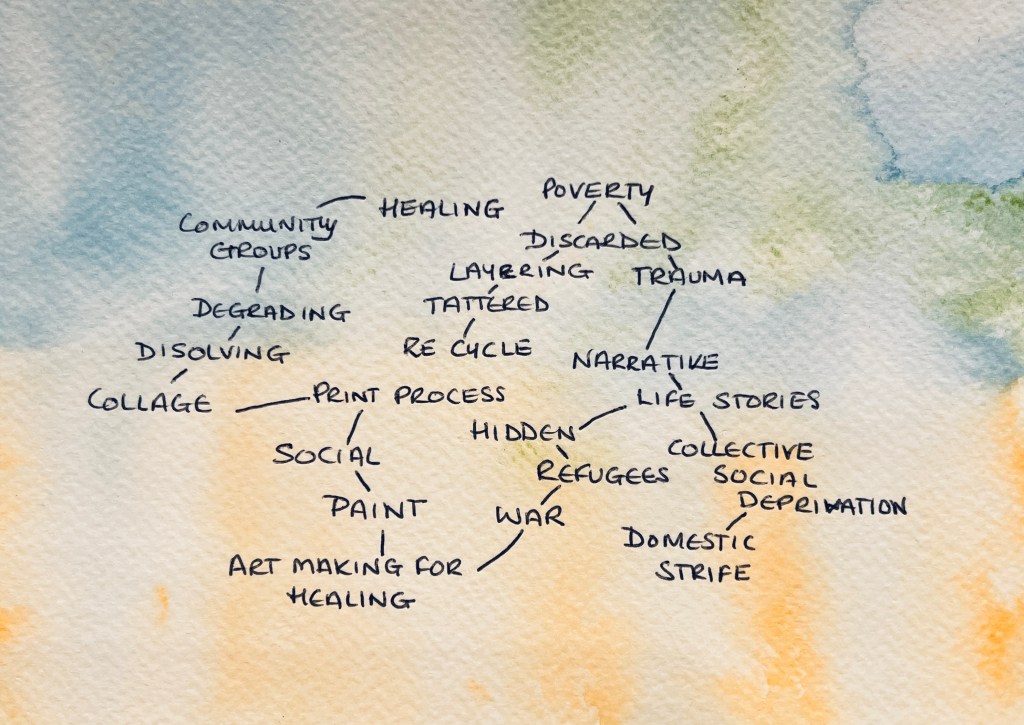
Below is a class task to engage within a group discussion on how to design / integrate a project brief with an interdisciplinary outcome.
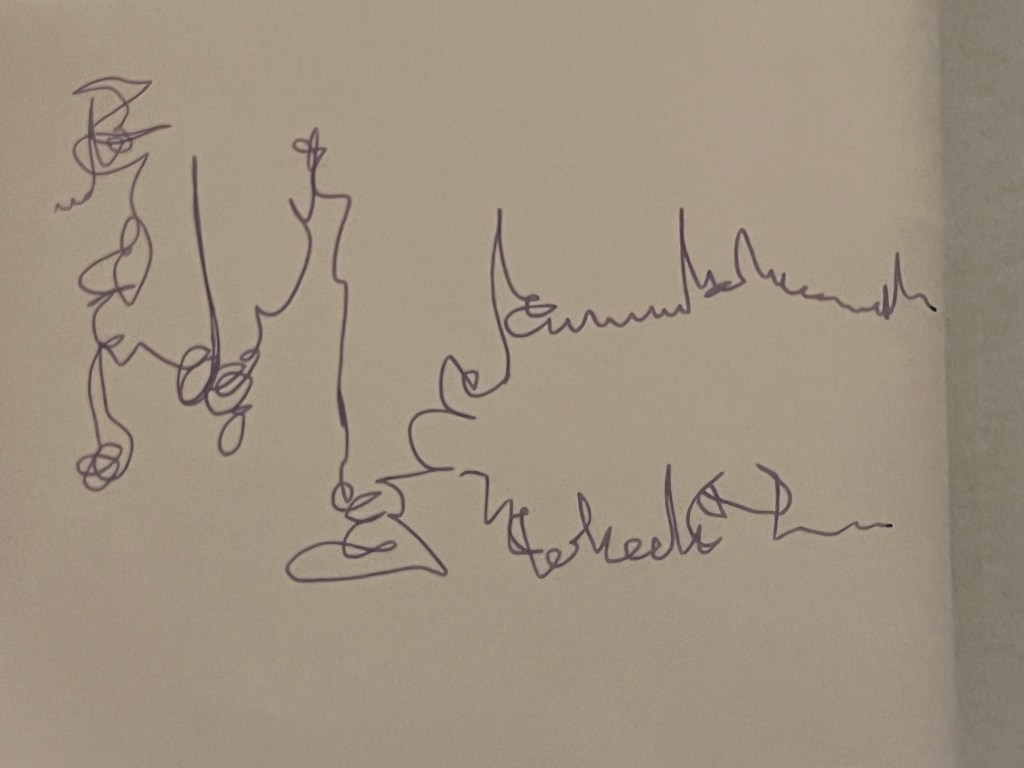
First sheet (Left) project ideas working in my own area of interest, words and ideas.
Middle sheet, who I would work with, proposed project, if there were no obstacles.
As this was off the cuff task, I had not had time to process my ideas before hand, therefore, with hindsight this could be a very different thinking process, which would develop as and formulate learning strategies within this module.
The last sheet (Right) an analysis of how one would initially tackle the project, but as stated, this is more about the process and not the subject matter, a way of exploring and moving my practice to another level, and below is possibly a tried and already tested method that I have used previously to put a project together.
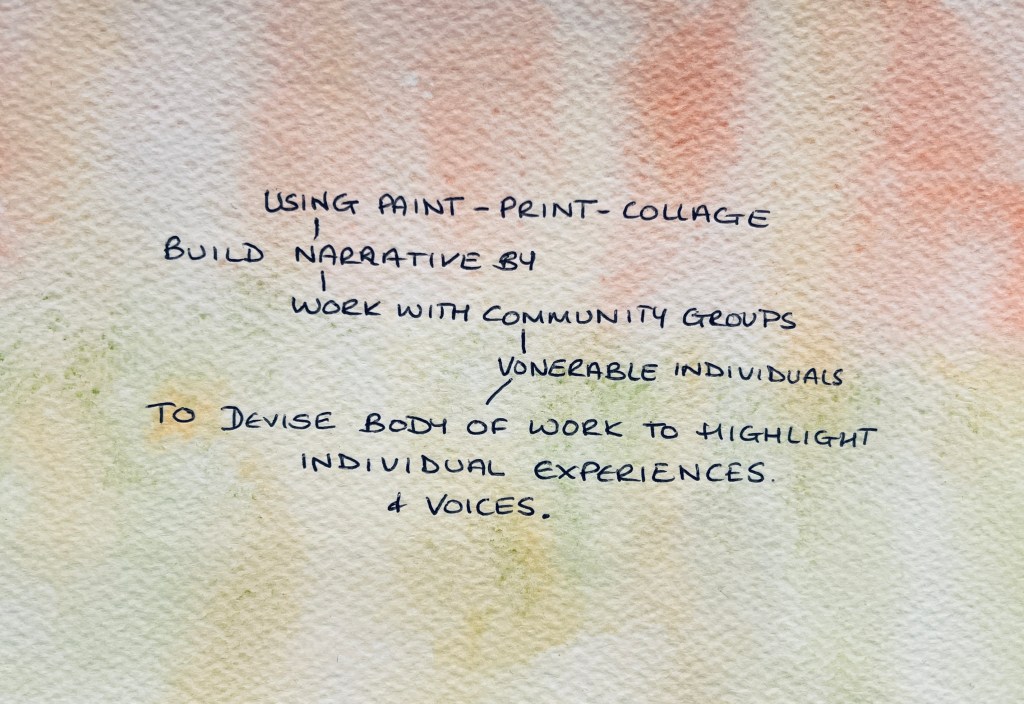
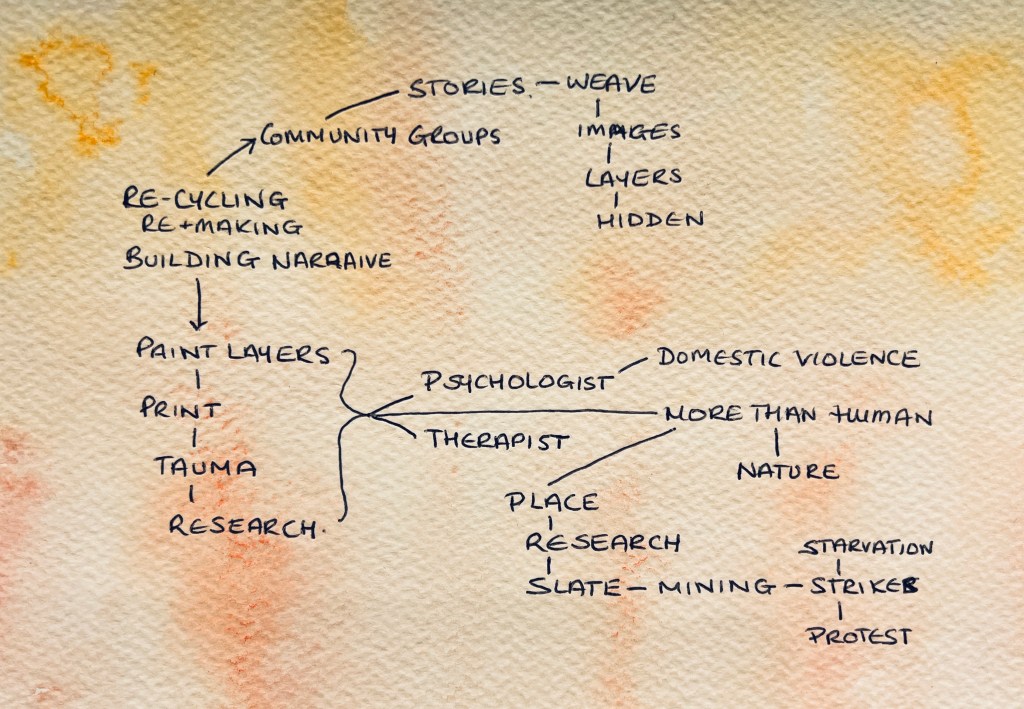
Initial Plan
In this module I would like to think outside the box, by collaborating with specialists outside of my field to expand my thinking on the subject of trauma. I have been thinking about internal human trauma, in this module I aim to expand this to look at non human trauma.
Blaenau Ffestiniog is where I grew up the landscape had suffered trauma from the slate mining, the community also suffered trauma when the slate mines closed down, unemployment and social problems began to rise, people were poorer those who were able, moved out of the area, this caused a downward spiral of high unemployment, lack of opportunities, alcohol and drug problems which led to further trauma. This is not an isolated town where this happened, however, Blaenau Ffestiniog is geographically ill placed when it came to individuals in the town being able to access employment that was commutable which impacted the chances of young people further.
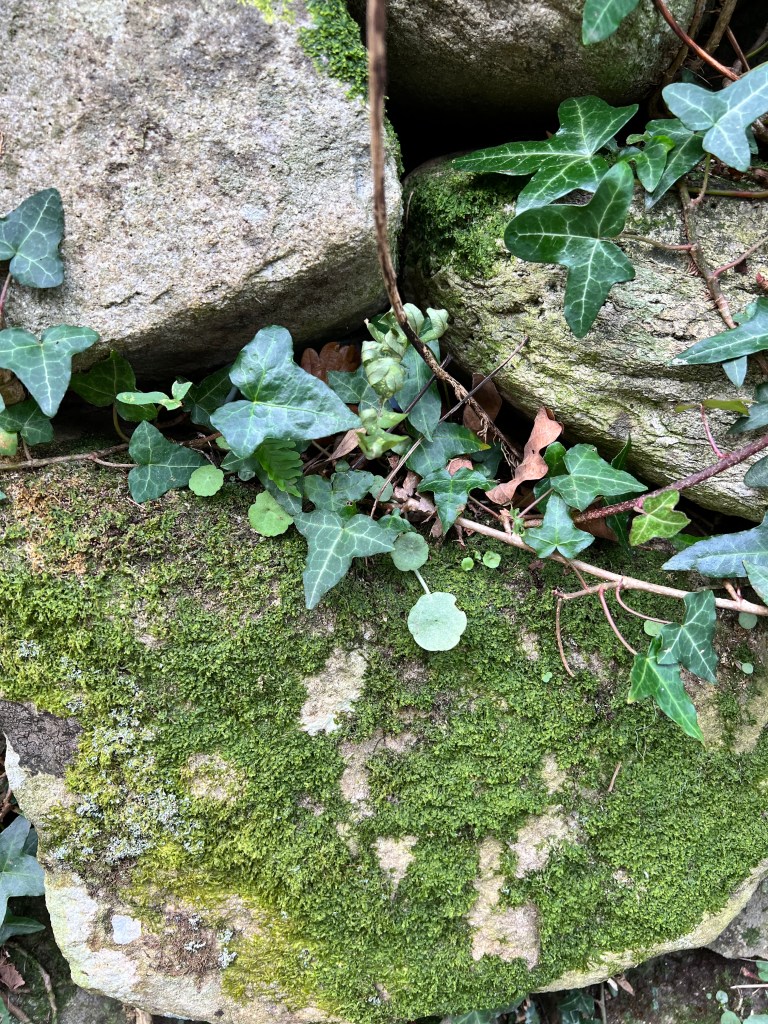
I have been pre occupied with nature, possibly the lack of greenery growing up in the shadow of slate slags, I am drawn to moss, it grows in between the cracks, it envelopes stones, it appears as a carpet in forests creeping up trees, Lichen is also in this category and its ability to appear almost dead but as soon as it has water it revives.
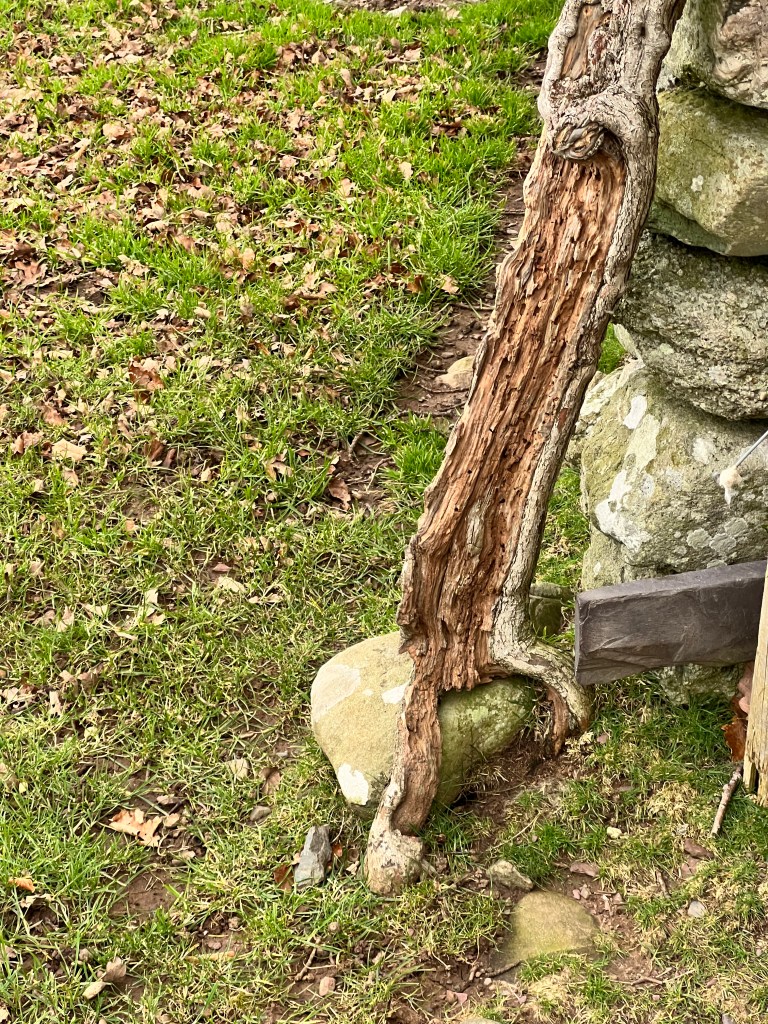
I began to explore which areas I wanted to look at, I began to look at trees that I felt had overcome obstacles, at this point I am not sure which direction to go in as I am exploring who I can work with from another discipline.
These images that I have taken in the last few days, the fist two is of a tree (Llanllechid) near Bangor North Wales that has grown over a stone, it has overcome its obstacle, grown despite the rock, it looks as if it walked there. The second two images (Llanystumdwy) near Criccieth North Wales Has grown over a fence, it is a huge tree that has also grow around its obstacle and it left me wondering how this began its journey up and over the fence.


Initial brainstorming of ideas, testing out, thinking, it may not be anything to do with the trees themselves, it may just be the journey around their obstacles, my journey around a metaphor a narrative of hope in a journey of trauma in a non human being, that made it to be a tree, but if I worked with a tree expert, they may have a very plausible explanation for why this has happened and in this simple way I can see how working in a Transdisciplinary method would change my knowledge, and subsequent outcomes but that my creative approach would also input into the specialist knowledge in seeing this from a different perspective.
At this starting point I am just exploring every avenue available, but trying not to take myself down a safe trusted route where I know my strengths lie, such as a community group scenario as I have already done this, so in this module i aim to explore outside my comfort zone and really push the boundaries, to take this opportunity to do some blue sky thinking some Transdisciplinary thinking, being open to suggestions and collaborations without limits.
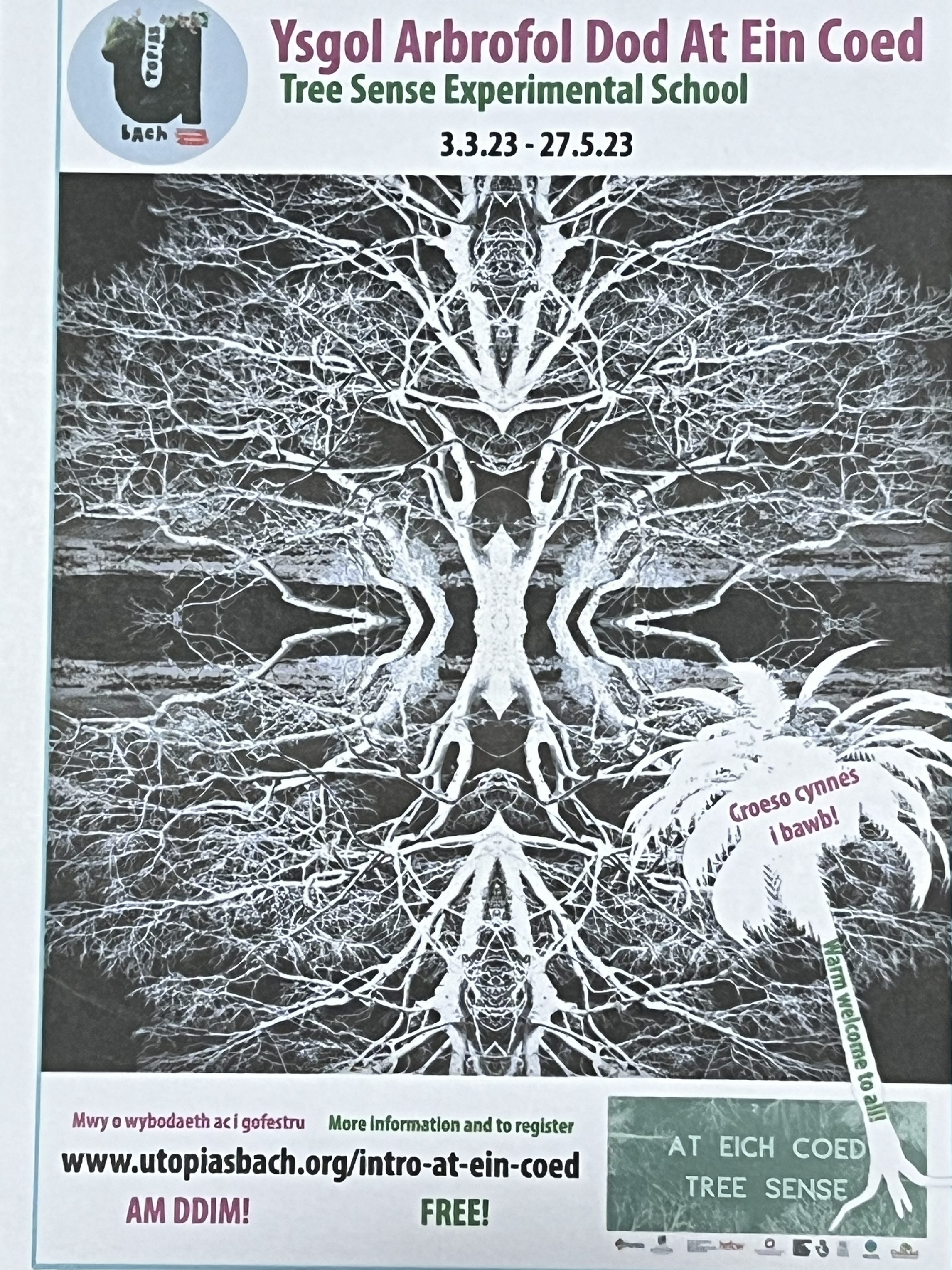
Observing and taking part (when I can) in the collaboration Tree sense taking part in Pontio, from 3rd March 2023 to the 27th May 2027 has been a humbling experience to see the project grow and develop in so many creative ways, using poetry, painting, crone making, to giving trees their own rights manifesto, as well as impromptu performances, that have enriched the landscape of Pontio into an interactive vista to the trees.
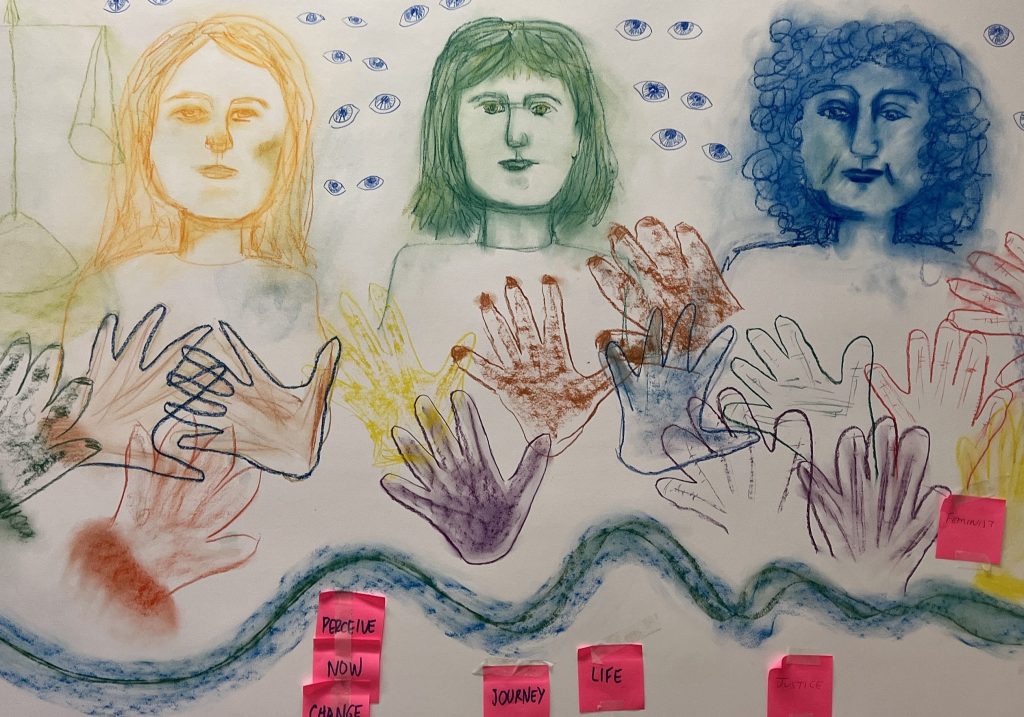
Talk from Heliana Pacheco, using a word game to break down barriers when working collaboratively on a new project. I felt that this was an interesting concept and would be a very good way to brainstorm possibly, however I found the delivery of the lecture repetitive and the power point video was firstly explained and I was looking forward to possibly a demonstration of the way this would work, however we then watched the presentation which was written text while Heliana read the script in the video. I did not find this method of teaching to be beneficial as a visual holistic, However when I was given the opportunity to see this word game in action whilst working with PHD students who spoke about their research in succession to students, they were given a time restraint, Heliana wrote words on to post it notes and the PHD students were then tasked with arranging, using or discarding the words in order of importance. This was to visualize their research working with art students.
Working with PHD students to visualise their research
AI, Critical Thinking and Introduction to Transdisciplinary Practice
I know very little about AI, I understand what it is, but I have never explored how to use this computer generated artificial intelligence. I would not know where to start as I am very much an analogue, made by hand student, I have learnt how to use technologies, but I am not one hundred per cent comfortable using it yet, I have transitioned to online blog instead of my hand written journals and I have found this to be beneficial.
I see the benefits of both, at this present time, I prefer by hand, however I am open to exploring new ways of working, researching and inputting information into a computer to generate answers that I may not have been able to come up with.
Round table events
Amy Rattenbury, tutor for the forensic students in our round table, where we as artists re imagined, discussed a mass fatalities that has been and how would we develop a new memorial for the victims.
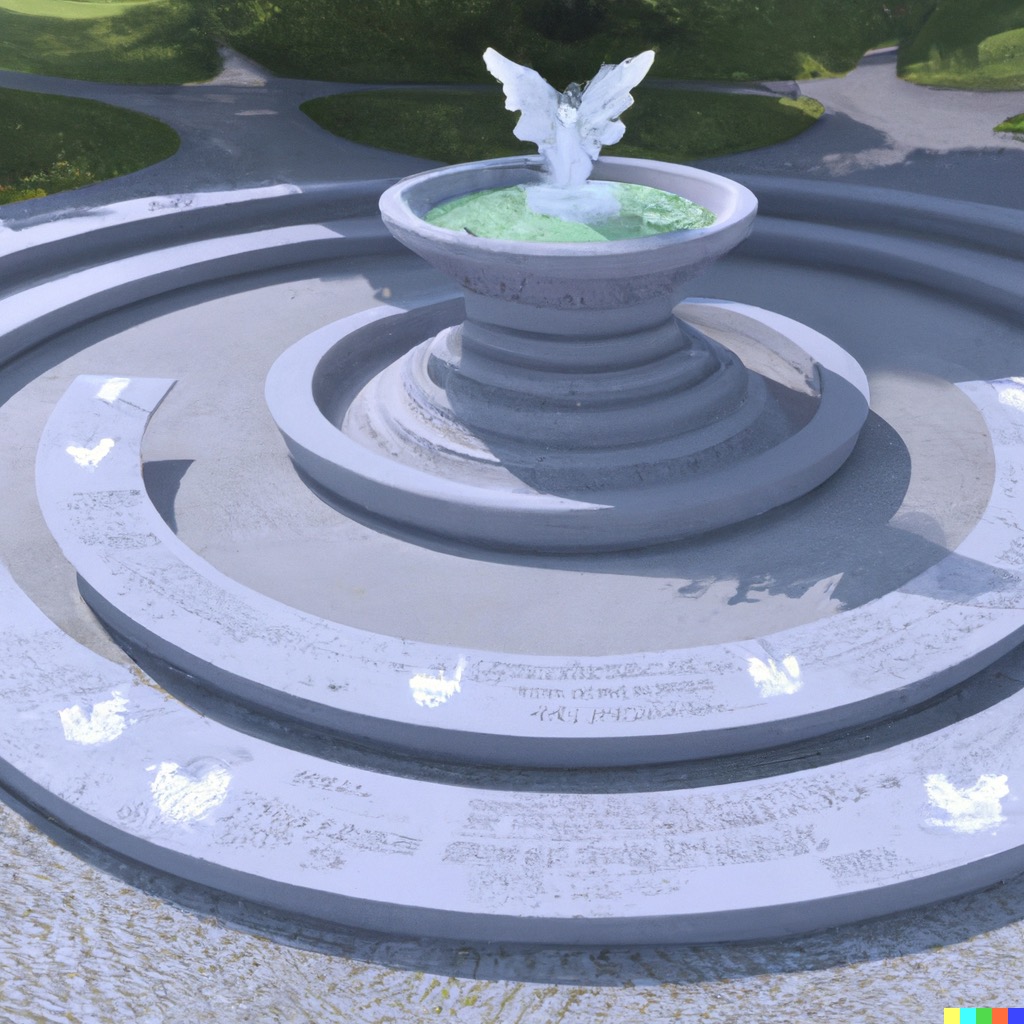
Looking at the work of Julian Ayres – Critical thinking
Looking at the work of a senior lecturer in Education who works with young people who have not found their way yet, using photography, artwork, modern art, a project teaching Math and English using art, this resonated with me in that I am a visual holistic, I learn by making, by seeing, by exploring materials and playing.
We completed a task with PJ using 9 dots 3×3 square where we were asked: “using only four lines without taking your pen off the paper draw through all dots”. It was a challenge, as I was taking the instructions as stated, but not thinking outside the parameters of what I thought were the rules, although the rules had not been given, but pre-conceived notions of not drawing outside the lines. It was impossible to achieve by following these rules, it was only achieved by drawing outside of the box.
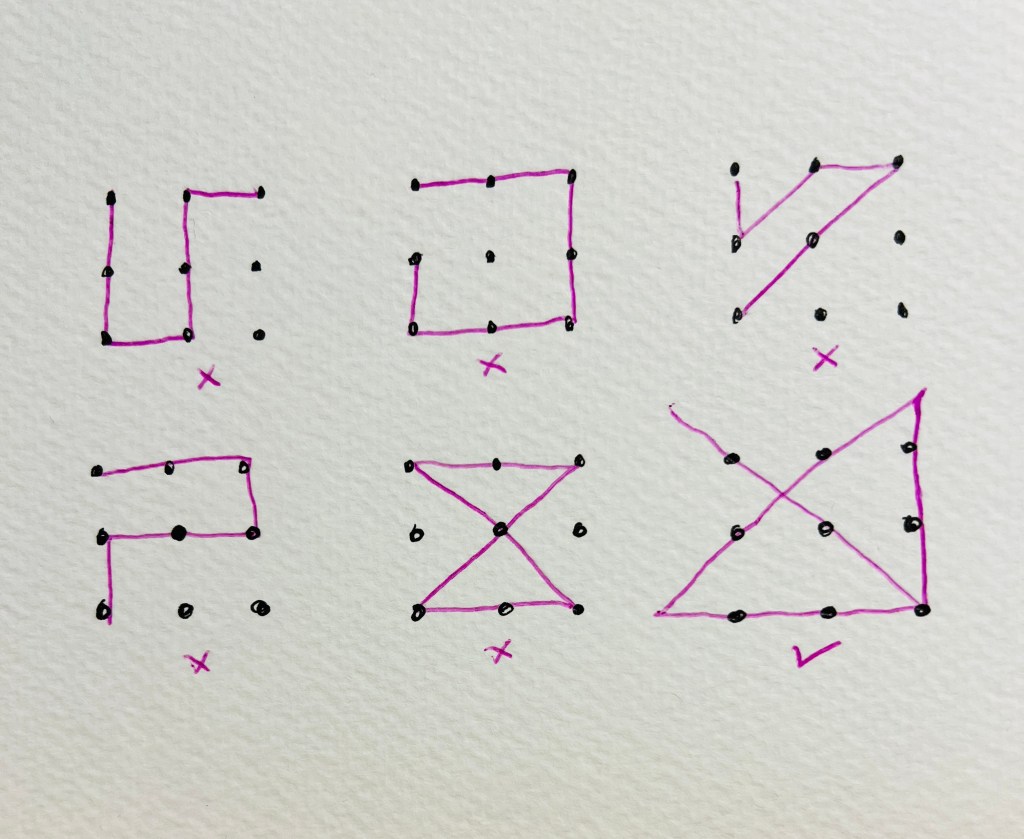
This raised the question of what is creativity? We explored as many ideas as possible of how to use a cup. Divergent thinking: Adults tend to follow the norm, however, by questioning and not applying perceived rules, exciting discoveries can be made.
I have been having IT support from Daniel Morris in the IT department at Glyndwr University with my WordPress and also to organise my files and folders on my apple Mac, as I often struggle to find my documents. Daniel went through my settings with me and showed me how to change my settings and then how to organise my work, this was extremely beneficial.
Collaboration with Delyth Evans Physics student.
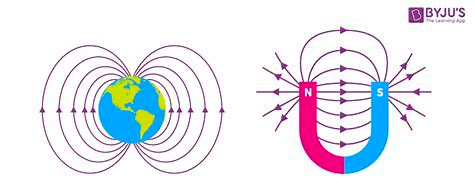
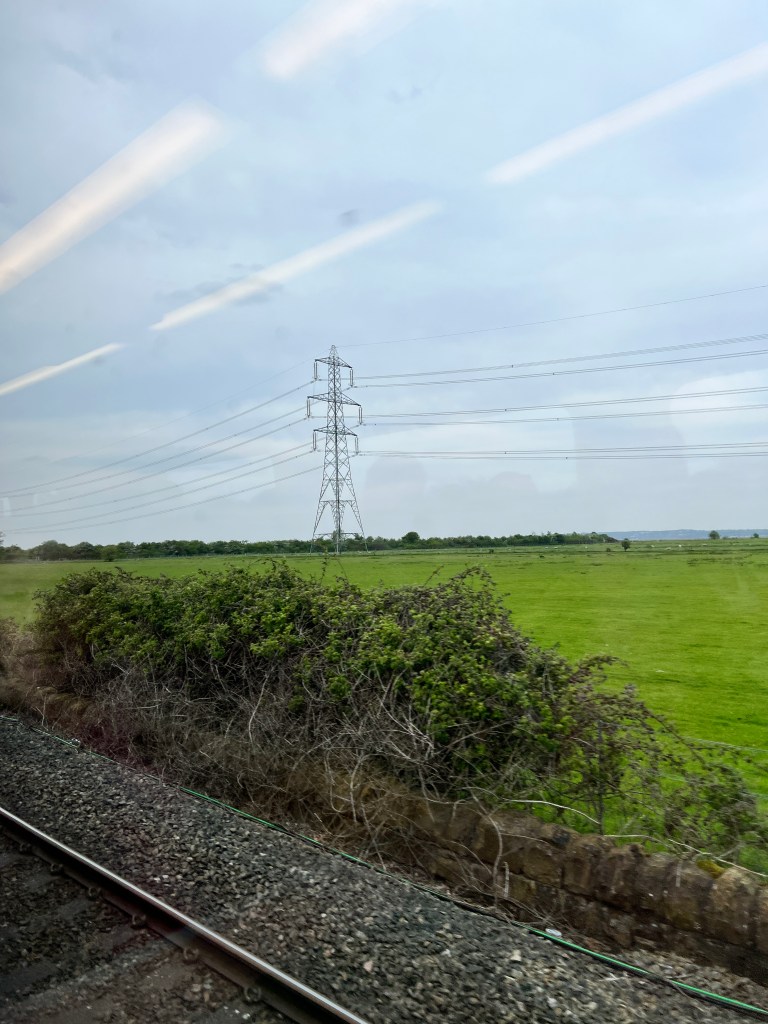
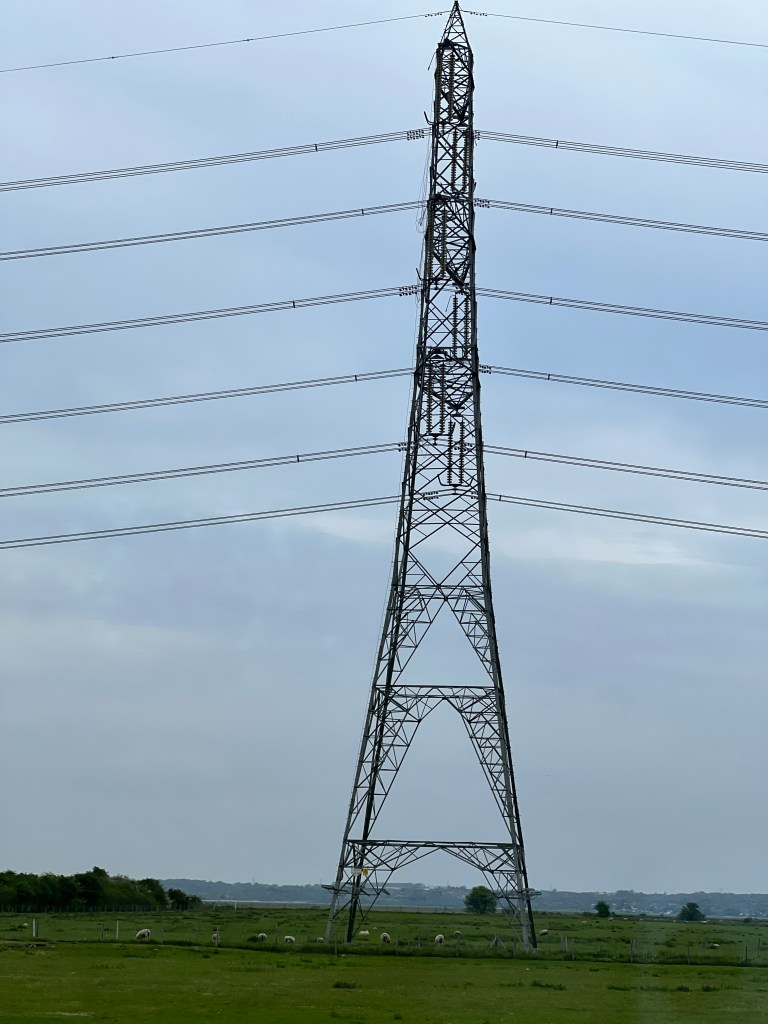
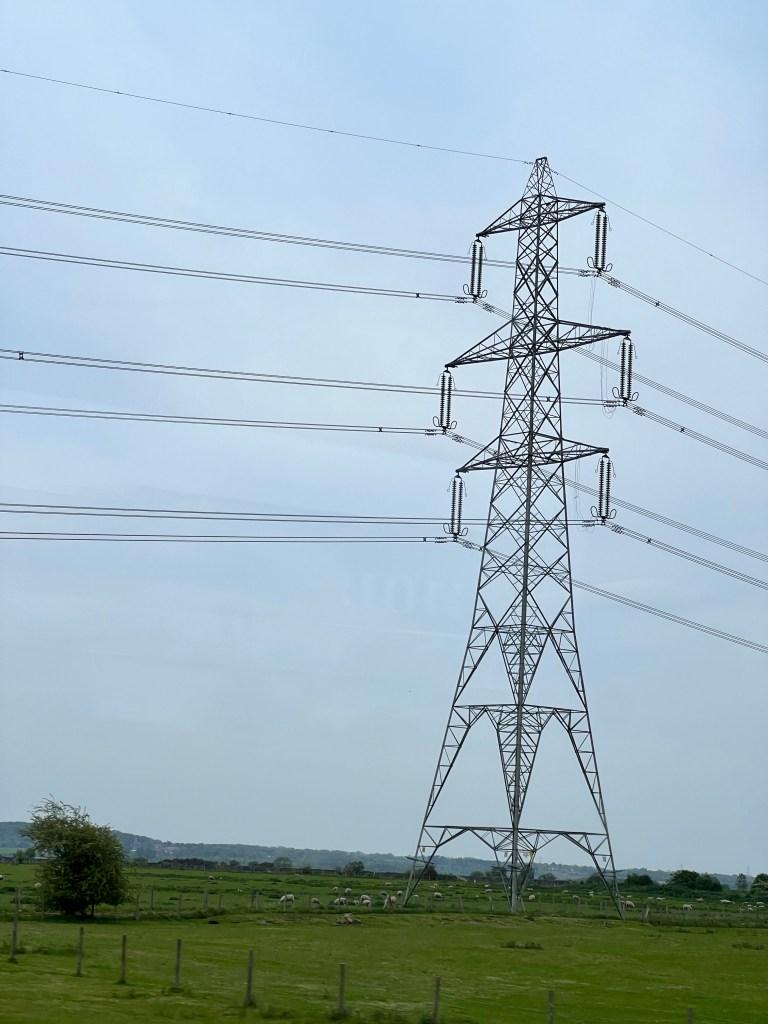
Initial discussion with Delyth whilst walking together to work from Rachub to Bangor, we passed under Electric pylons that are quite low and you can hear the buzz of electricity, or possibly a hum, we were discussing how our electronic access cards sometimes do not work when we get to work, and the possibility that this was due to the electro magnetic field caused by the pylons.
This conversation continued and we explored these unseen forces in the landscape. My conversation was on the line of forces in nature and how you can feel the difference when you are in the countryside from being in a city environment, not just the noise but the energy is different.
Delyth explained that she is studying Physics and her current project looking into electromagnetic fields and how these affect the earth. I discussed my initial ideas for my current project, to collaborate with someone from outside of my field and we agreed to work together.
We initially did not have an outline at all, just a vague common interest of forces in the landscape. Having also explained my interest in landscape that has undergone trauma and how this must also affect the energy of the place. We agreed to look at where our interests meet and explore how as an artist I would visualise these fields of energy.
Image below of lighting in an article about electromagnetic fields
“Origin of electromagnetic fields not the same that was previously thought, say scientists”
Even though it is two centuries since electromagnetism was deduced, scientists still have a lot of questions about the actual origin of massive electromagnetic fields.
- By Revathi SivakumarOctober 23, 2019 14:09 +08
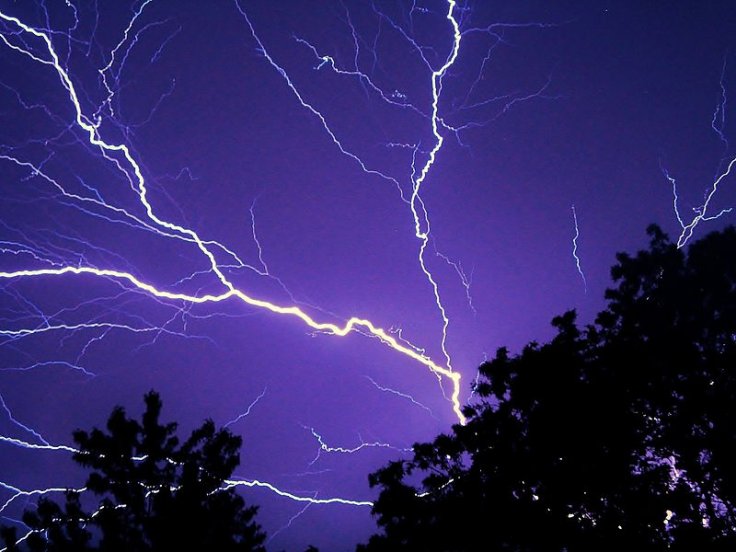
Delyth gave me a book, “The spark of life” and I began to dip into this book. we planned another meeting to discuss our initial ideas. The lightning reminds me of tree branches.
Initially I was excited that I had found someone to collaborate with, but I was also apprehensive, as I knew nothing about physics, and I was not sure at that point, how we would progress or what we would explore.
Artist working with electromagnetic charges, Dries Ketels
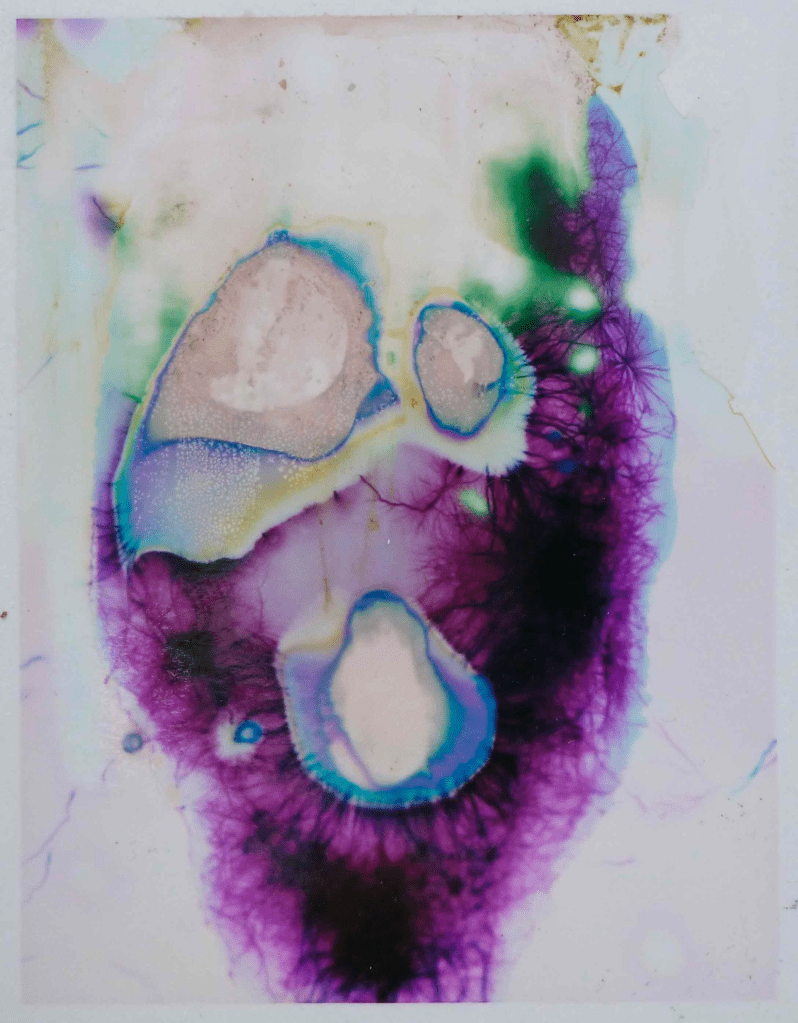
Dries Ketels
Description
“Our Souls Captured in the Electromagnetic Field”
The artist created this image using electricity (up to 30.000 Volts), a variety of different chemicals and painting mediums, … . In order to use electricity as a painting medium the artist developed a new painting method that gave him the opportunity to actually compose the image and to paint with these chemicals and paint with ‘lightning’ (static electricity)”.
Utopias Bach
Below these images are part of the experiments for Utopias Bach
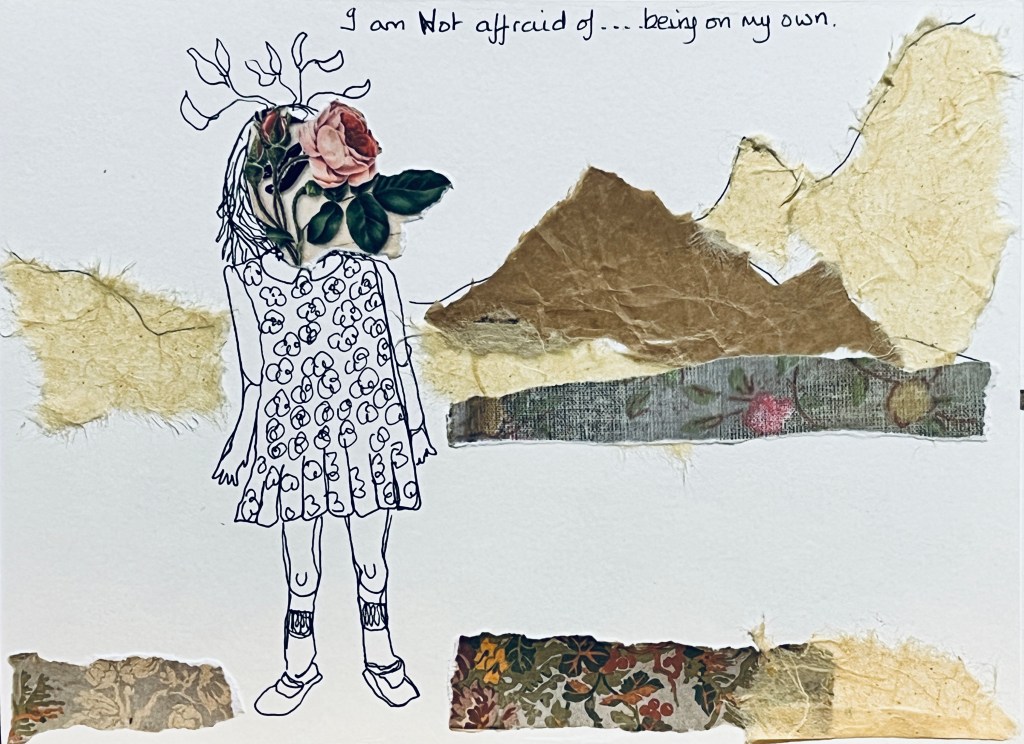

I was interested in trees as part of the Utopias Bach “At Eich Coed, Tree Sense collaboration taking place with Pontio from March 3rd to 27th May 2023.
I have also been taking part in an “Cwrs Utopias Bach course, an experiment” an online eight week course exploring the fundamentals of Utopias Bach, weekly experiments, and invitations, where we shared our images on a padlet, an online sharing portfolio. We sought questions, instead of answers and any answers were not binding. This led to “How can we communicate with more than human beings”, the resulting experiment from this invitation led to some beautiful poetry, drawing, tree rubbings.
Below are my offerings, new tree growths, found tree offerings and decaying wood.
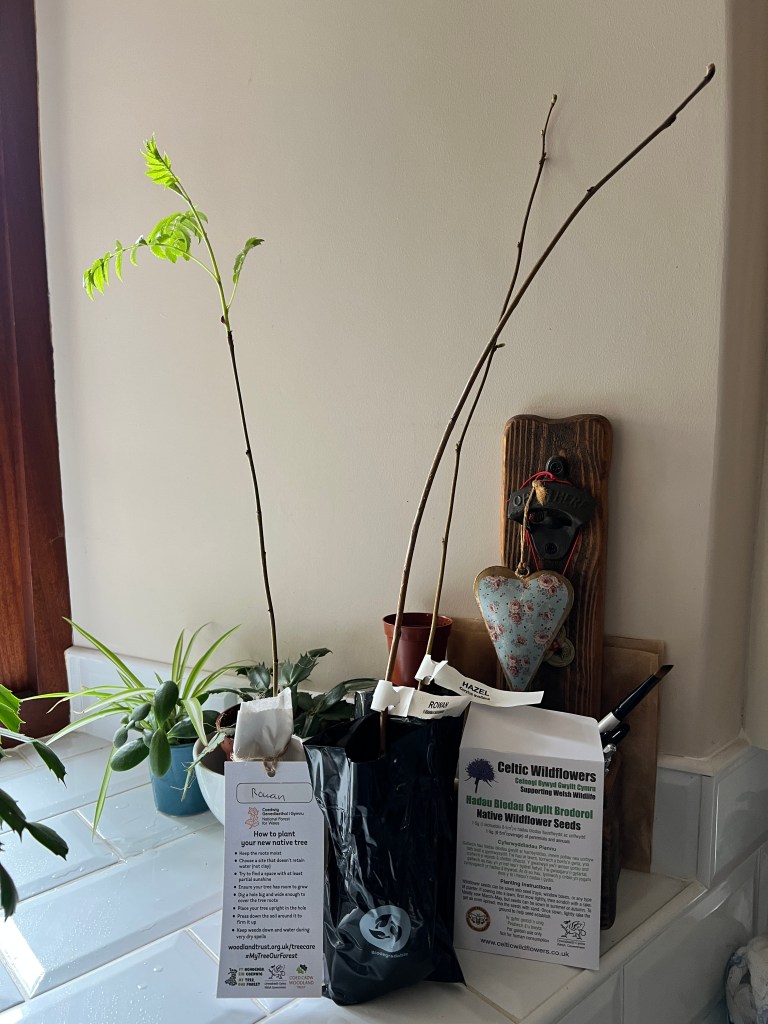
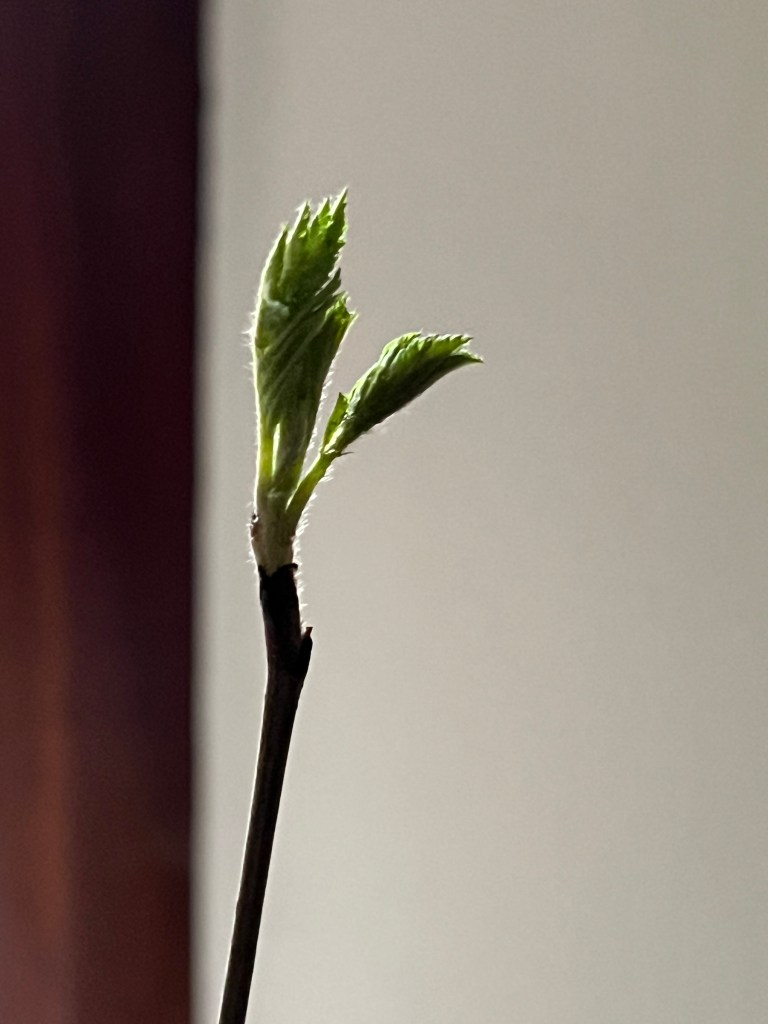
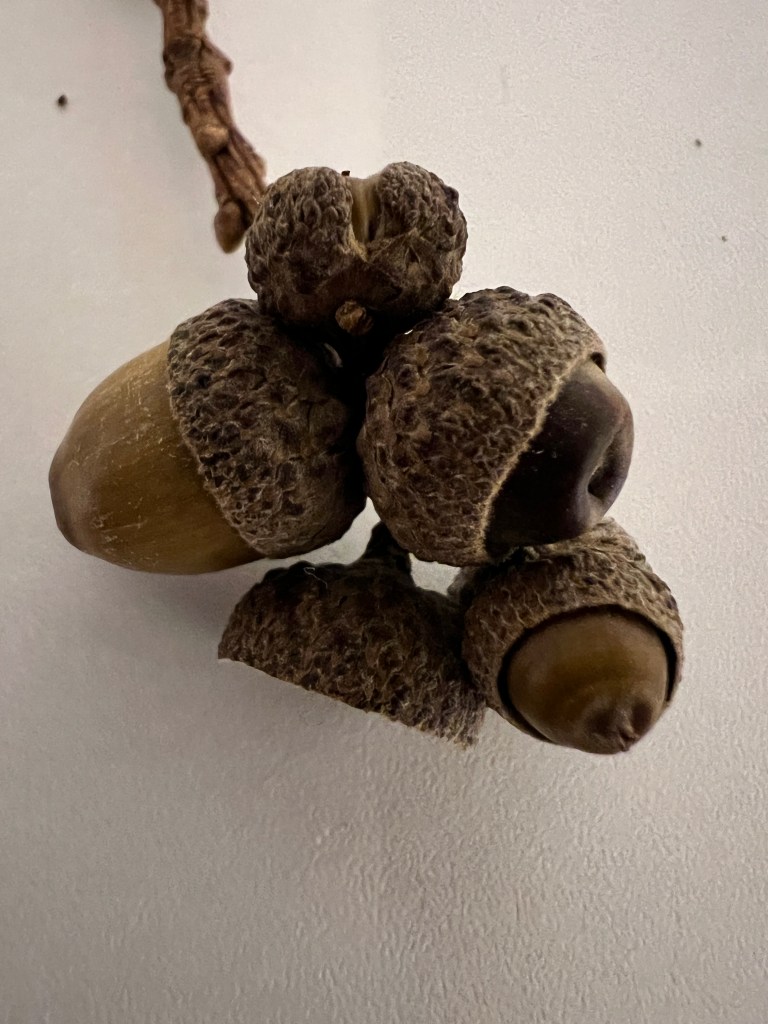

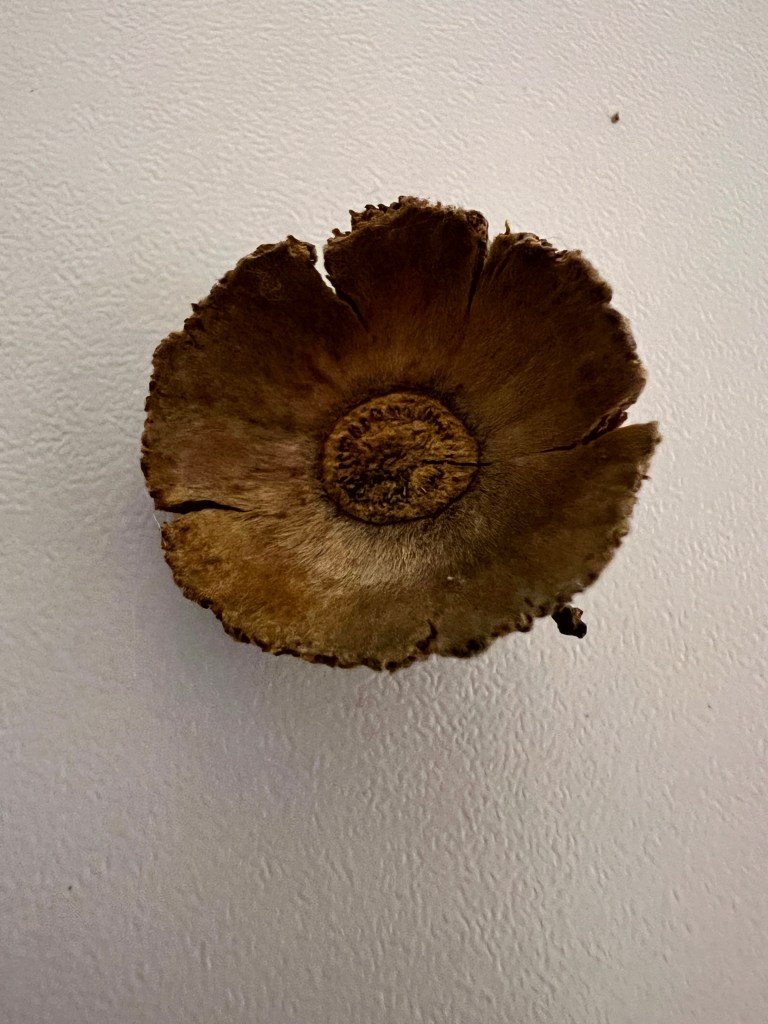
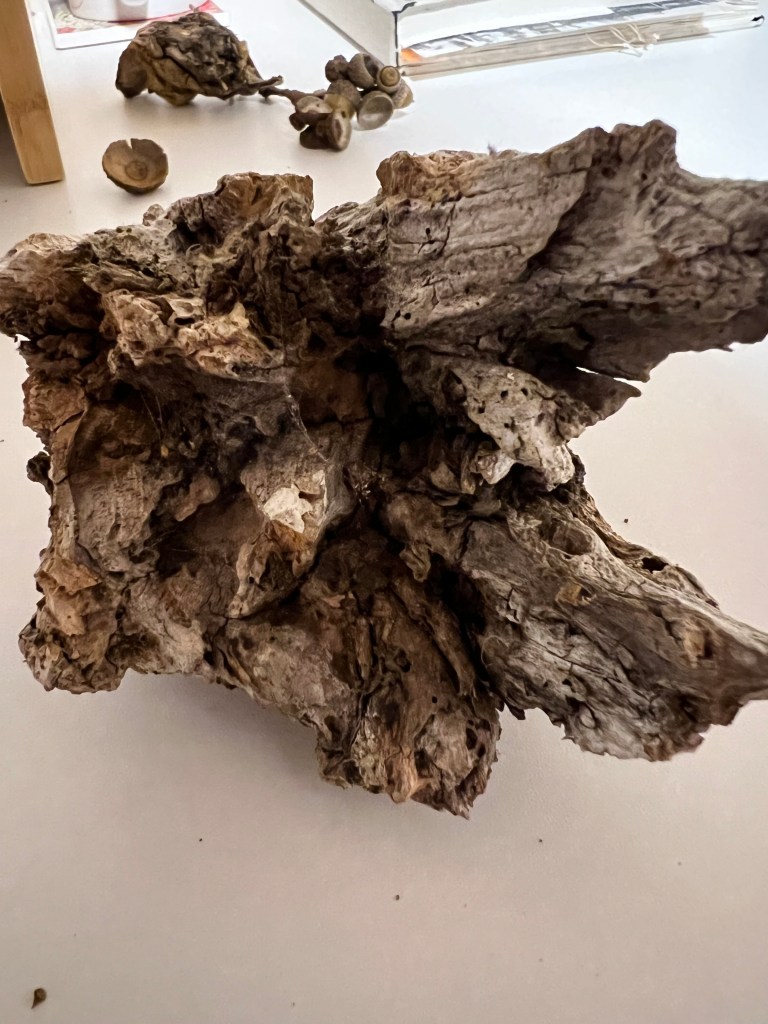
As well as these images I took and found. Roots cutting across, through, over, under other materials in the natural world. I find it extremely interesting that tree roots will find their way around obstacles, even through walls.


Inspiring artists using innovative ideas: Jane Plahe
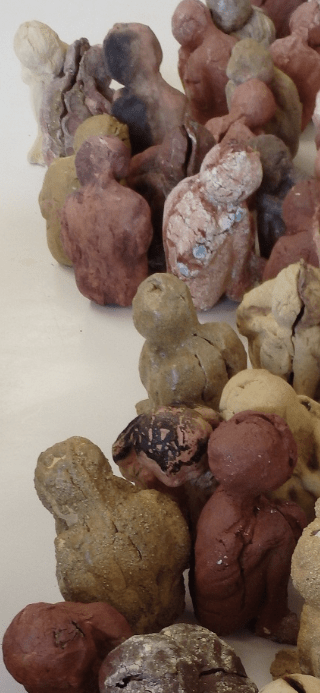
Research, Moss, Jane Plahe (Mud and Fire Ceramics) who is based in Luxembourg and exhibited in Ceramic Wales in 2019 she makes lichen pots and figures using excavated clay and gathered materials from under her feet, what excited me about this artist is her use of a traditional medium used in a different way, the addition of moss and lichens gives the pieces an ethereal fragile feel, as if you picked up the pot it would disintegrate such as lichen does in the summer when it is completely dried out.
The lower image is one of my stitched blanket forms, where I have worked into the fabric imagining growth and how I could replicate moss, fungus spores and multiplying organisms.
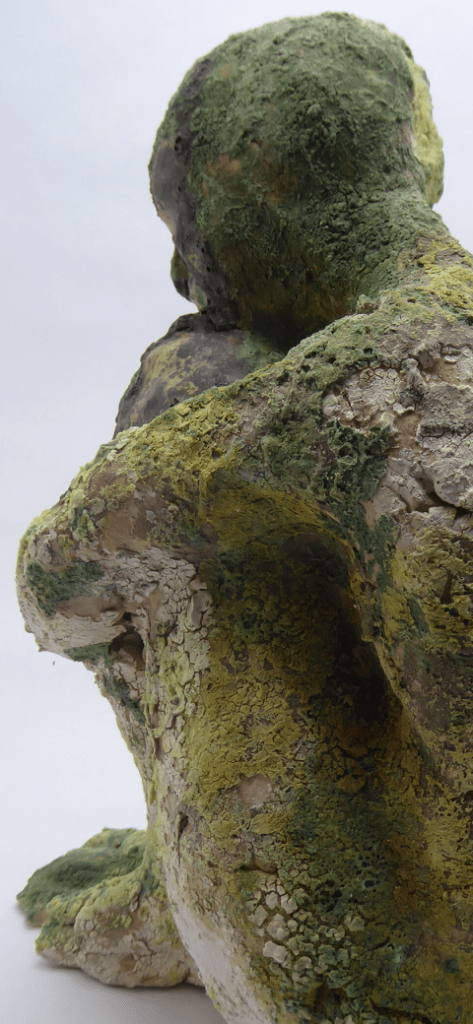
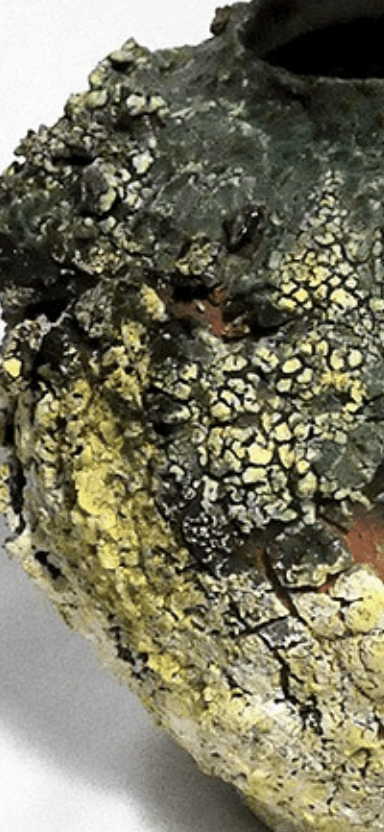
Ideas, brainstorming
Continuing with the theme of trauma, but in a new context, trauma within a wall, (close up image of peeling paint) caused by water ingress, producing Mold behind the paint and bubbling out to form a beautiful multi layer formation on the wall, I do see these lending themselves well to textile processes and may explore layers with fabric and stitch. How would I explore this in pain? I may be able to use acrylic mediums to build up this erupting moss coming out of the paintwork.
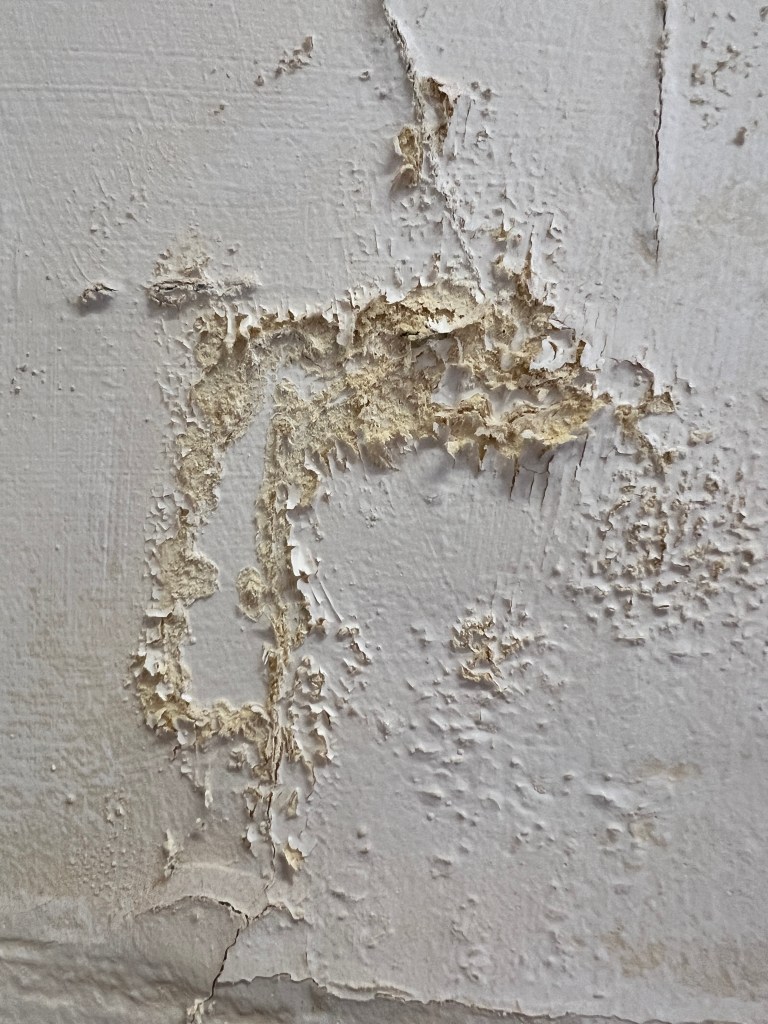

Research, experiments and the beginning of the visual research
Sketchbook
Using my sketchbook below to plan out some imagined landscapes. using watercolor, blending colors, my final paintings will be possibly made using acrylic, my initial plan is to do a set of three paintings, but this will depend on the experiments and how my work will progress as I explore working with Delyth Evans who is studying Physics.
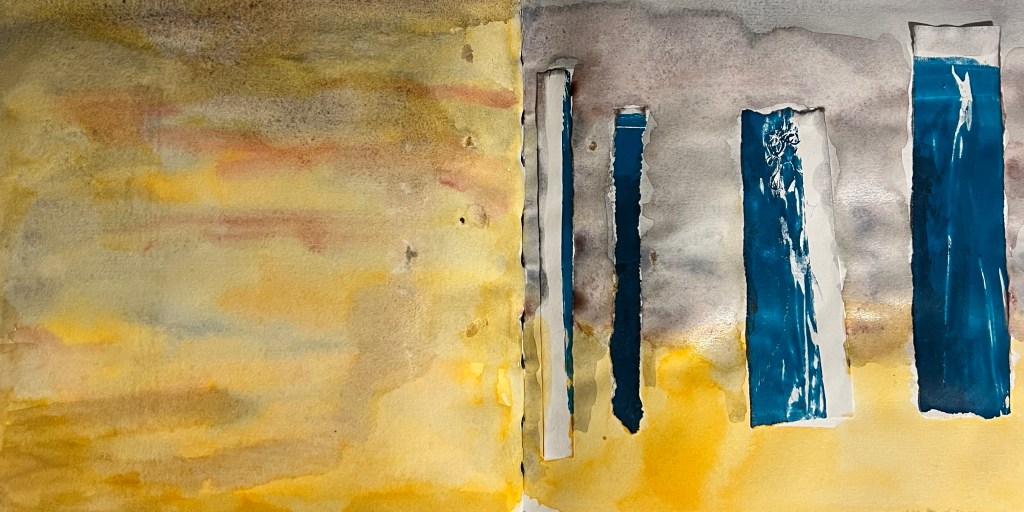

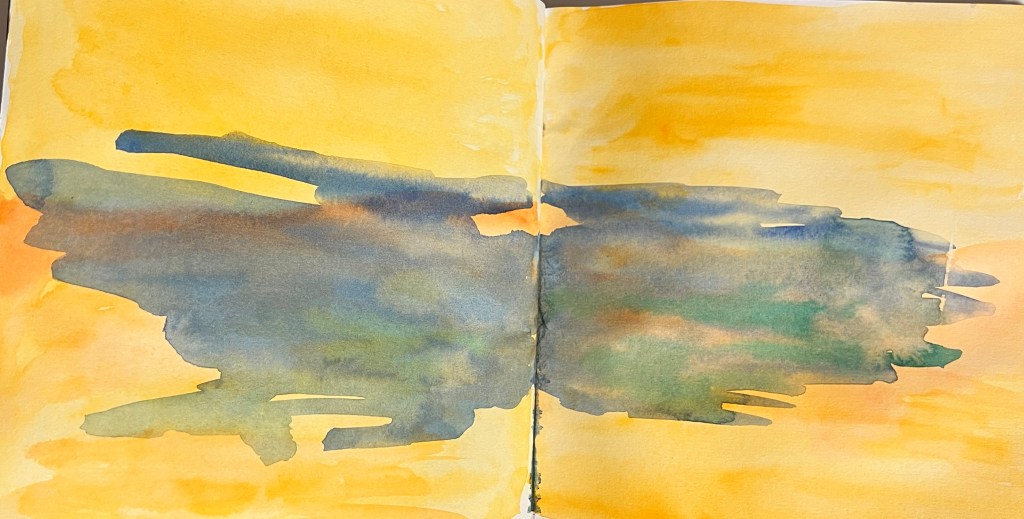
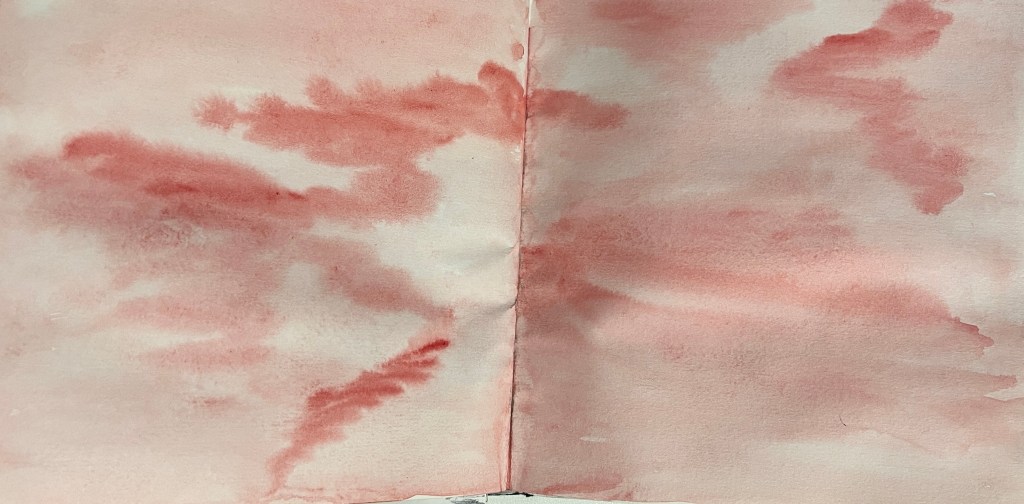
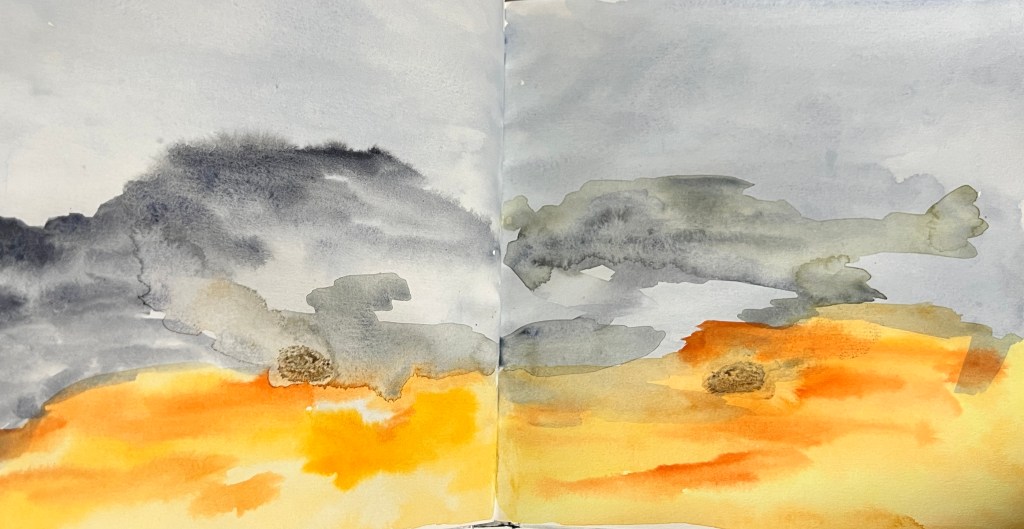
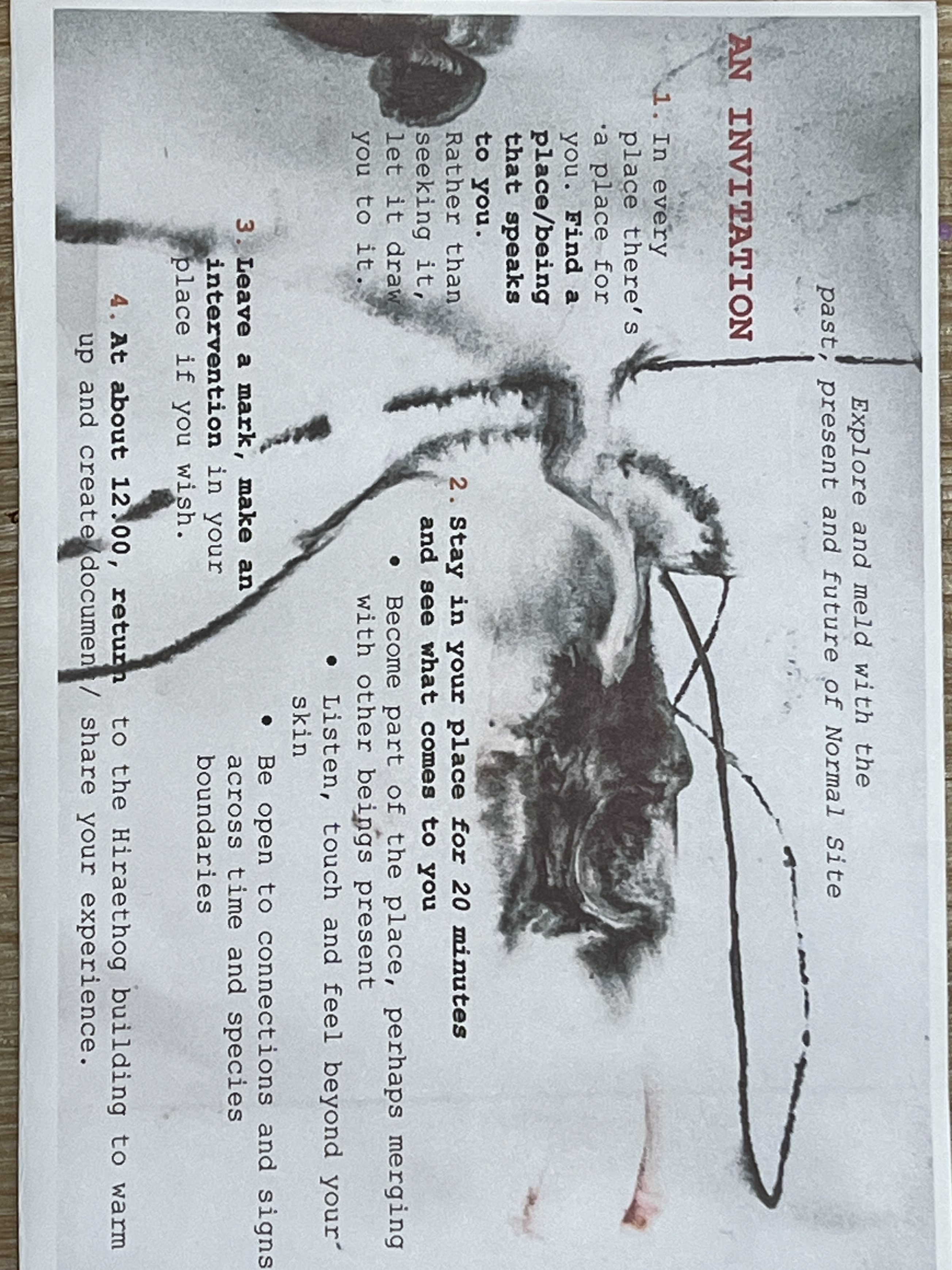
Further experiments below are partly inspired by the Utopias Bach, an invitation to sit outside in nature, to sit for 20 minutes to just contemplate the surroundings, in an almost meditative state, this they say should be enough time for nature to be used to your presence and be in tune with the vibrations within that setting.
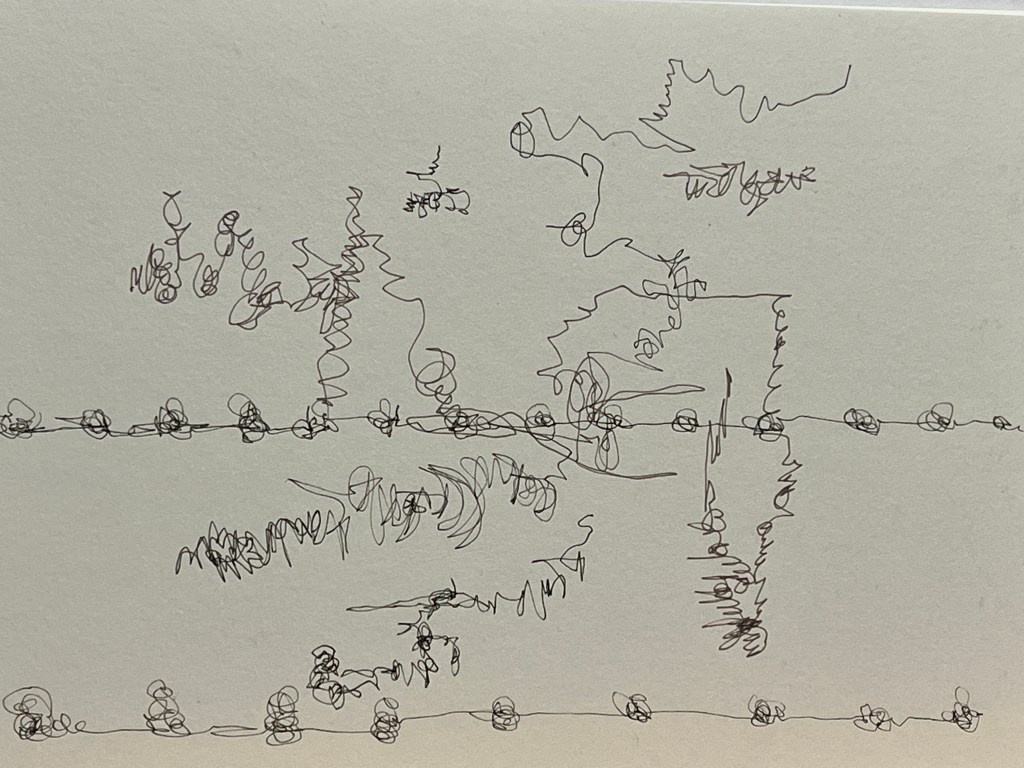
This was an exercise I learnt whilst taking part in a project with Utopias Bach. Using a pen, without looking at the paper I began to draw what I felt were the vibrations, the noises, crinkling leaves, robin’s scurrying in the bush, the wind, small repeating sounds of bird song.
This time doing the experiment for the purpose of exploring the vibration (or energy) within the landscape felt very different to the one I did with Utopias Bach, as I had been working with Delyth and my focus was to tune in to the unseen forces, the vibration of these forces and also I noted that if I had sat in the city to do the same exercise these vibrations would be very different with technology all around, 4G and 5G signals, multiple layers of sounds, never turning off, a constant hum. This thinking of the energy, the differences in different spaces made me think of the magnetic fields that I have discussed with Delyth, (middle image below) these energy forces that are also within us, but also within the earth.
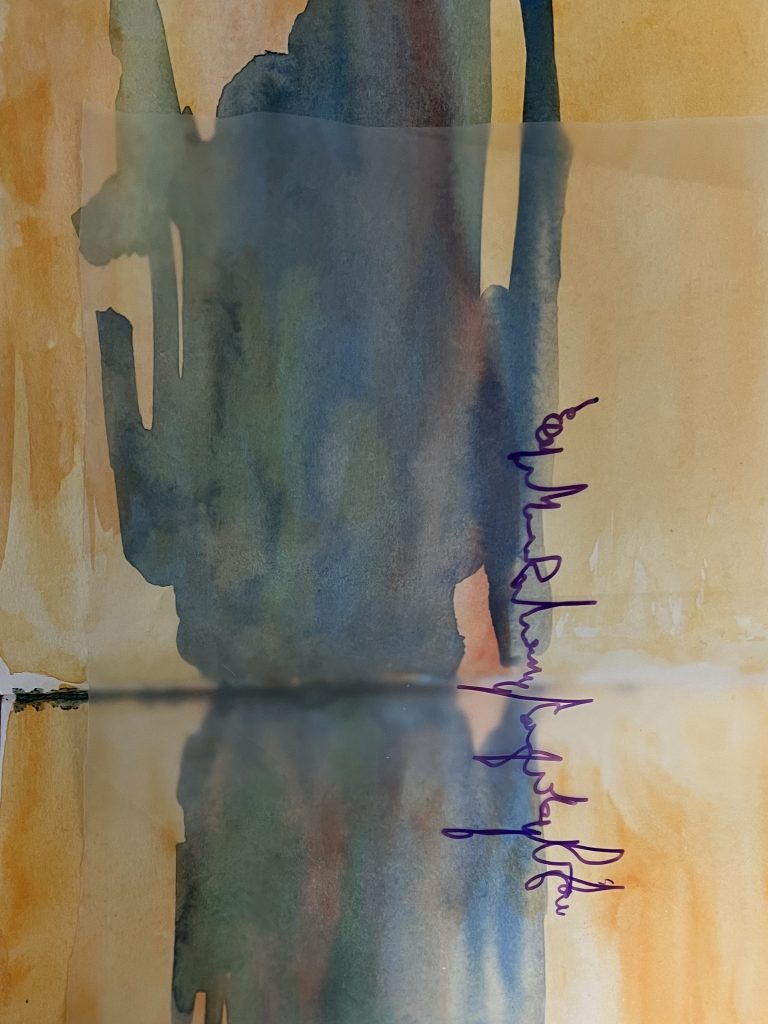
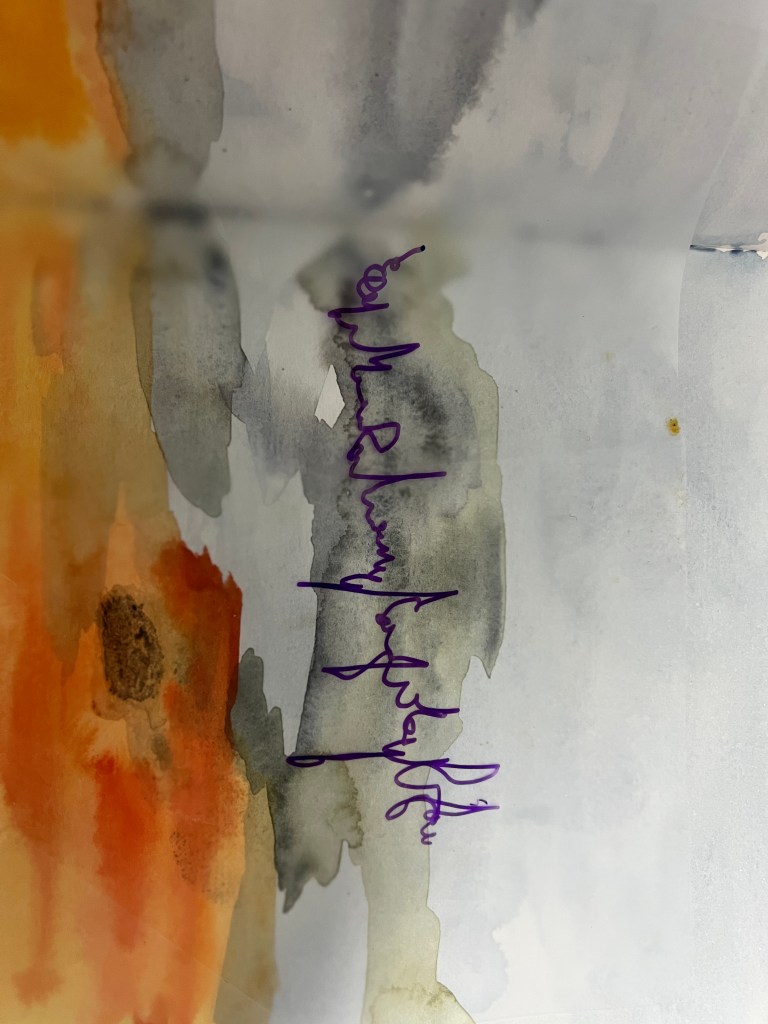
I made several of these visual interpretations, I experimented using thin sheets of various transparency paper and vinyl films, from transparent to opaque, using a marker I imagined these waves of energy, how they bend explored these layering over each other, and began to explore how these would transfer to energy fields used in physics, unseen forces, what would these look like.
Sound, energy fields imagined whilst sitting still focusing on nature, in nature, becoming attuned to outside senses, imagined or real. In this module I have been working on several bodies of work, or several projects, I can see how these are influencing my direction in my enquiry with Delyth, but also how my perception of nature with this new knowledge is changing and I have been surprised at how much I am enjoying this process.
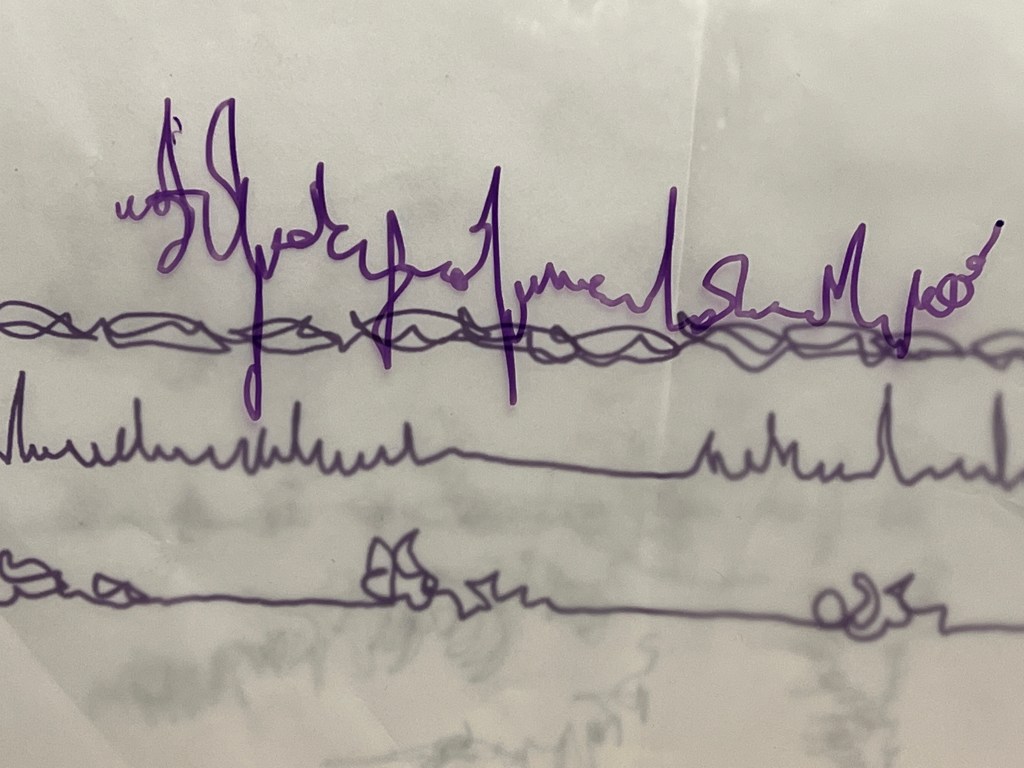

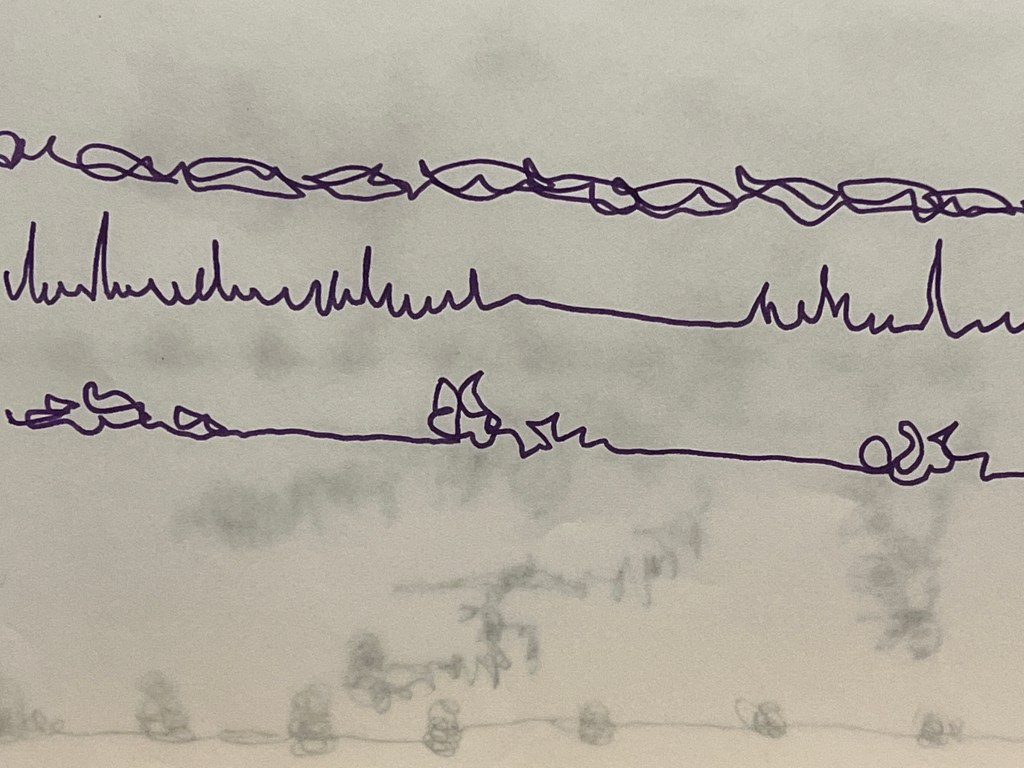
Experiments using the initial imagined landscapes in my sketchbook with these transparent films layered over
Below, Layering in the landscape using the semi transparent layers over these initial imagined landscapes with possible unseen magnetic forces, imagining these forces by layering with transparent films over them. Myself and Delyth discussed forces that we can see, such as when you rub a balloon on your jumper, then put the balloon above your head to see the hair raising, this is a simple way to see how magnetism works, I asked about lightning, having seen the work of Richard Long who created the “Electric field” where he set up a series of rods to generate lightening when there was a storm and the images are illuminating.

Initial challenges
The difficulty I have so far in this module, is that I have yet to find my direction, this is a good thing too, as it is making me question my normal way of working, highlighting how one gravitates towards usual patterns, and by deviating from this path has been somewhat illuminating, it has forced me to face questions about the methods I use when generating new ideas for work. Also how I can move forward when I am stuck, and most importantly, it has made me think in new ways, working outside of my field of expertise in approach and delivery, whilst working with an expert in another field has opened up many avenues of thought, research and possibilities.
The weekly round tables have been really interesting, each week there is more information, a different set of possibilities that have in themselves raised new questions and things to think about. Working in an interdisciplinary and transdisciplinary way that are different and how some of the round tables were really interesting to me and others although interesting did not inspire my interest further.
Workshops for Pontio
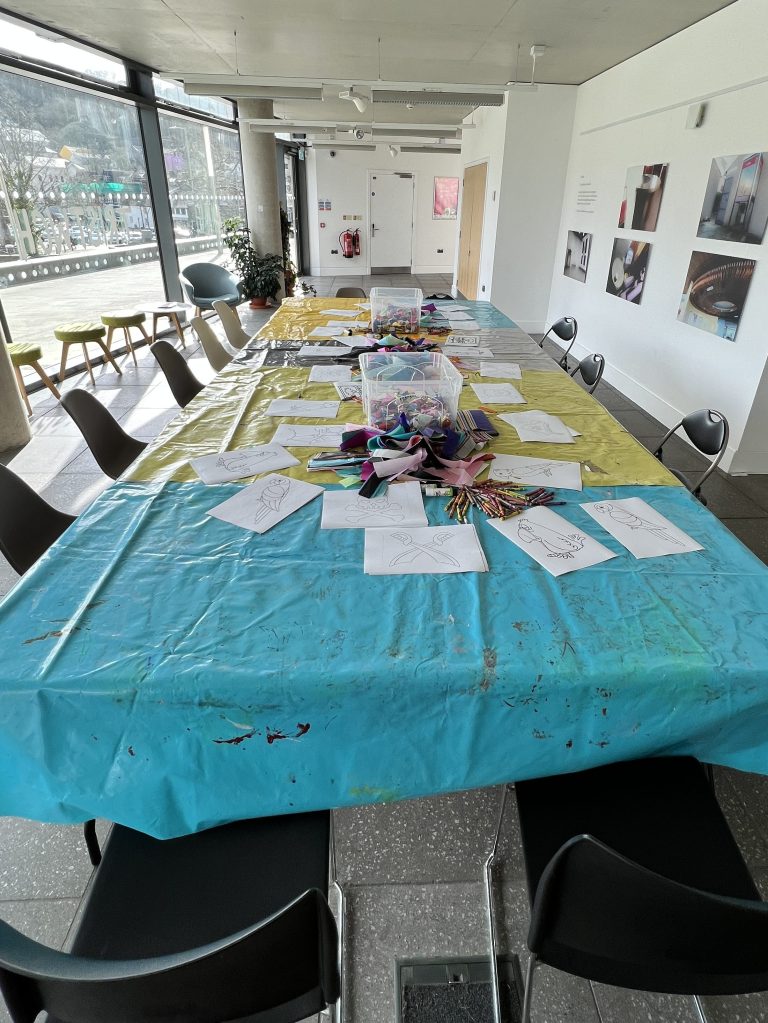
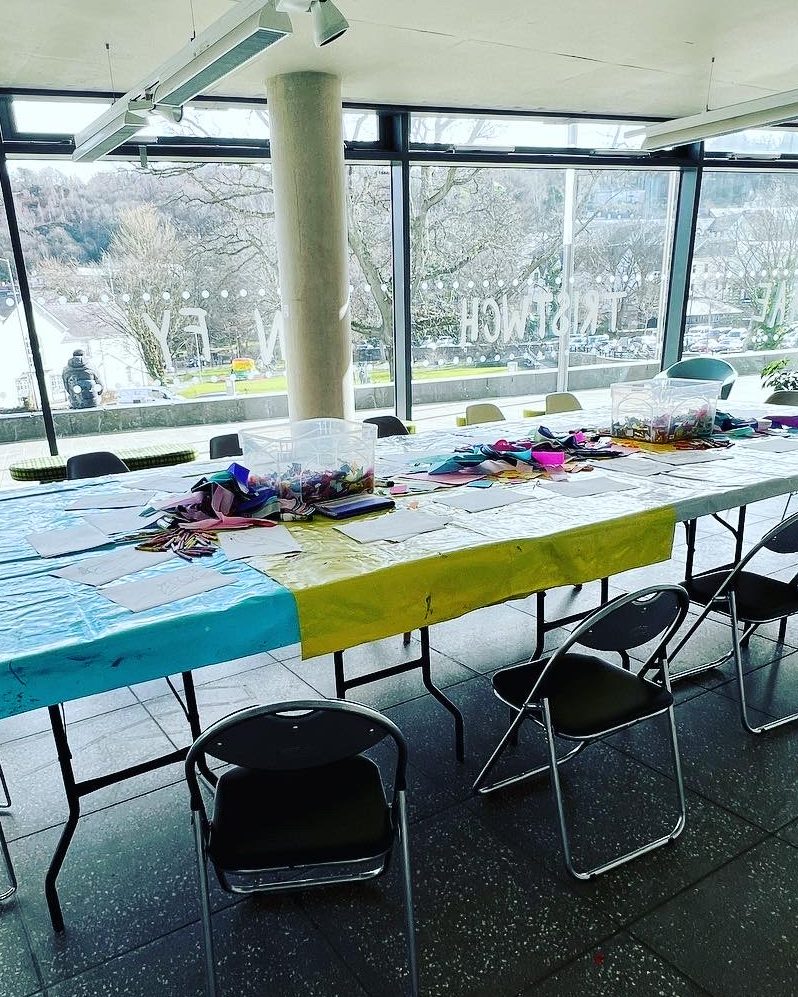
The top three images below were taken in Pontio, as part of an post show workshops for children aged 4-7yrs a storytelling show called Pirate Bonnie. The brief was to engage participants to explore pirate themes in a make and take workshop, I planned the workshop having several years experience of doing similar workshops at festivals and summer open shows, therefore I decided to print out an array of pirate themed coloring in pages sourced from free websites. The children and parents were encouraged to color in images using only collage of tissue, magazine images, shiny sheen ribbons and foils as well as some stick on jewels which were pre ripped in the two ‘treasure’ tubs on the tables. armed with only Prit stick glue, they were encouraged to complete the pictures, however some Crayons were provided for children who didn’t want to glue. There were approx. 50 participants in each sitting, and both workshops lasted for around 1 hour. It was well received by participants and parents alike with very good feedback.

Workshops KBI Colwyn Bay
The images below are from working with Kind Bay initiative (KBI). KBI are a community enterprise set up to help homeless and venerable individuals, they have a small shop in the Colwyn Bay shopping area, they provide refuge, company, food, advice and workshops for venerable, lonely, homeless individuals.
Helen Robinson is one of the founders of the organization and I have known her since moving back to Wales as she was also part of an artist co-operative that I was part of. I struggle with her as a person at times as she is outspoken and domineering, this will never be published but felt it was appropriate to give my feedback here. I had been contacted by Helen as she is the Art’s officer for KBI, our initial conversations were well received, and HR was enthusiastic for the workshops. Her style of management however is to leave everything till the last minute, demand a new list of materials, as well as where to source these, change the format agreed, and whilst running the workshop, take over! I smiled politely and did what I was there to do. I felt she was rude and dismissive to the participants but stated that she was extremely happy with the outcome.
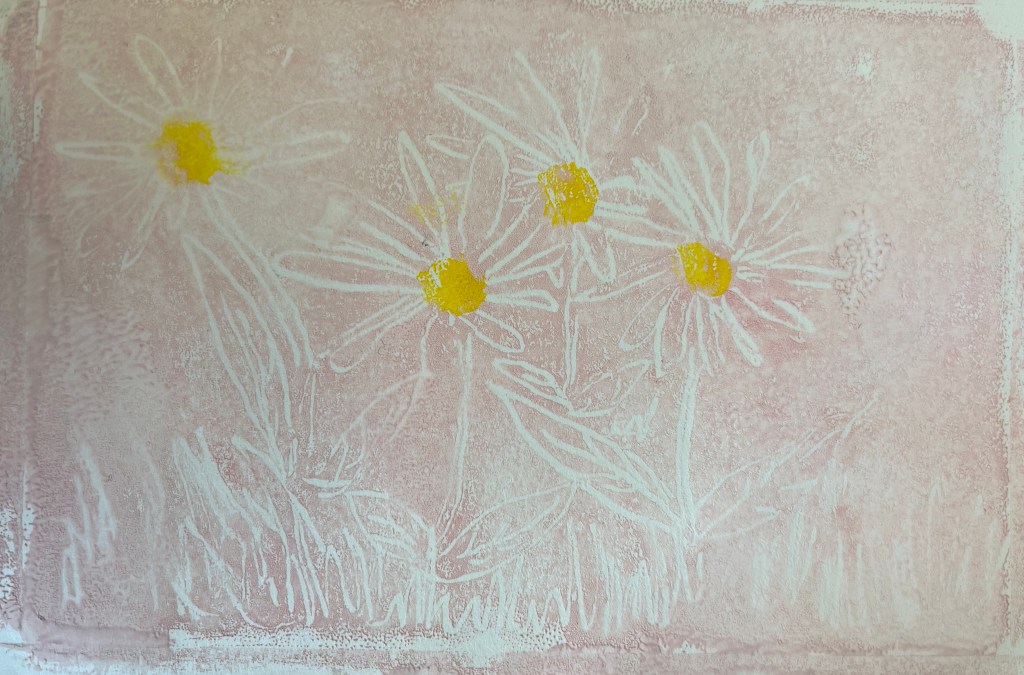
The workshop was printing using Gel plates, a fairly new printing technique using a gelatin plate, it is set to approx.5cm depth and come in various sizes, from A5 to A4. These plates do not last forever but can be re melted and set in a mold to make new ones, the biggest advantage is that you can produce fairly good abstract prints and using stencils in reduction methods can give nice effects, you can use printing inks but also acrylic paint, the method of using acrylic paint on to the plate with a brayer then applying stencils, texture with tissue papers, mark making tools, then placing your paper on top, it is an easy way to produce prints without a printing press, however these are mono prints as the paper lifts all the paint from the plate. We experimented with this process which was the agreement, however HR decided that the group would be making items to sell in an upcoming craft show, this changed the focus from experimenting and learning to something quite different and put pressure on participants to experiment and learn less in my opinion.
The second session was planned for the 4th April 2023 but was put back to the 25th as I could not face it, if I am honest.
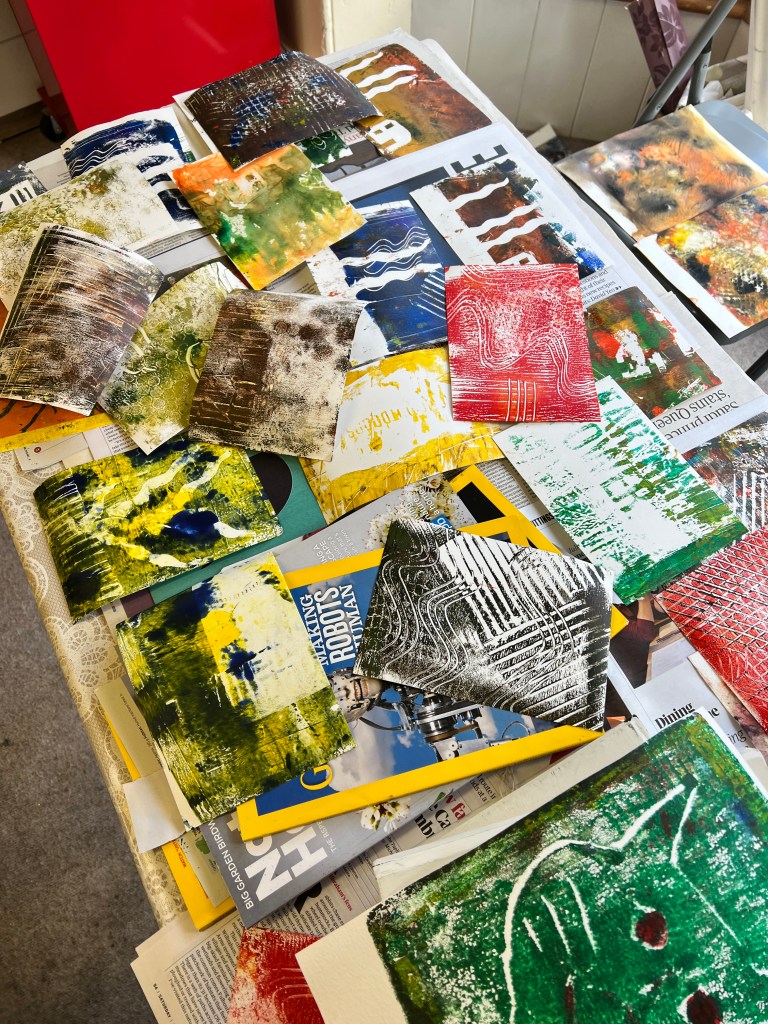

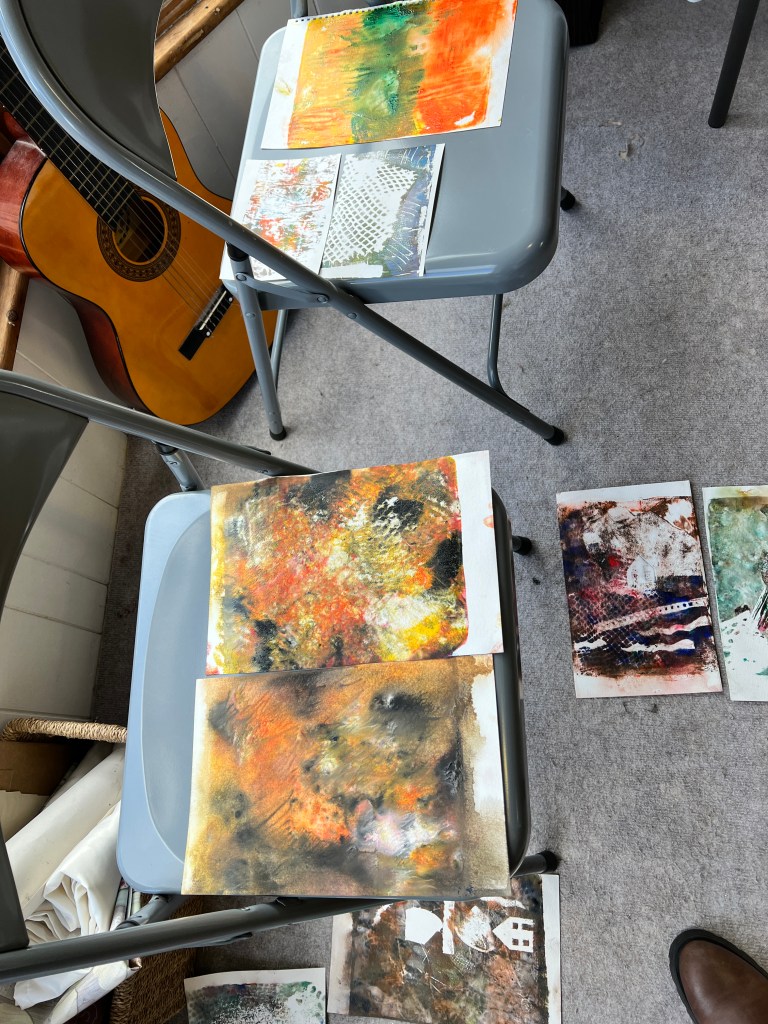
KBI workshop part 2
Working on sheets of glass adding thin layers of printing ink, then drawing into the ink, what I found was that this workshop was not as successful as the previous one. The individuals struggle to draw into the ink and resorted to using the ink sheets to make designs which they then printed, we tried several mono printing techniques and overall everyone appeared to have enjoyed the session, Helen Robinson, has changed the focus of making to selling and not experimenting, and I feel that we were at odds in this workshop as individuals followed her lead, I stayed professional and continued with what I had been tasked to deliver in the original email trail. I was swiftly paid after sending an invoice, I shall not be returning.
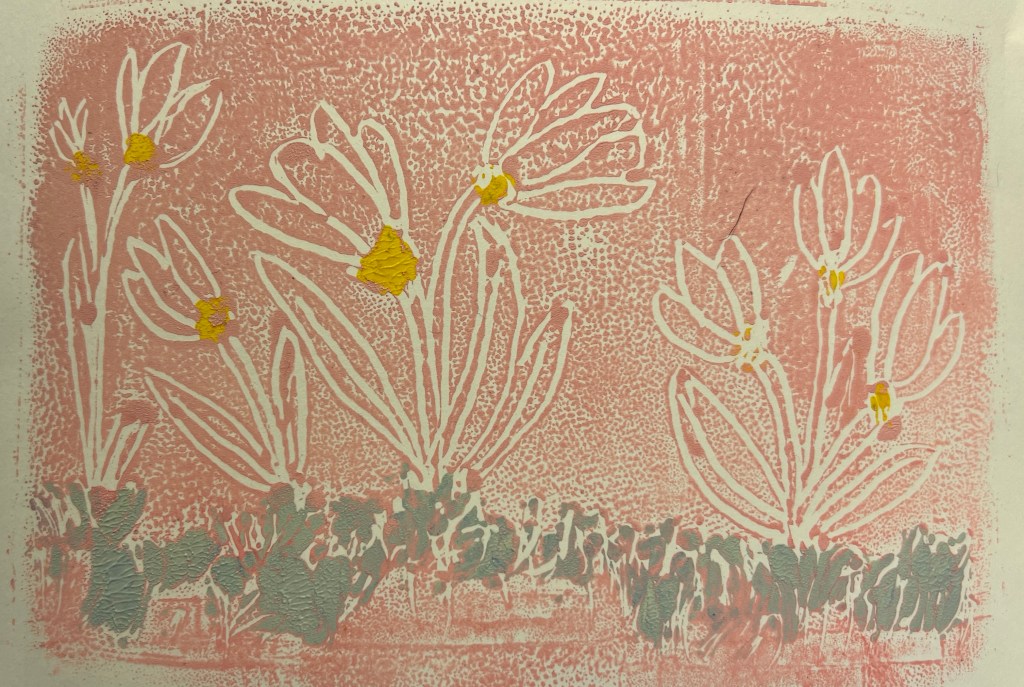
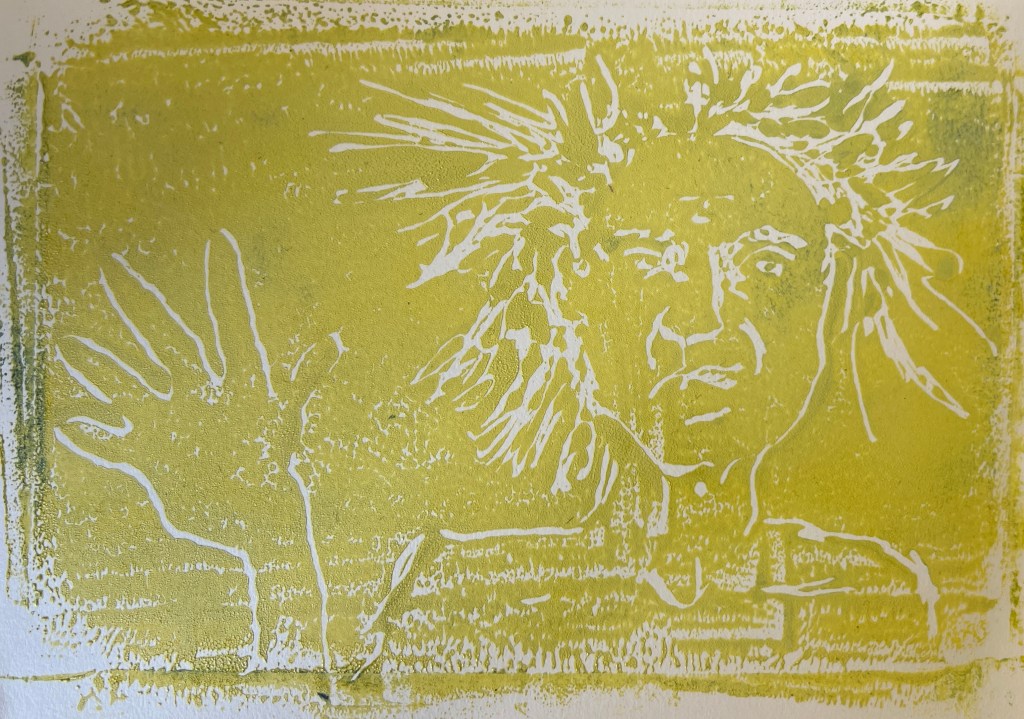

Transdisciplinary thinking
Below are images of electric pylons, it was whilst walking under one of these with Delyth Evans that our conversation began about unforeseen forces, energy, radiation, and the hum one can hear when near these pylons. I photographed these from the train and noted their huge presence that I had not considered before, despite seeing them often, there is a difference in seeing and really taking notice. I remember my transition to really taking notice, when I was on foundation, I was painting a shell still life, and I clearly remember being astonished when I began to notice the extraordinary array of colors within this seemingly simple shell, it seemed to explode my vision, and nothing seemed the same after that.
This module has been a transition for me, from initially feeling overwhelmed and challenged as to how to approach the module learning outcomes, where would I begin, would I work with someone from my trusted and known background, or would I venture into a new way of working, it is easy to say this now with reflection, I discuss it further in my evaluation of this module.

I attended all of the round table events, scheduled each week, and it was a revelation that some of the events that I thought I would really like, such as working with the trauma unit students, although beneficial, It did not inspire me to want to work with them, I found all of them interesting, I gained most from the ones I have discussed above.
I found working with Delyth a Physics graduate and student exciting, illuminating, challenging, I really had to work hard to understand these new concepts that Delyth and I were exploring. We began with energy fields and magnetism, and Delyth explained the way magnetism’s positive and negative charges work, but how it works in the world.
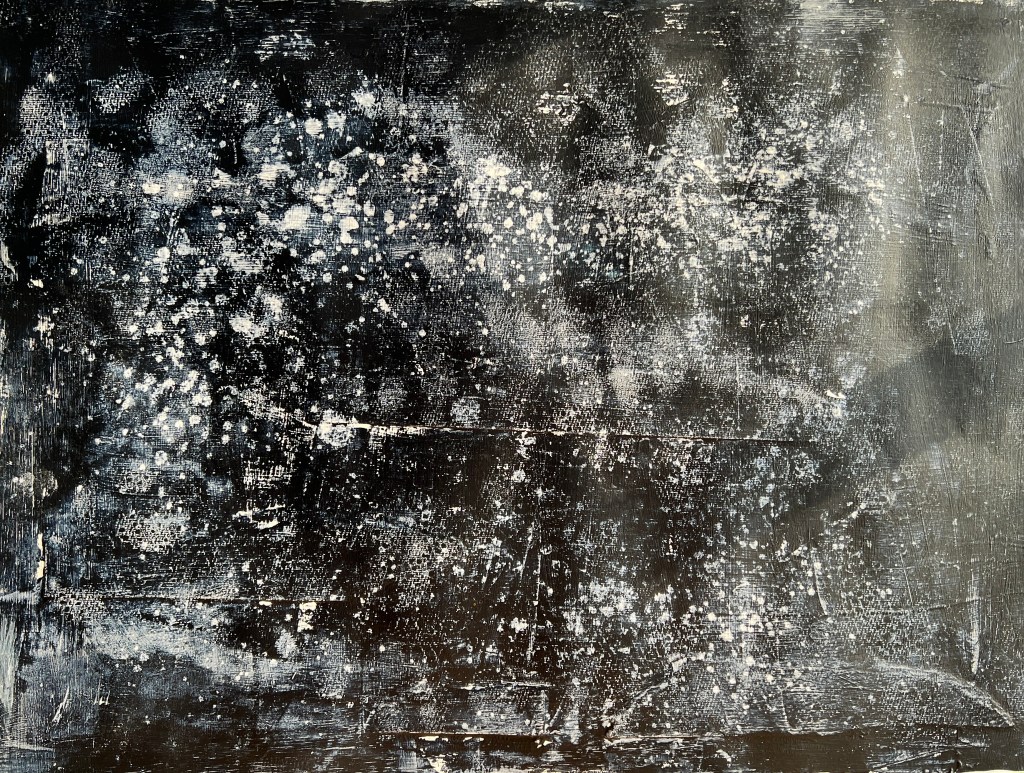
Below is the beginning of paintings, where I am imagining these landscapes, their unseen forces of energy, these paintings below are A3 in size, I have prepared the background with three layers of gesso, adding texture with pieces of ripped paper of various shapes and sizes adding these with primer before the gesso unlike my previous paintings where I added them after the gesso with PVA glue which then became elastic under acrylic paint and lifted off in places when I began the process of marking into the new paint layer.
I then added a layer of black acrylic paint, I used a process of using droplets of water, then lifting these off with tissue paper then using a tool that I re purposed from an old calendar the spiral bound wire to make a scraping tool, my intention was to put further layers to give the impression of imagined landscapes, however I like this as is at present, as a landscape my be at twilight, or evening, an imagined place.

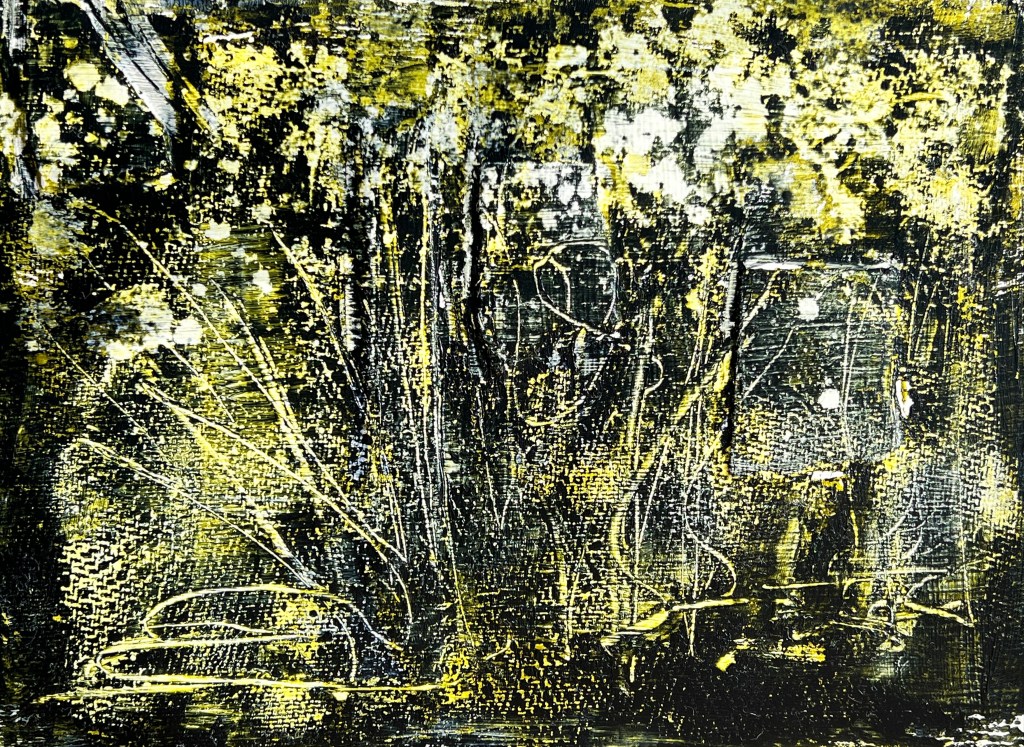
These three images below are smaller studies, A4, heavy paper, I have used the same method as above but I have added some color over the initial layers, I am not happy with the color, however it does add another dimension to these imagined places.


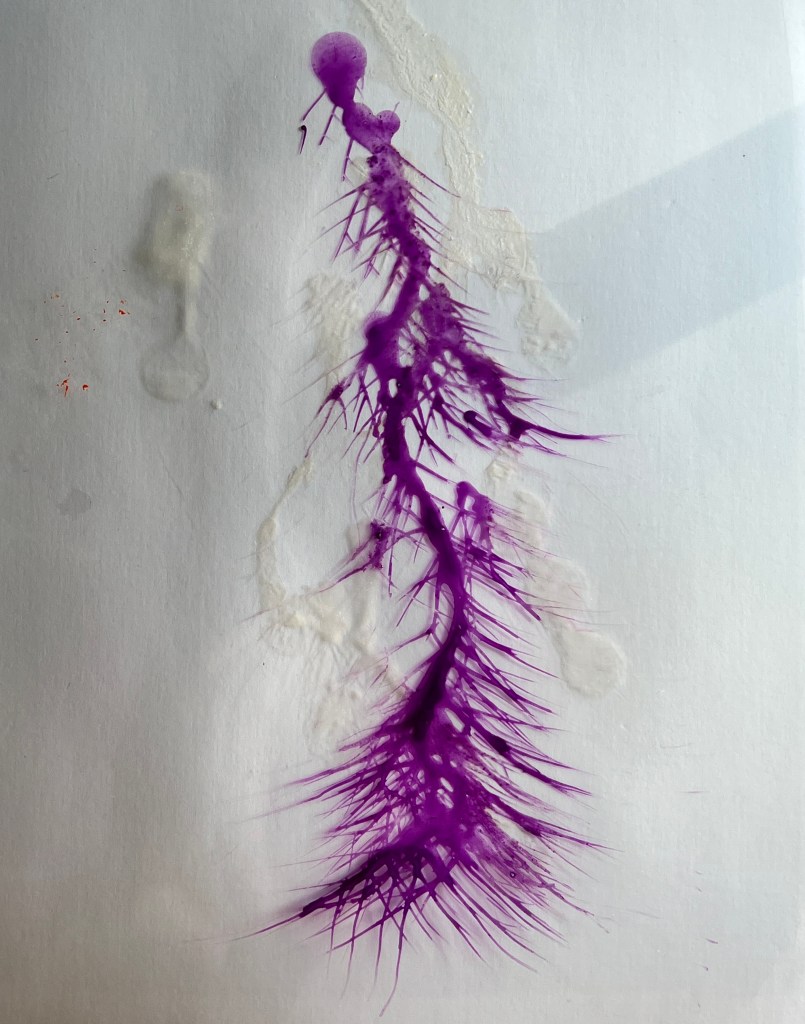
Below are my latest experiments, I imagined that I would put some acrylic ink on the the clear acetate and use a hair dryer to move it in a way I imagined that unseen energy may be moved by forces in nature, energy, wind, rain, weather, lightning, anyway this did not happen not yet anyway, however I improvised with a plastic fork to pull the ink into what I imagined would be this splurge of energy.
The purple ink also has an iridescent ink which does not show up very well here.
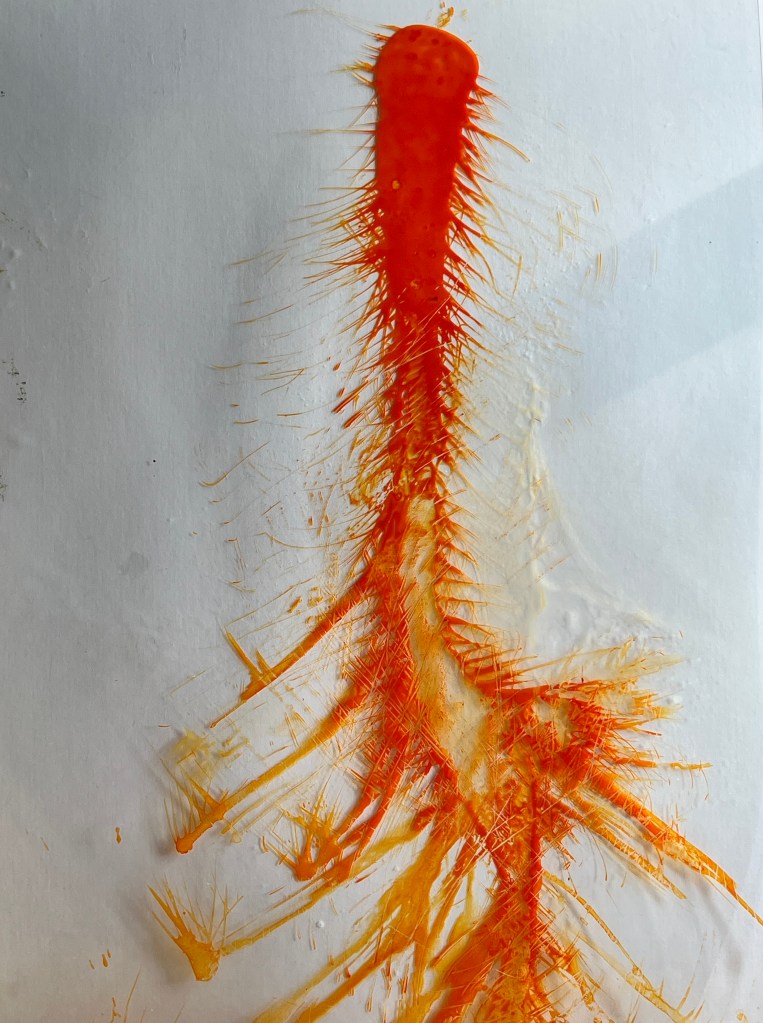
My experiments were to layer these transparent films over my paintings, these are over the A4 size.
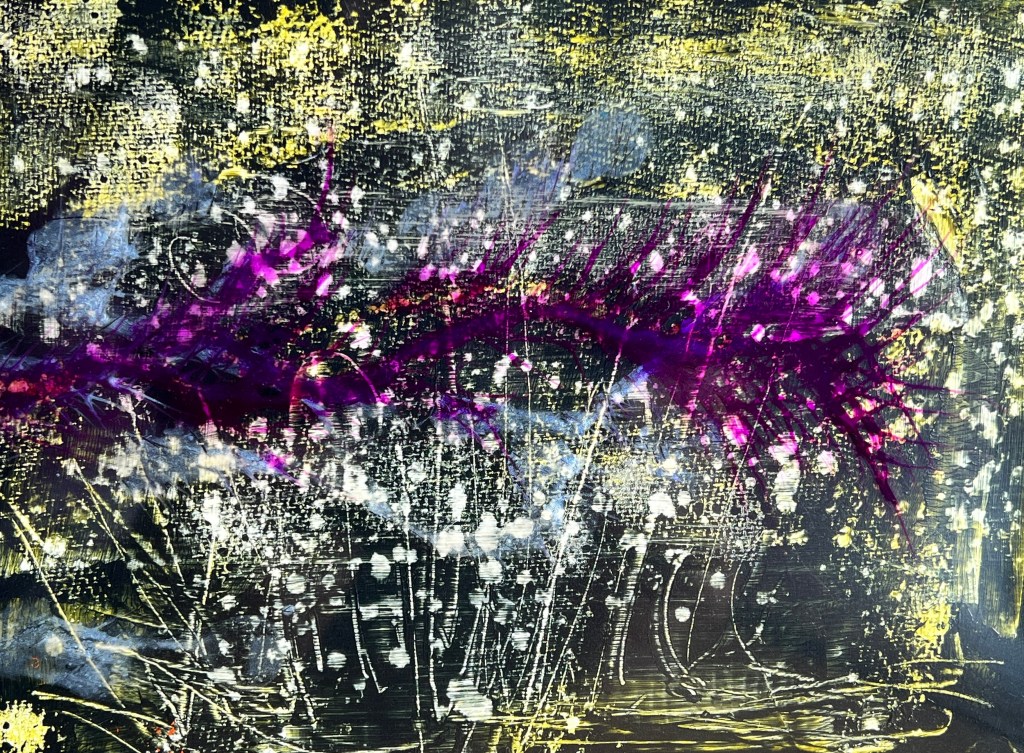
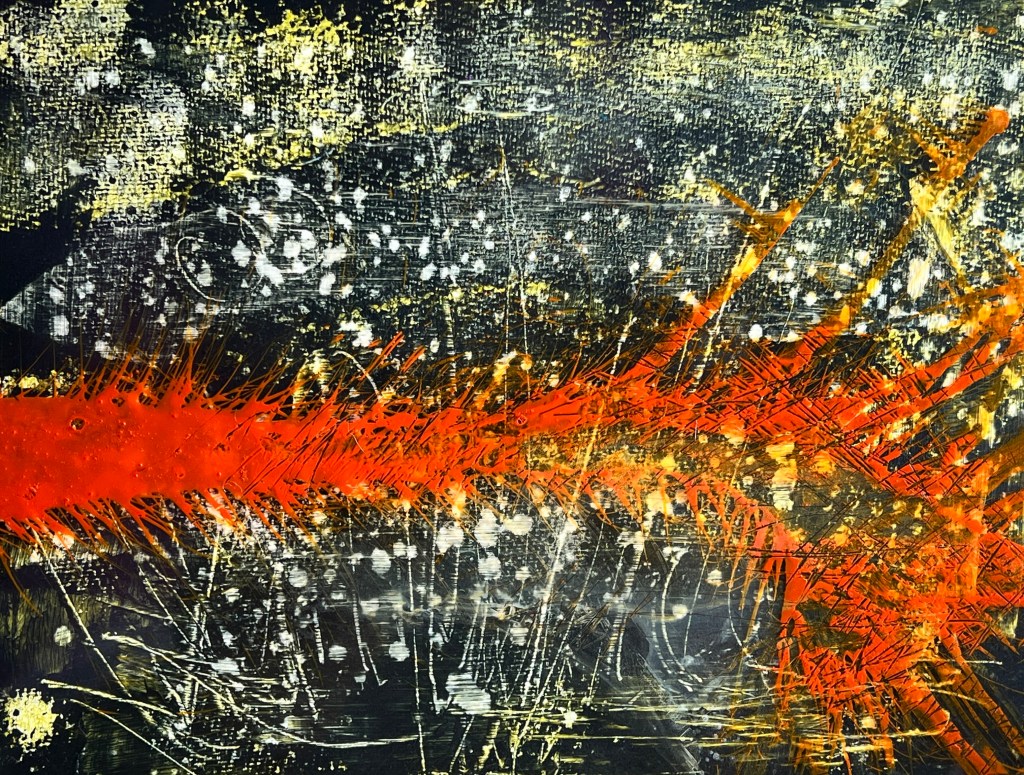
I think they look far better on the larger A3 size, These are experiments that I plan to work on in the next module, I also plan to continue with this body of work into the next module. I particularly like the orange, it is more lightning like, but I will experiment with different colors and techniques when I develop this work further.
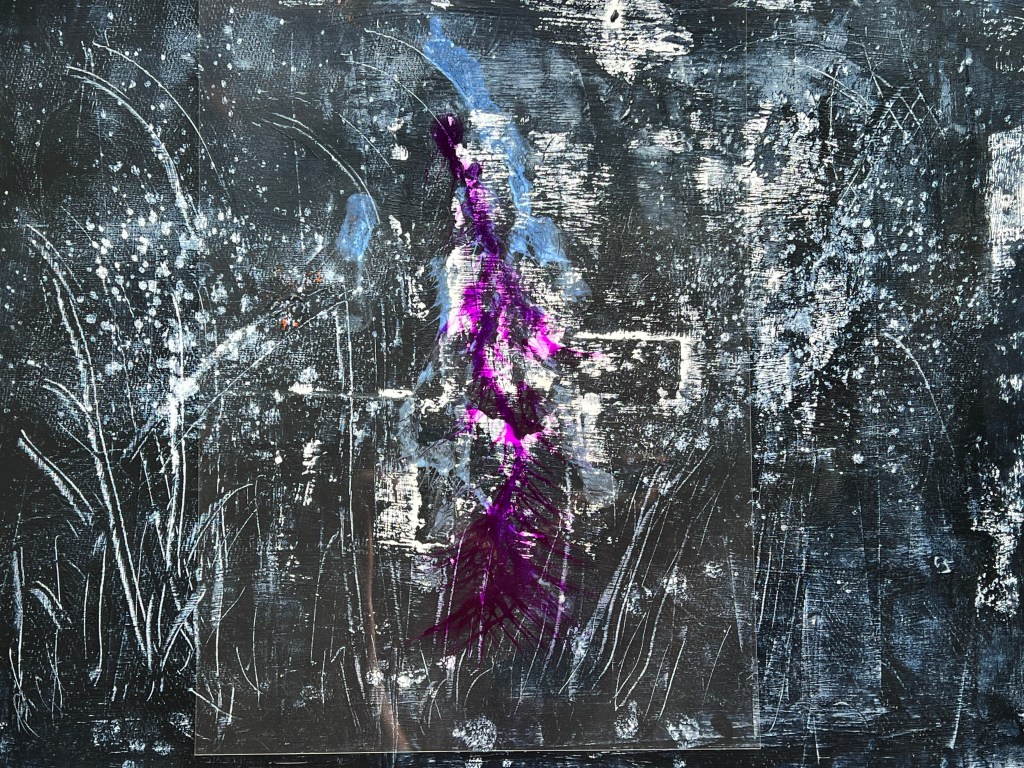
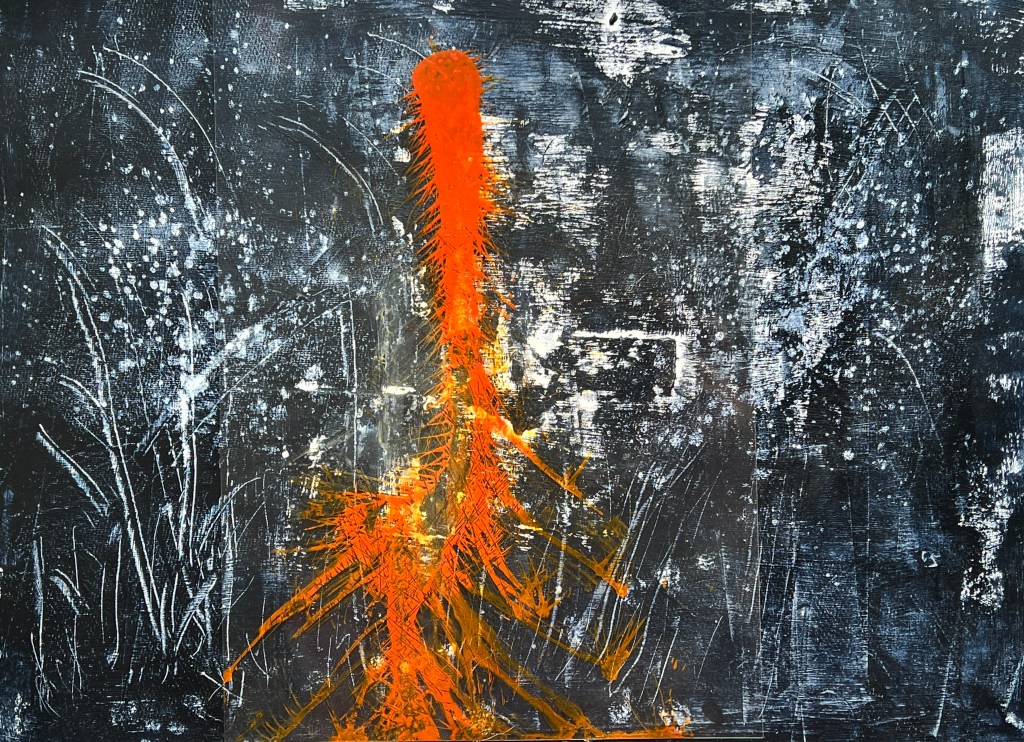
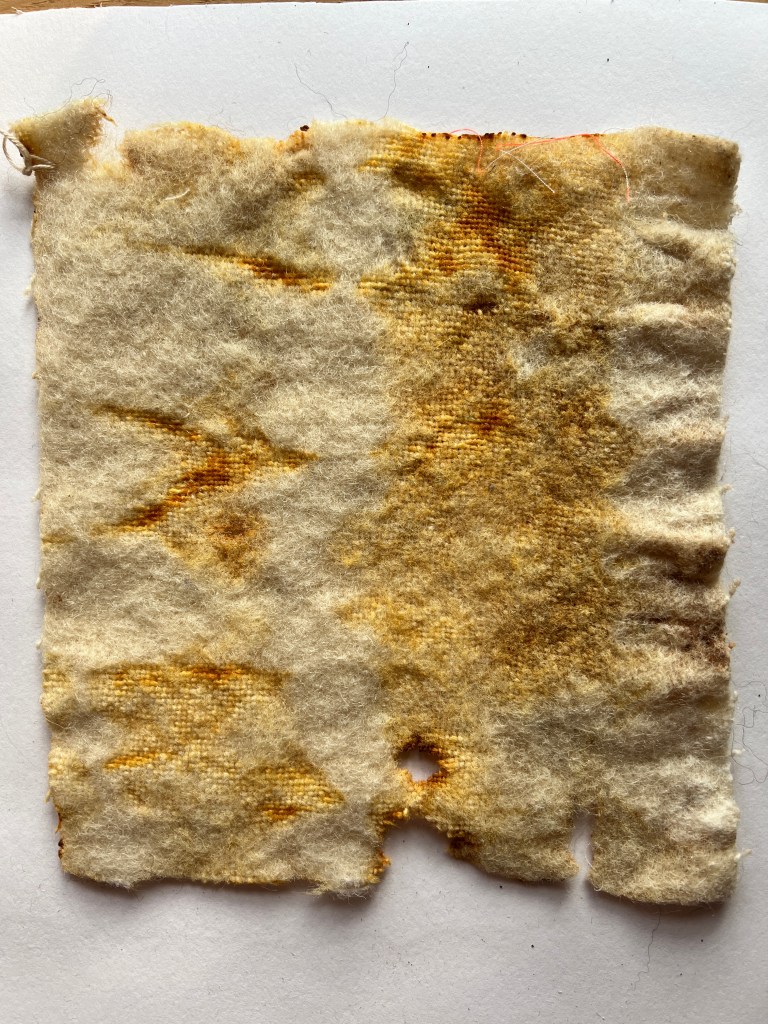
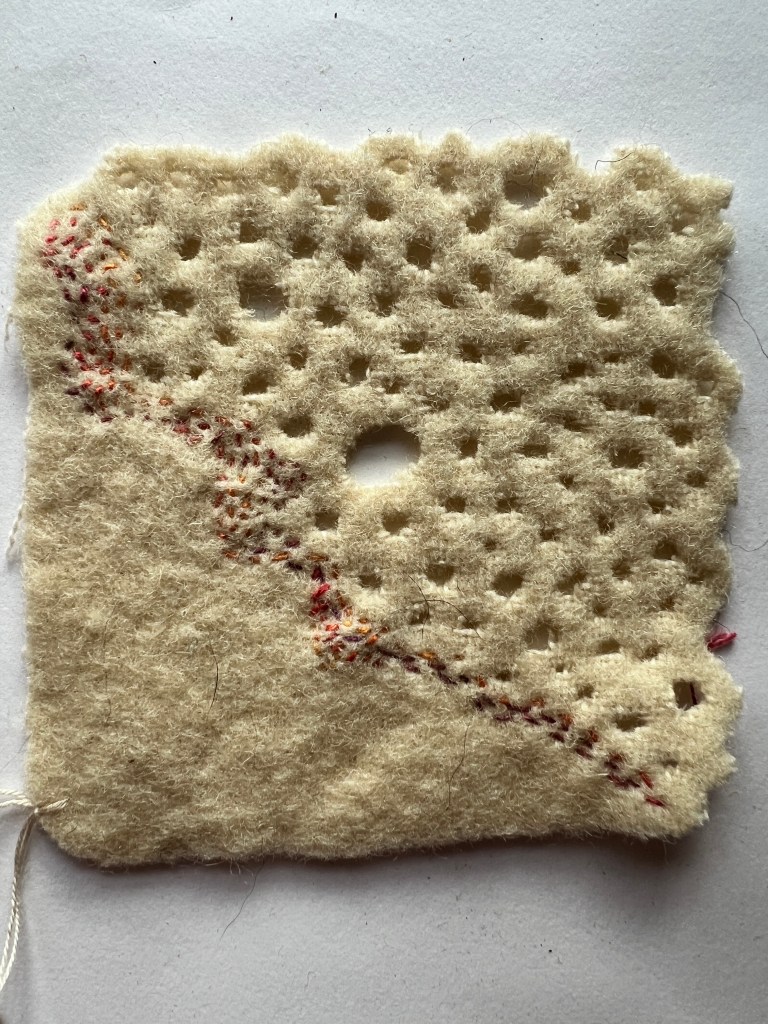
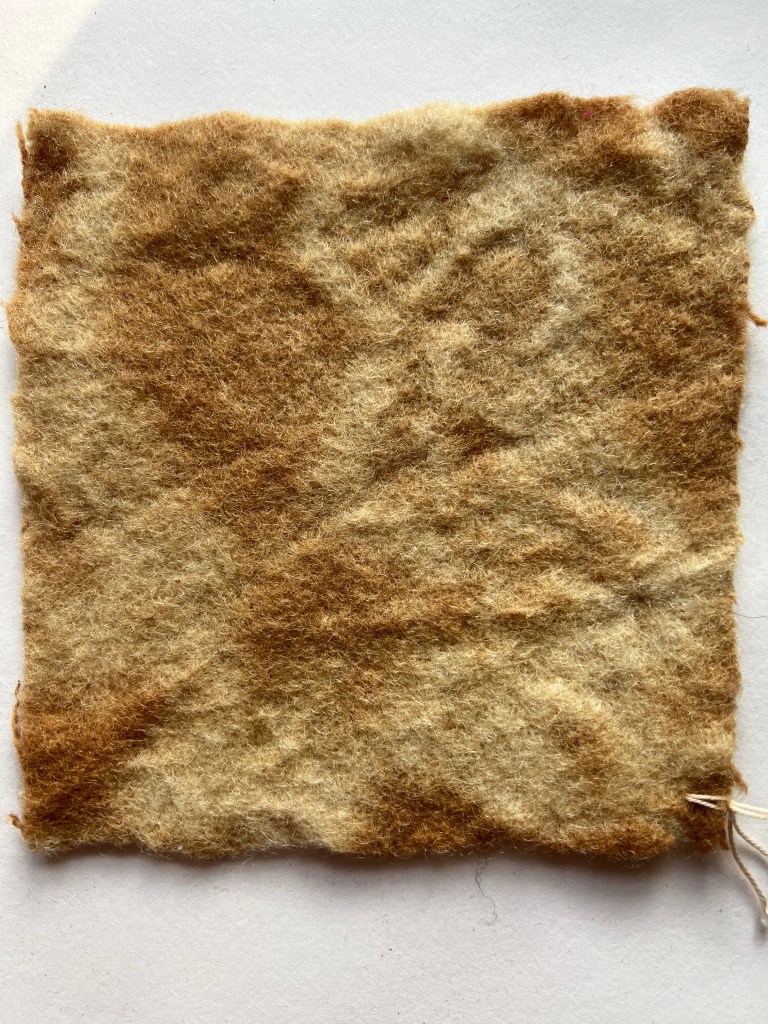
As well as these paintings I have re-purposed wool samples, by using felting wool and threads to show how energy could be seen as it bounces and jumps, the image below is a close up of a small piece, however, by showing this in detail it exaggerates the details. As unseen details are all around us, but also me and Delyth discussed nature, growth pushes through the earth towards the sun in opposite direction to gravity, but also we discussed gardening by moon, plants like us are made up of water and therefore as the tides are directed by the moon, humans have 60% water and the term lunatic comes from the heightened behavior seen in patients in asylums at the time of the full moon.

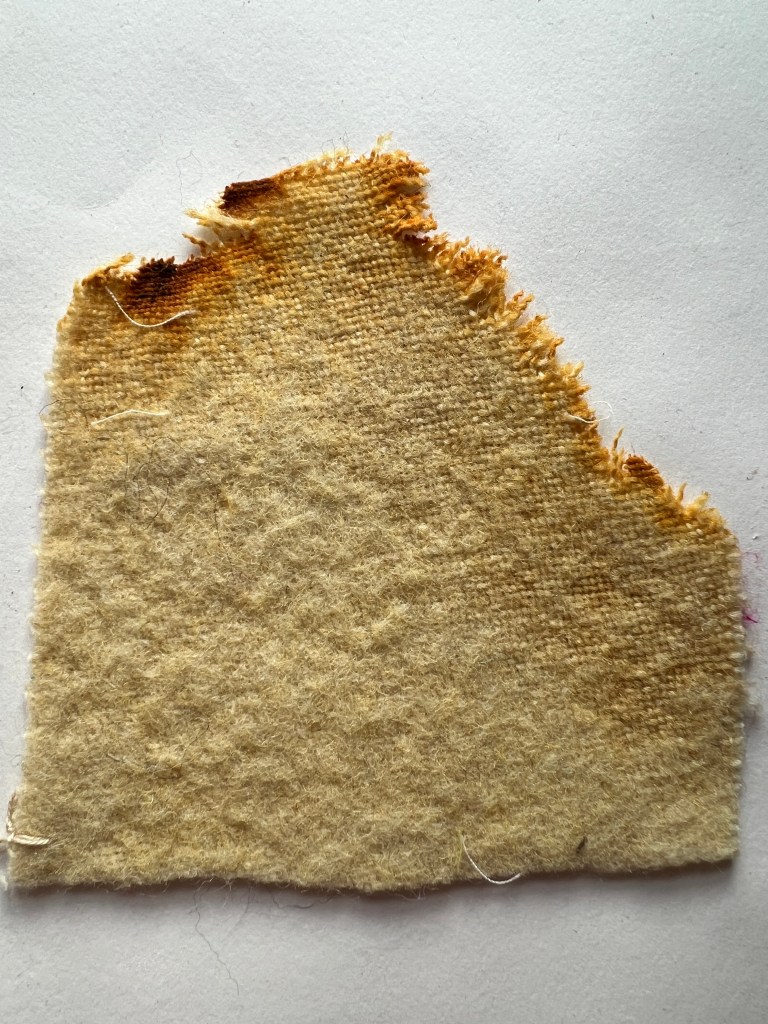
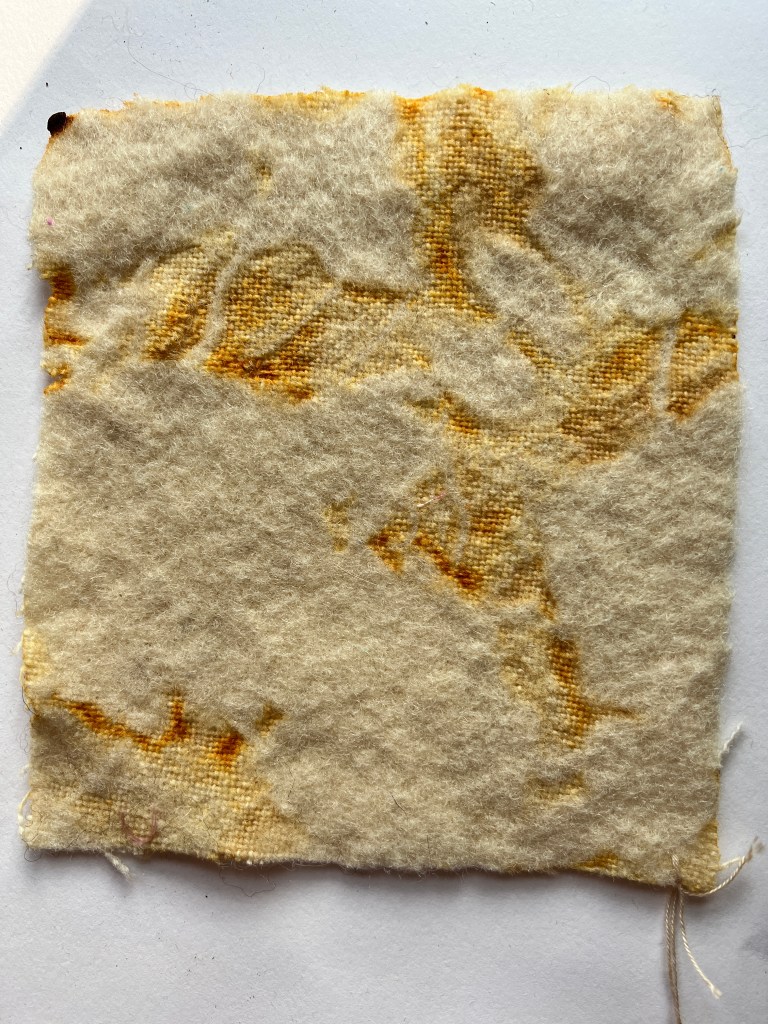
Below are more samples that I have manipulated and plan to explore further in the next module.



Evaluation
This project as I have stated has been challenging, mostly due to personal issues that I have discussed, but also challenging in a very positive way, when I reflect on my journey through the MA, this module has pushed me further than any other module, I began my journey through a cathartic healing experience, finding my way but staying within what I knew, trauma, childhood issues, working with themes that I deemed to be safe. The most illuminating thing about this module is that I have been able to move away from personal work, that can be exhausting and emotionally draining.
I have been able to explore new thinking, to be an observer of my own thoughts, and by the process of previous work, I have been able to resolve many of my insecurities and imposter syndrome that I previously held. I began a process of what is called metacognition, Thinking about thinking, cognition about cognition and knowing about knowing. I am at the beginning of being free to explore new vistas and it is ok that I do not know everything before I explore, on the contrary It offers an opportunity to freely explore in my own way, as a child unbridled by perception of what you should do. My conditioning has been revealed and I had no idea that following the rules was something that I do, but whilst thinking about thinking exploring my thoughts, get ready thoughts, have breakfast thoughts and on and on it goes following rules of what I perceive I should do, what has this got to do with my Art work, it has everything to do with it. Questioning my reasons for choices that I have made, being open to new ideas, exploring these in new ways, not discounting anything.
Devising my own learning plans, checking the learning outcomes to ensure that I have fulfilled these in my module, my greatest discovery in this module has been to be open to everything, question and explore all possibilities, could I have done more, yes, but I am satisfied that I have done the best I can under the circumstances.
The most significant shift has been in my thinking, thinking about thinking and allowing myself the permission to take my time to think through processes, to explore as a child would, new discoveries, imagined landscapes and unseen forces which will be the title of my next module or thesis.
Evaluation with Delyth
We met up to discuss what we had achieved whilst working together and below is a statement that Delyth then emailed to me.
"I immensely enjoyed working with Carys on this project as I found it novel and useful to view scientific theories from an artist’s perspective. In physics the main method of describing a phenomena is by using mathematics, for example in electromagnetism we use Maxwell’s equations to describe electromagnetic waves and fields, in quantum mechanics we use Schrodiger’s equation to describe the location of an electron and modern astrophysicists study the stars by analysing data on a computer. While this is the most effective way of studying physics, the effect of this is that physics sometimes feels abstract and when looking at a page of equations, I sometimes forget that I am studying the real world.
This is why I found it so useful to discuss electromagnetic principles with Carys. By discussing the theories with Carys I was able to understand the topic better by taking a step back and explaining it to someone else. Carys was then able to visualise how the electromagnetic fields and waves would look, this can be difficult to do as they are invisible and their shape can change depending on factors in the environment. The founding fathers of electromagnetism, Michael Faraday and James Clerk Maxwell were both said to have the ability to “see” the electromagnetic fields and this led to their success in predicting their behaviour.
While working on this project I have come to believe that scientific disciplines can benefit from an appreciation of art. Society perceives art and science as a dichotomy, with science being perceived as cold and unfeeling and art being perceived as a non-academic subject, however I don’t believe this is true. Artists and scientists are both motivated by a passion for the world around us and by a desire to perceive and understand it, the difference between them is simply how they do this.
Many famous scientists were also artists, such as Leonardo da Vinci, Samuel Morse, the inventor of Morse code, and Louis Pasteur. This overlap makes sense as creative thinking can help scientists come up with theories on how the world works and what experiments they can come up with to test them. Faraday would have needed a good sense of creativity to imagine the possibility of invisible electromagnetic fields, as nobody else had considered it a possibility at the time and the scientific community didn’t believe him until Maxell proved their existence using mathematics 19 years later. On this note, creativity is such a valued skill in mathematics that mathematical institutions are looking into ways of encouraging it in young students.
I benefited from working with Carys as she was able to approach electromagnetism from a different perspective, allowing me to appreciate what I am studying more. The experience has led me to believe that art and science could benefit one another, scientists could benefit from artists’ creativity and artists could become inspired new scientific discoveries".
I was extremely pleased to receive this from Delyth, and it is very much how I felt, I have learnt so much from the collaboration, going forward it has given me the confidence to realise my ideas, work out new ways of working and find other specialists to work with.
 CarysAnne.Art