Began my summer recess with a course to find deeper meaning in my voice, to understand my process, so using the design cycle to generate new ideas and continue to push my boundaries within my practice.
Initial Mind mapping
My initial mind dump, next task to look at themes and pick three words or areas, one suggestion was given as History, Place and People and this intrigued me. Finding clarity is always difficult for me, I like a lot of different things, essentially it boils down to character, but it does have to be a certain type of character and this is where my research comes in.
Using these three words, I am now making a new map for each. I am also collecting images for these so that I can research from these. What I had not included was my love of nature, not beautiful tended gardens, rather rugged hillside grasses, moss that grows on rocks but I will slot this in on my place map as I see this as an image that changes, possibly easier to decide what I don’t like.
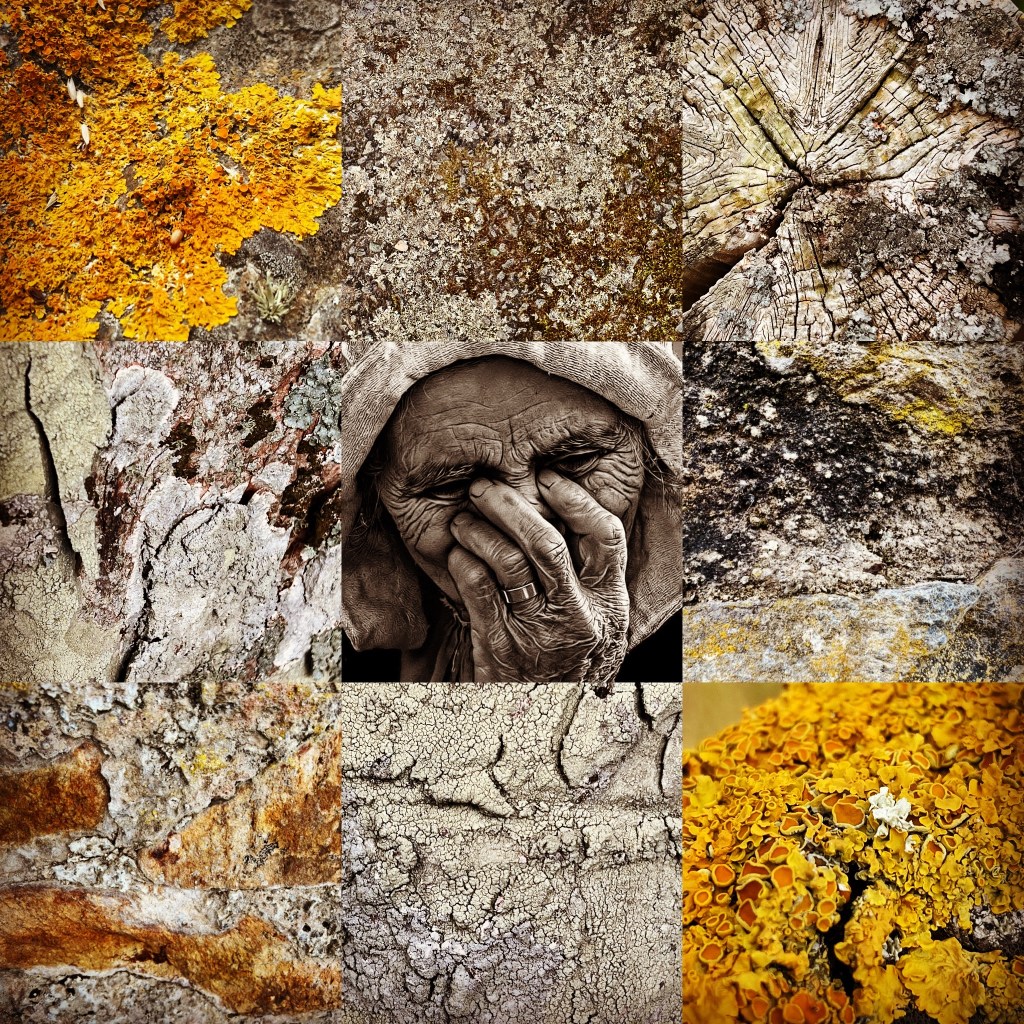
My initial images of character, this face of this old lady is so beautiful, the lines defines her life, it appears to show long hard life possibly, it is an image that I’ve admired for a long time, the lines of life, the textures of those wrinkles and lines the passage of time.
The face reminds me of the textures of lichen on the post, this grows slowly over time, it creeps over it’s still host, so leads me to think of rotting, how over time the body degrades and organisms thrive from this decay.
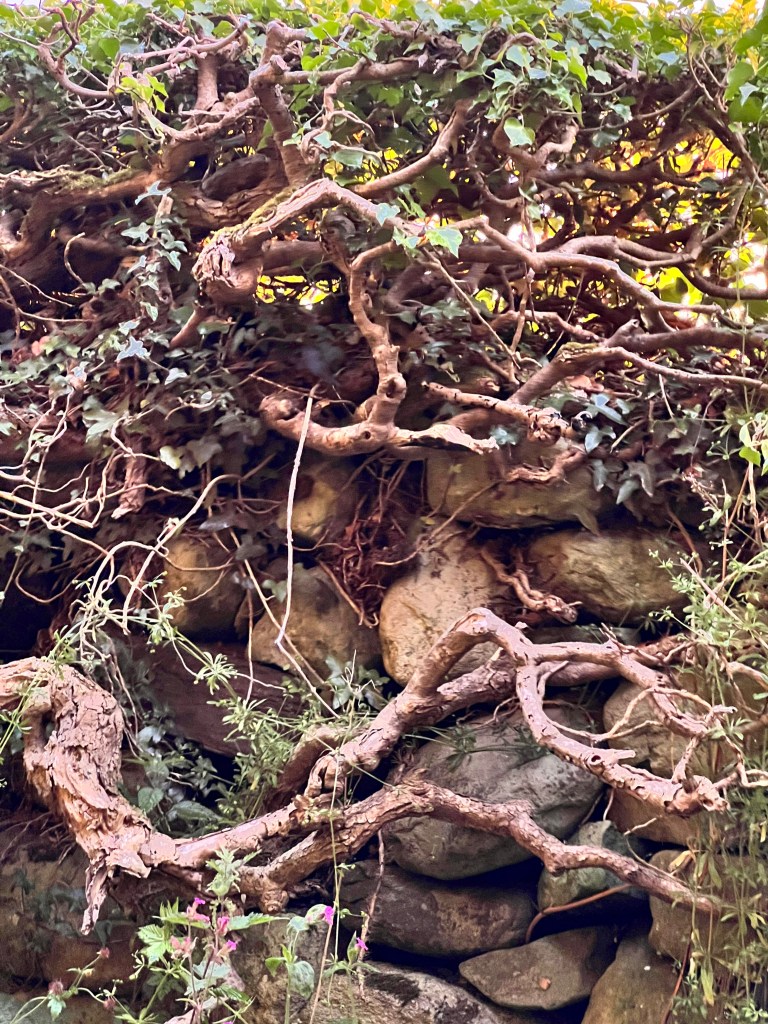
The roots of the tree, encasing the stones as it’s grown, life clinging on in every circumstance. As humans it’s our greatest drivers, to survive.
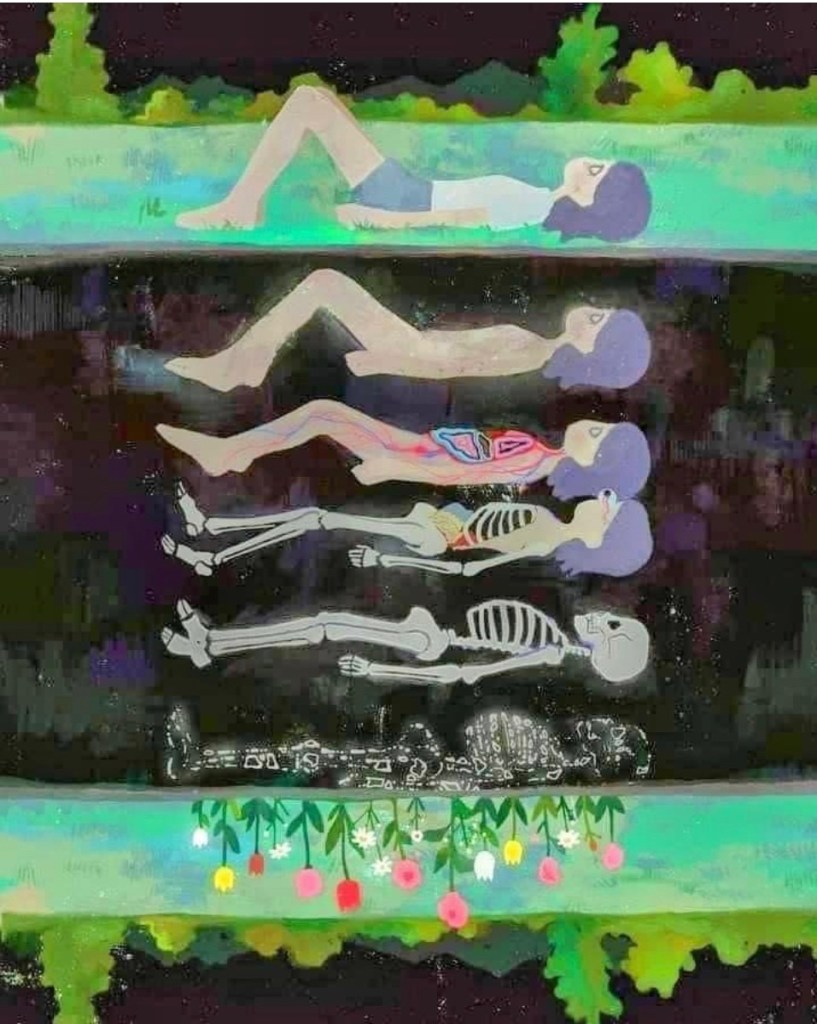
Artist unknown shared on social media
The picture above was shared on social media by an unknown artist and it intrigued me how the decay of the body had been portrayed in such a colourful manner when I would have considered this to be a dark matter so my interest is how colour changes our perception of an image. This is important in my work, I am trying to portray darkness, does the colour need to be dark?
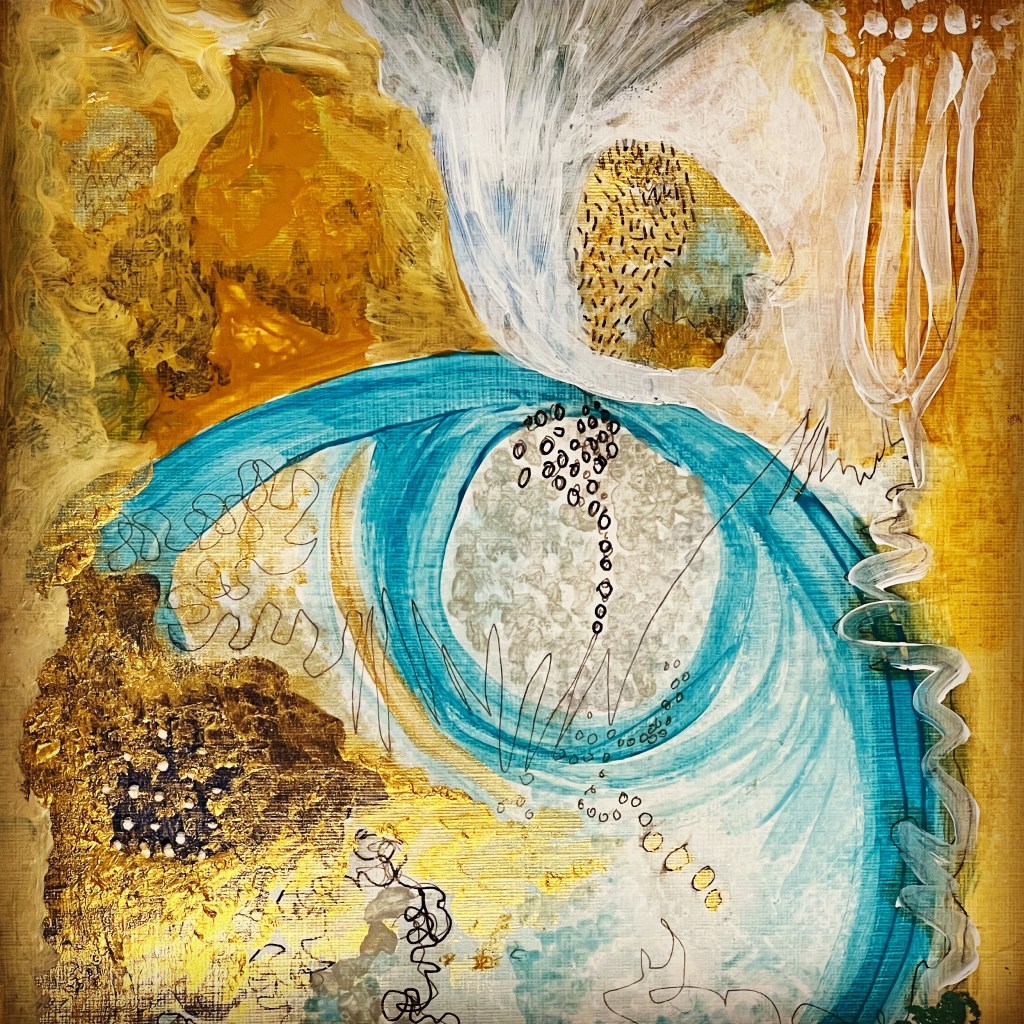
Exploring colour through tone and tint, while exploring abstract art as a way of loosening up and letting go of perfection. Trying to convey a narrative in an abstract way. I have started by just exploring abstract painting techniques, following other artists who use this method.
The complexity of building up a painting in this way intrigues me, I feel uncomfortable with the process initially resisting my basic instincts to go back to controlled method of drawing and painting from life. Reassuring myself that I was only playing, it wasn’t a finished piece.
Using Onomatopoeia words initially to draw initial drawing such as bubble, splat, swish, I also took a line for a walk in a continuous line method with these words in mind.
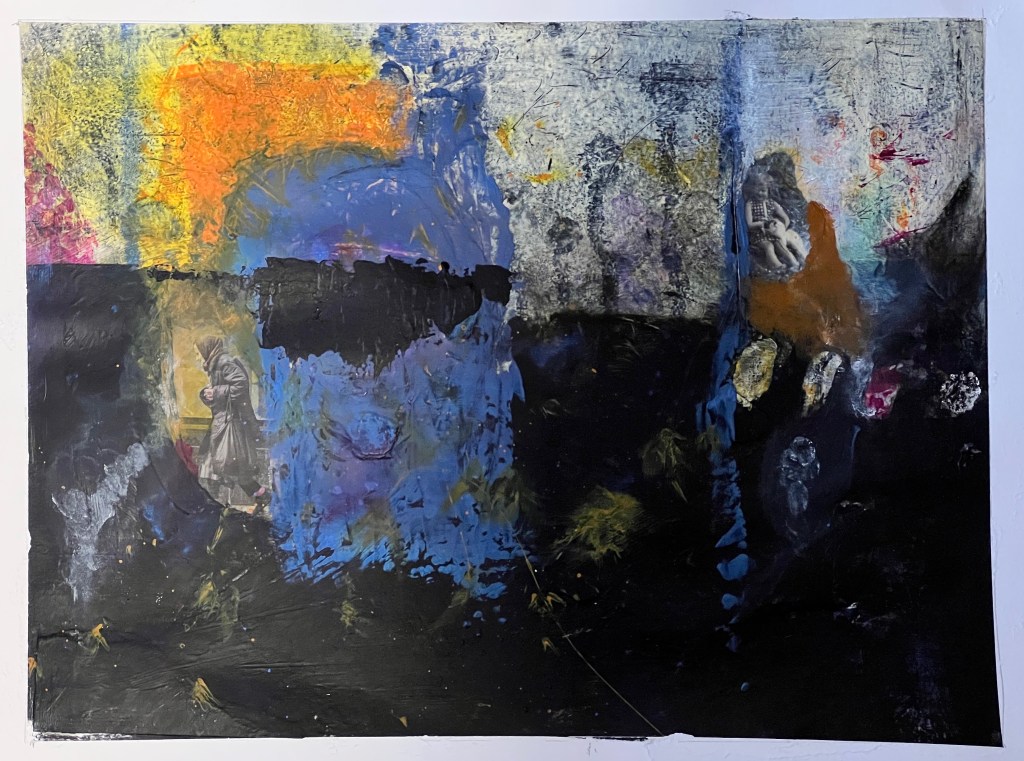
I am really pleased with the outcome of my painting, it’s on acrylic paper 300g and I used fine liner pen, gesso, acrylic paint watered down and neat.
This process of loosening up inspired my thinking of where I am and what I want to do going forward, I feel that using this method along with printing techniques and textile exploration will push my practice forward.
I aim to carry on with this practice while I begin to evaluate and reflect on where I am up to before I return for my final year on MA in September
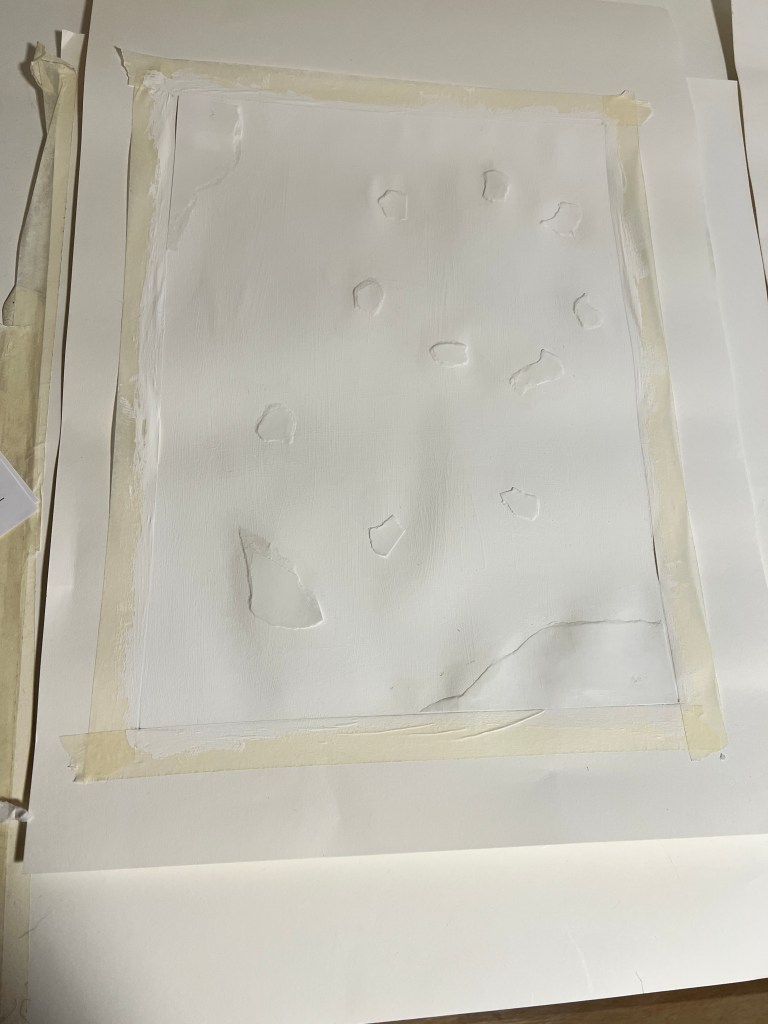
Starting the process from an online painting courseLayering and mark making Another layer DetailsCovering details Focus area of the painting.
I began an online workshop in abstract art following the suggested steps for the initial first few layers. The layers had to dry completely with each new layer, this was a time of pause and reflect and where I began to think about the “why” (another online workshop) for a long time now I have wanted to explore my art through paint, but I didn’t really know how to start.
I have never been taught how to use paint, the rules? Are there rules? I learnt the hard way that there are a few basics, PVA will bubble when you apply wet paint, so working into the new layer to make marks meant that areas with PVA underneath came straight off so I used modge podge for the collage, it was suggested that I use Gell Medium but I could only find Matt medium, so learning as I was going along.
The workshops were easy to follow and I began to feel confident using paint, however it took me so much longer as I found my contemplating took far longer than the workshops were available and I wanted to produce my own work.
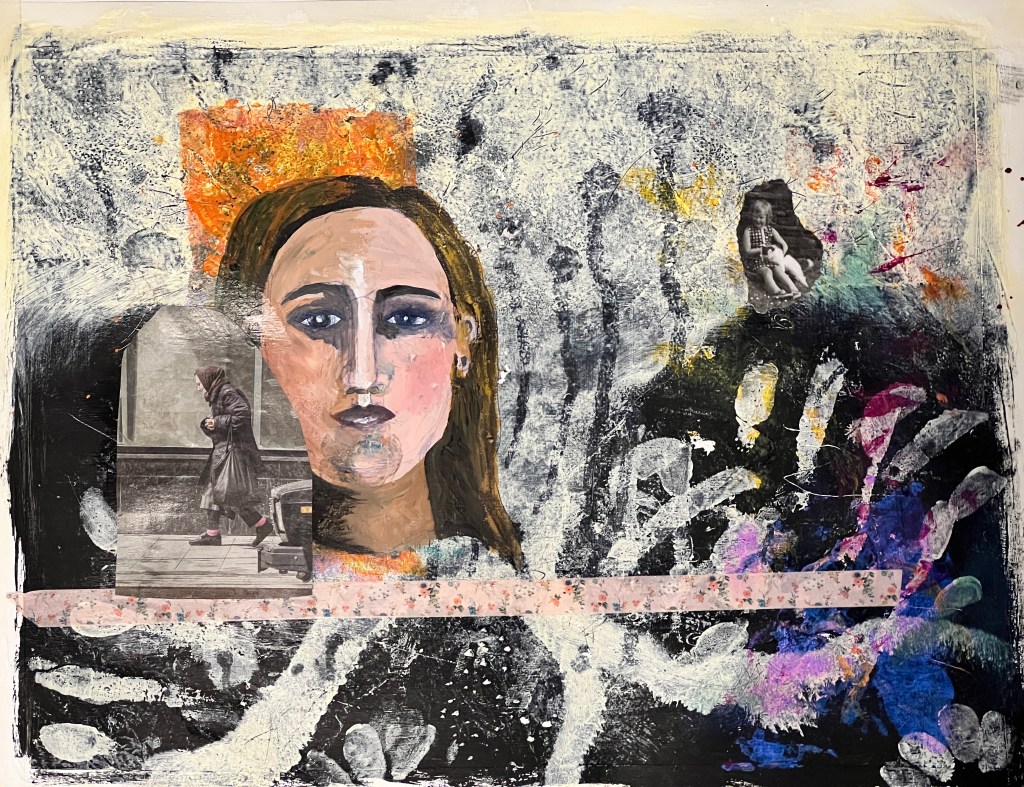
I painted the face, I spent a whole session exploring character within an abstract, I let it dry but I wasn’t happy.
I sat with it for several days before making the bold move to paint over it. I resolved that it was all a learning curve and not to be too precious about it.
What came from this was a focus area that I really did like, I draw and paint emotively building layers of meaning, memories of childhood experiences often haunt my dreams and this focus area felt part of that narrative.
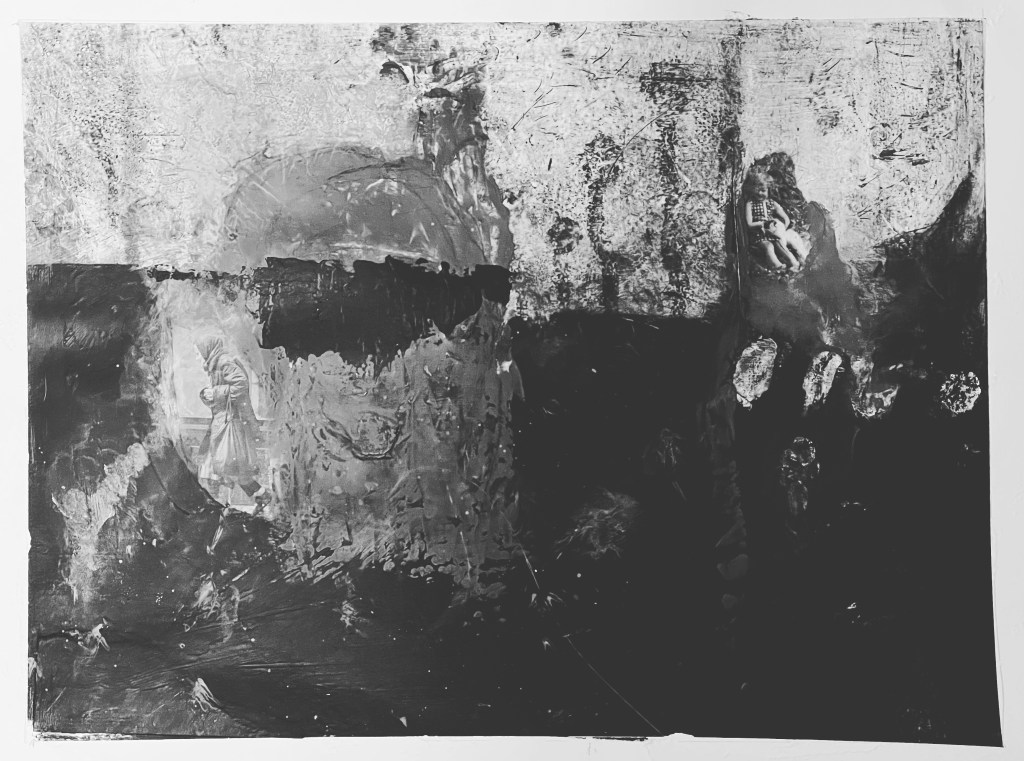
Final stagesChecking the contrast in this Silverstone filter from my image.My finished painting
This first of three paintings that I have started recently. This is a new direction, although painting was always part of my language it got lost in the textile direction that was my main focus.
This brings me to my quandary, my mixed media textile pieces have been cited as strong emotive pieces, and I will continue to make these, but as my rheumatoid arthritis ravages my fine motor skills for textile processes. I have to find a new way to express my narrative, it has been a traumatic experience in itself, to accept that artwork I could once make effortlessly, is now only possible when I am well, and at a much reduced level.
I am however, able to continue to paint and what My aim is now is for the same strong emotive relationship with the audience that my textile pieces have, like past trauma it’s a journey.
My body of work consists of mixed media figures using textile processes with these as a response to my first task in this module where I looked at a paper about a textile exhibition, working with textiles as your predominant media poses several struggles, mainly due to the hierarchy of acceptable fine art material and as such is yet to gain a similar status, possibly also due to the problems one may pose for a curator when it comes to display. Cloth is however a powerful material, despite its connection to domestic sphere, cloth is with us from when we enter the world and shrouds us when we leave with all of that cloth in between.
Through this module I have joined several online forums, what I have experienced is that an Artist who uses cloth, does so as a medium to narrate their vision, others use textile for the textiles sake? I am happy to debate this.
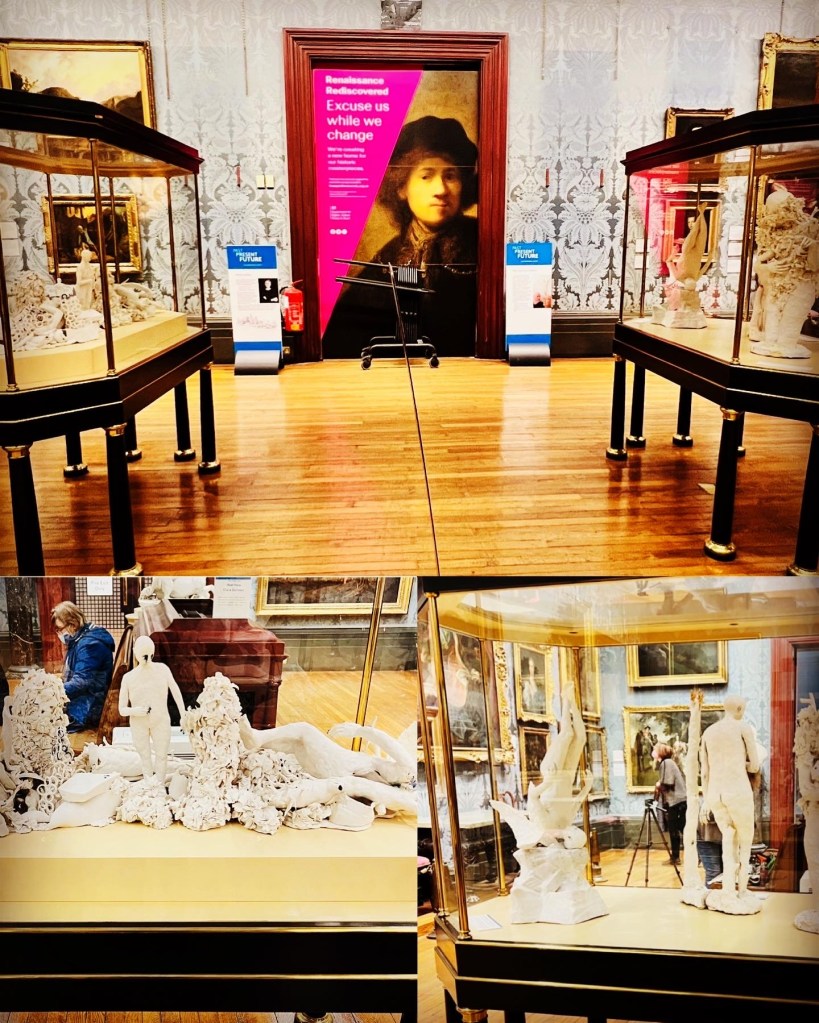
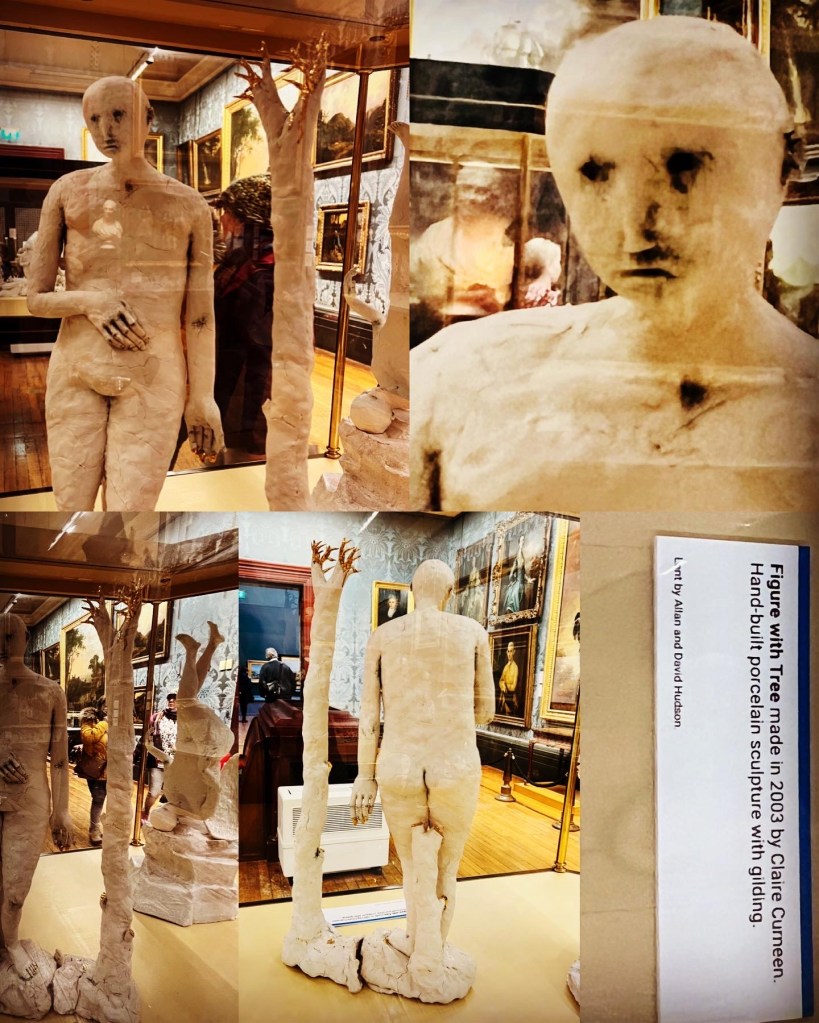
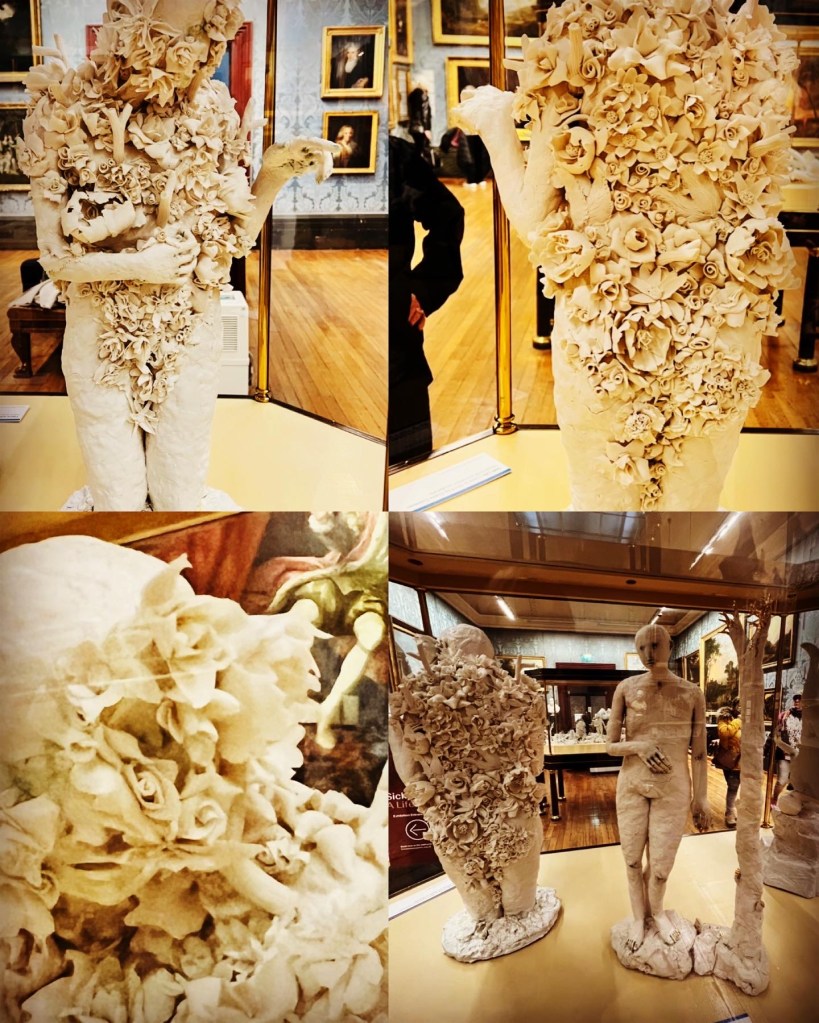
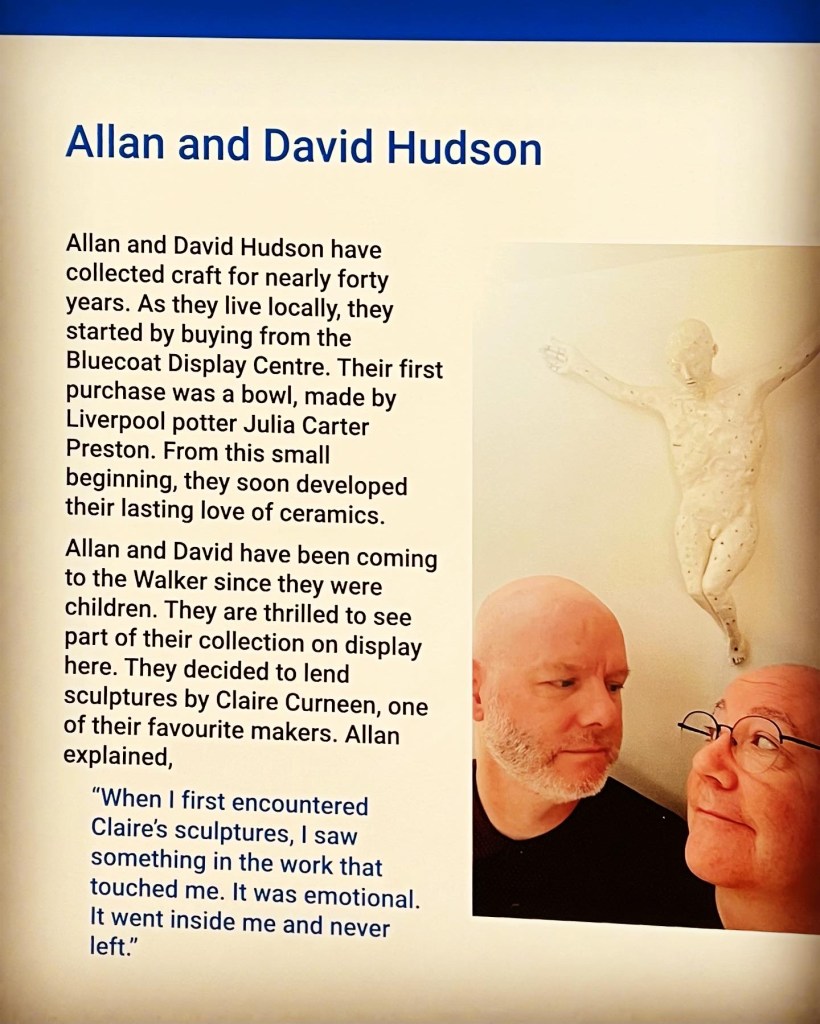
The figure, for me, the human condition is my way of expressing my trauma through my practice and through material thinking. It draws me towards artist who also work with what appears to be raw emotions, with figures such as Claire Curneen (below) a ceramicist who builds poignant figures, their venerability in their stance, the lack of facial features, their small heads and large hands, naked mostly without gender adding to the venerability, flowers growing out of their skin depicting life / death.
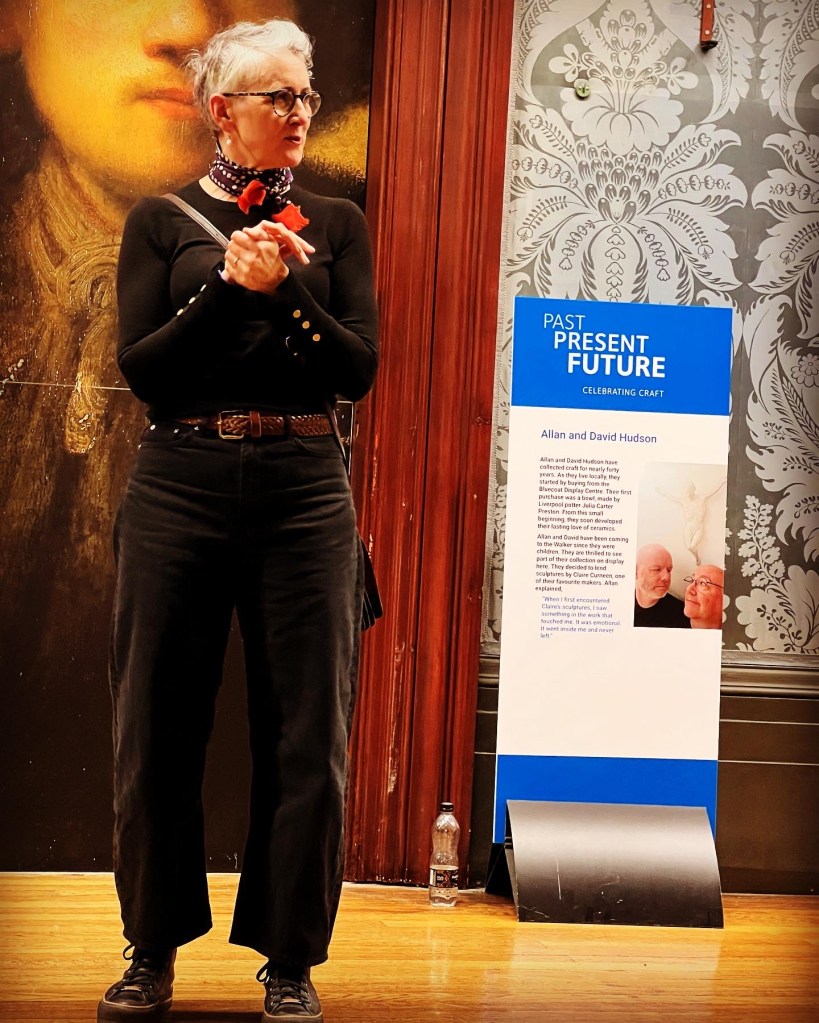
The talk was for over an hour, it was an informal talk in the gallery, I felt very honoured to be there, I already know Alan and Dave Hudson having met them years earlier, they have two of my pieces as well as a commissioned piece, they are important collectors and they semi detached home in Widnes is a shrine to collected artworks as well as William Morris wallpapers, they have several of Clair’s pieces in their collection. Talking to them both was monumental in establishing myself back on the artist platform, I may be gripping on for dear life but at least I am getting back to where I was.
Claire was charming, she went on the journey of her work, why she made the figures, how she felt about them what the symbols meant, the process of building these magnificent pieces, the technical skills involved in working with hand built porcelain, the importance of drawing. I asked her why the heads were small and the hands big, she said its just the way she made them, that then became her signature.
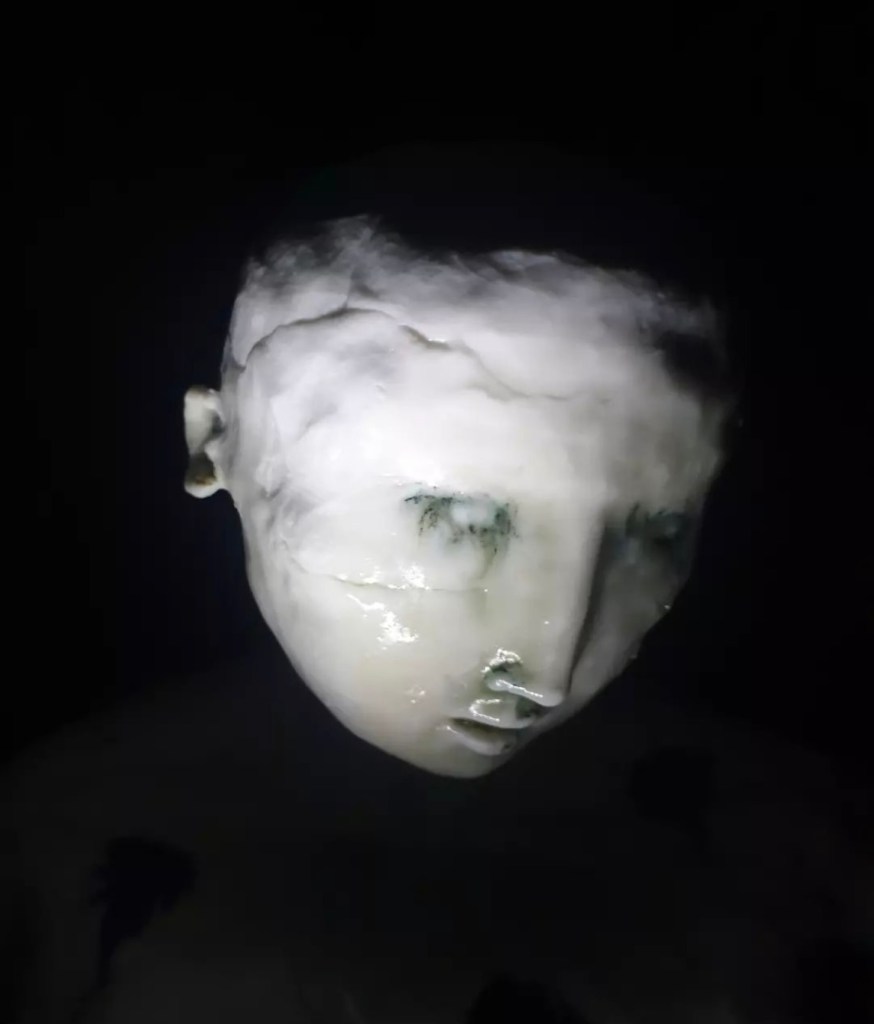
At this talk I also met Sharon Griffin Artist, Figurative sculpture in ceramics who’s figures have a huge anguish, her glazes add to the sense of rot as if the figures have been left in a forgotten forest to rot, their expressions and features quite often distorted.
I also met a dear friend of mine that I had not seen for an age, Angela Sidwell ceramic and mixed media artist who predominantly depicts animals within her work.
I was so glad that I had gone to the trouble to email the organisers for a ticket as it was sold out, I spent the day talking to likeminded people and it reminded me where I need to be.
London exhibition trip for three days including Louise Bourgeois at the Hayward Gallery, Foundling Hospital, Science museum, Natural History museum
The London trip was epic! I arrived late as I had booked a later train, but in time to see the full photographic exhibition but I did purchase books from their bookshop which was really good. Susan Sontag, (Regarding the pain of others and On photography) Both really interesting books.
Tate Modern Visit
We then went to the Tate Modern I elected to see the collections rather than the paid exhibition, having worked out my budget for the trip and decided which exhibitions to attend. The Radio Ballards room was brilliant, a tower of old radios, casette decks, gramophones all playing different sounds, it had a feeling of being in a different far off dimension, the light was dim with just the lights off the radio channel selection panels the noise merged was as if contact was trying to be made from far off other places, or I have watched too many films of this nature, the scale of the piece added to its majestic central position within the room.
The pieces I most admired from the collections was Patricia Belli pieces from 1996 Mixed media, textiles rope and wood, my favourite piece made from various used corsets stitched together to emphasise the painful effect that corsets have upon women’s bodies. In the description notes it states that the title refers to a paining by Freda Kahlo entitled The Broken Column 1944 where Kahlo depicted herself wearing a steel corset, it goes on to say, Belli’s layered corsets suggests the collective pressures and enduring inequalities that women face in a patriarchal society.
Natural History Museum
Photographer of the year was a paid for exhibition within the museum that I decided to visit instead of the V&A exhibition planned, This showcase of exhibition entriy winning categories were phenomenal, It showed the extraordinary talent of photography in this digital, everyone has a smartphone camera age, their categories spanned the earth, oceans, ecology, animals, human destruction, people’s choice and although less relivant to my practice than other exhibitions, I felt it was w worthwhile excursion.
The rest of the natural history museum was extraordinary, with all sorts of curiosities, granted not as dedicated to curiosities as Pitt rivers museum but it was a beautiful building, majestic and interesting.
Sience Museum
Initial thoughts were why am i here? but on the second floor it was dedicated to medicine, anatomy, prosthetics for children, illnesses and all manner of diseases and mental health issues, brain function and an original depiction of a pharmacy it really was brilliant.
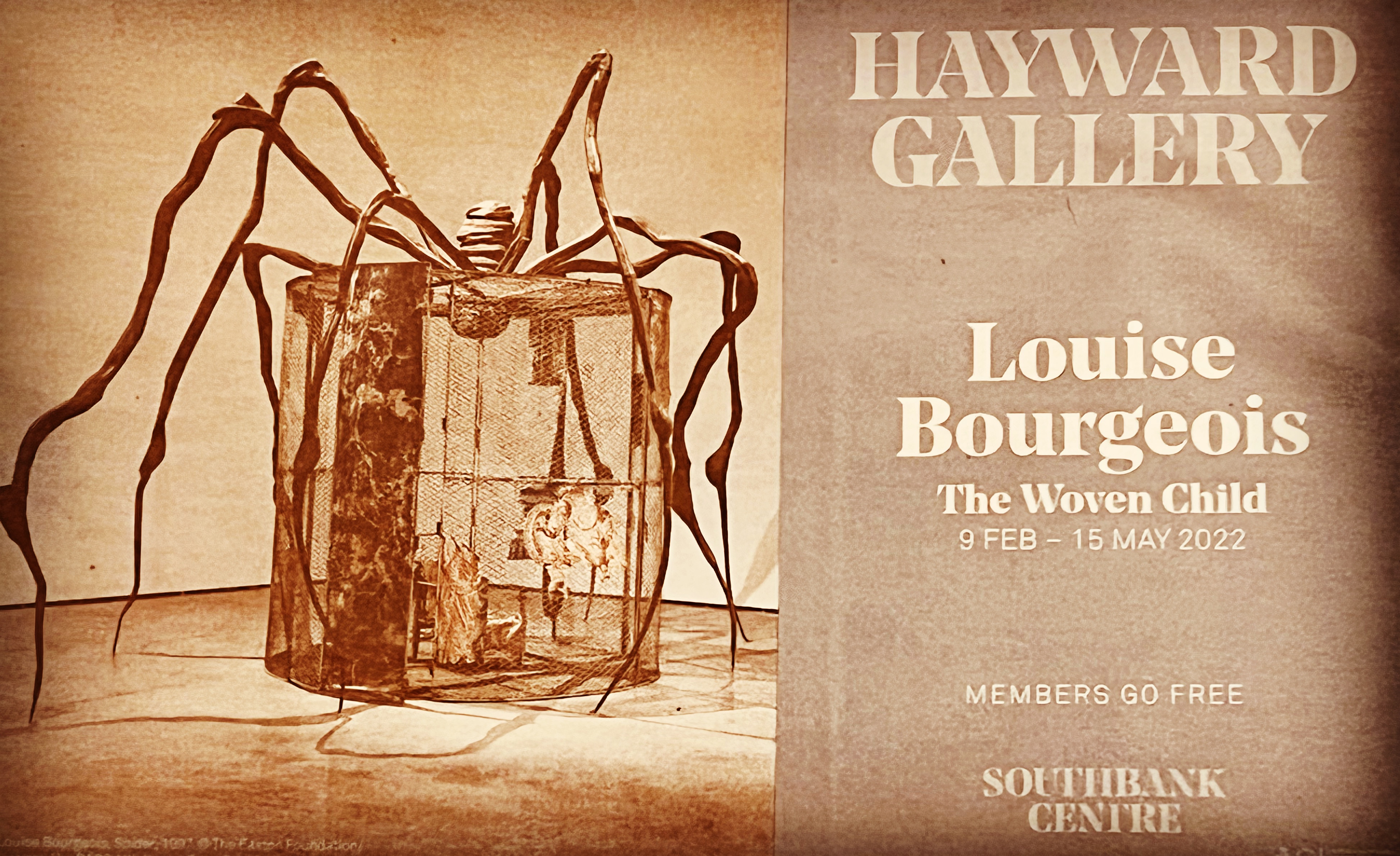
Louise BourgeoisThe Woven Child
The Hayward Gallery was the first major retrospective to focus exclusively on Textile pieces, the exhibition opens to a room with hanging clothing off a contraption that looks like an extended hallway coat hanger, yet many of the pieces are translucent, there is a black sequin dress, it takes me a few seconds to realise that these are hanging, not from hangers but from huge animal bones, like flesh hanging off the bone, lifeless hanging, waiting in limbo and I got quite emotional about the lifeless clothes, deceased former owner that no longer needs them, but the essence of her remains in these bits of fabric that once adorned her frame, if they did that is?
There were so many pieces that moved me, the (Cell XX11 Portrait, 2000) for me a child who had given up, I have no knowledge of why she made this piece sitting in its cage, head down without arms, the stitching visibly on purpose, but it felt more like a raw emotional way to stitch, was it rushed, the little shoes, almost missed these, are they shoes, or is it the way the feet have been stitched? Sitting on it’s own in a cage as it is brings forth strong emotions of abandonment and i am almost overwhelmed with grief for this piece, the Lady in Waiting 2003 a small figure sitting on a woven tapestry chair and from her stomach emits a spider it is part of her, its metal legs protruding, this figure has no arms as such only spider’s legs. the tapestry fabric that has been used is such a difficult fabric to use in this intricate way its unforgiving, its open weave so difficult to sculpt and I admire her skill.
What strikes me the most is the sheer volume of work produced here, the patchwork pieces the stacked cushions, but most of all of the bodies, the soft sculpture bodies, life hanging from each other, just legs, small bodies in different stages of pregnancy then with umbilical cord in a small scene indicative of a nativity scene for a maternity hospital except there are mirrors everywhere. On the whole this exhibition felt like I was privy to Louise’s private collection, where she worked things out her fabric sketchbook, some pieces felt raw and unfinished such as the pinned hooks and eyes. I was emotionally drained on leaving but in a very good way, knowing that I felt that other artist have poured their emotions into their work.
Foundling hospital museum, was harrowing in parts, reading about mothers who had no way of feeding their children having to give them up, also harrowing depictions from the former children who lived there, beautifully put together exhibitions, a good mix of how the fashion to be a patron became fashionable among the wealthy.
Serpentine North Gallery Radio Ballards opening day of this exhibition and it was such an emotive exhibition artists working with community groups responding to mental health, abusive relationships, dependancy, and the way that these groups had responded to working with the artists, the students on the Art for Health should visit this exhibition, wellbeing, community support and how they got through their issues. The film I saw about a young woman who had to find a way to cope to ward off mental illness by walking the soundtrack of a choir singing adding to the emotive film made me cry, for personal family reasons both my sisters suffer with bipolar condition, one walks the other heavily relies on medication, so its a subject close to my heart.
Whitechapel gallery A century of the Artist studio 1920-2020 was a fascinating look into how artists make their work, Fraces Bacon among those shown, such a different and interesting look at how we as artists produce work everyday. At this stage in the London trip I wish I had more time to explore further, the whole trip was enlightening and I feel it has helped me to contextualise my practice, asking the questions at each point, where do I sit within this.
Liverpool Tate Emily Speed,
I was slightly disappointed with this exhibition, it felt more like a project, but perhaps I missed the point, It did not tick any boxes, it may have been due to the setting which was dimly lit and i’m not sure why except that the film was also playing in the same space.
Bluecoat Craft display centre Jess Chorley
I have been following Jess Chorley’s work for some time, her work is indicative of lady’s samplers from victorian times, it has been popular in the stitching community, her shop in Camden market was on my hit list, but she has moved to new premises and I have moved on with what is now on my hit list.
Bluecoat exhibitions
Suki Chan, a series of films abut memory each film was set in a room adorned to look like that of a nursing home and it added to the sentiment of the films, there was a warning before entering that these could cause an emotional reaction, they were not wrong having worked in that field it was emotive, how memory fades, what is left behind, once you enter one of these places, where does your identity go to, it certainly does not come with you, formerly important people reduced to Bill in the room on top of the stairs who always looses his teeth, it made me think about my own mortality and what will be left after i have gone. very powerful exhibition beautifully put together, my reaction to the exhibition is that all that was missing was the smell of piss, apologies but its true.
Hayv Kahraman (The Guardian, 21st February 2022 printed 19.05.2022)
I am panning to go to see this when I visit London in June.
Plas Bodfa
Part of the Anglesey art open studios, a mansion in need of repair, a former steak house restaurant, old people’s home set in grounds overlooking the Menai Straights above Beaumaris a dramatic landscape where the sea channels the island away from the Carneuddau mountains and Snowdonia behind them in the blue haze of a beautiful clear day.
The house is now owned by Julie Upmaer they live in mobile home below the greenhouse where they begin to transform Plas Bodfa into a family home, an Artist who plans on setting up an Artist community and centre, the exhibition brought together 77 artists who responded to a “Continuum of time”
This exhibition for me is the best one I have been too! All the artists responded in their own style, some directly, using the surroundings to influence their making. I particularly was moved by the oil paintings of the former residents of the old peoples homes, especially the one where the outline of the person in the wheelchair looks out at the view.
What I felt was exiting was that this felt inclusive, it felt accessible, achievable as an artist it showed me where I felt my art belonged, it gave me courage for the possibilities ahead. The collective power of artists working together. I will post pictures to follow.
I have attended many other online and artist studios, but I’m out of time, my Instagram artist page feature on my home page has the images, my phone has decided that I cannot upload any images at this point, it is a learning curve that although technology is meant to improve speed and efficiency, I disagree and it has been an annoying hindrance at times but I am pleased of where I have got to with it.
In the Journal above I found a paper by three PhD Scholars, the keywords were Art, Feminism, Women, Gender, Embroidery, Textiles, Autobiographical Practice. This is an area of practice that I am familiar with, I use textiles, toys, methods that would be considered feminine, I have considered this element throughout my work as a method of executing my narrative.
The articles I have chosen have raised several questions, the contemporary modes of communicating through the use of medium, art therapy as a mode of self healing, does my use of medium, add to or take away from the narrative, would my art be viewed differently, if I used paint or ceramics instead of cloth. Does the fact that I am a woman pre position my choices, or do they kick back at contemporary notions of what art should be. Do the methods I use in my practice determine my art as a feminist as well as/or artist who is surviving childhood trauma?
Reading the article on Embroidery and Textiles, it struck me that this conversation was current, and that it was also a feature when I graduated from BA (Hon) in Embroidery at Manchester Metropolitan University in 2004.
The article refers to the exhibition “Entangled: Threads & Making” a contemporary woman artist art exhibition Turner Contemporary 28th January to 7th May 2017, 13 years after I graduated.
My interest still holds, the article raised questions are we still here? I know that in some areas we are not still where we were then, but it did initially make me angry. The fact that this conversation is still going strong suggests that the same issues are still prevalent today.
I plan to explore this issue further through research also through a renewed vigour to use textiles, embroidery and print on to cloth. I see the use of these mediums as tactile medium, I had not fully considered that the medium could be viewed as feminine. I deal with childhood traumatic experiences that are play over and over in a sepia coated memory loop that layers itself with coping mechanisms, unreliable accounts, sibling accounts of the timeline differing to my memory, therefore, I will explore these through creative research methods in a new body of work using current methods with textiles, embroidery and printing as a medium while I explore and analyse this challenge.
Film Club (Thursday 3rd February 2022)
Brogan Burke’s Film, I do not know the title, the film starts with images of what appear to be buildings, the sound is of running water, there is overlay of colour that merges into black and white then back to colour. The sound of running water did not match the film and therefore for me added another level of interest as to why the sound of water. It felt like a memory of place, not any particular place, just a place, such as you would encounter in a dream.
The film that stayed with me was (Incident at the bank 2010) where a robbery unfolded as a few individuals witnessed and their commentary is heard, For me the film questioned what we do in times of crisis, when occurrences out of the normal happen, as creatures of habit and routine how do we react, having spent many years working in an environment with individuals with complex challenging behaviour where fight or flight endorphins are never very far away, this film for me was also interesting from an ethical point of view, should the individuals ring the police, or as they did just viewed the whole thing unfolding before them, there was initially disbelief then questions, then the moral questions. I think that this film stuck with me as I am interested in the human character, and it feeds into my practice, fear, emotional.
Relevant Articles
The Evening Standard had an article 1st February written by Tracey Emin on Louise Bourgeois: “Working with her was like holding hands with history” The article is written by Tracey Emin and is ahead of a new Hayward Gallery Exhibition about Louise Bourgeois. The article is about Tracey Emin as much as it is about Louise, however I will book tickets to the Hayward Gallery it is the first to focal exclusively using fabric and textiles, this interests me from a subversive point of view, using cloth, textiles can be seen as a predominantly female characteristic and this interests me along with my use of toys, textiles to convey a narrative of trauma.
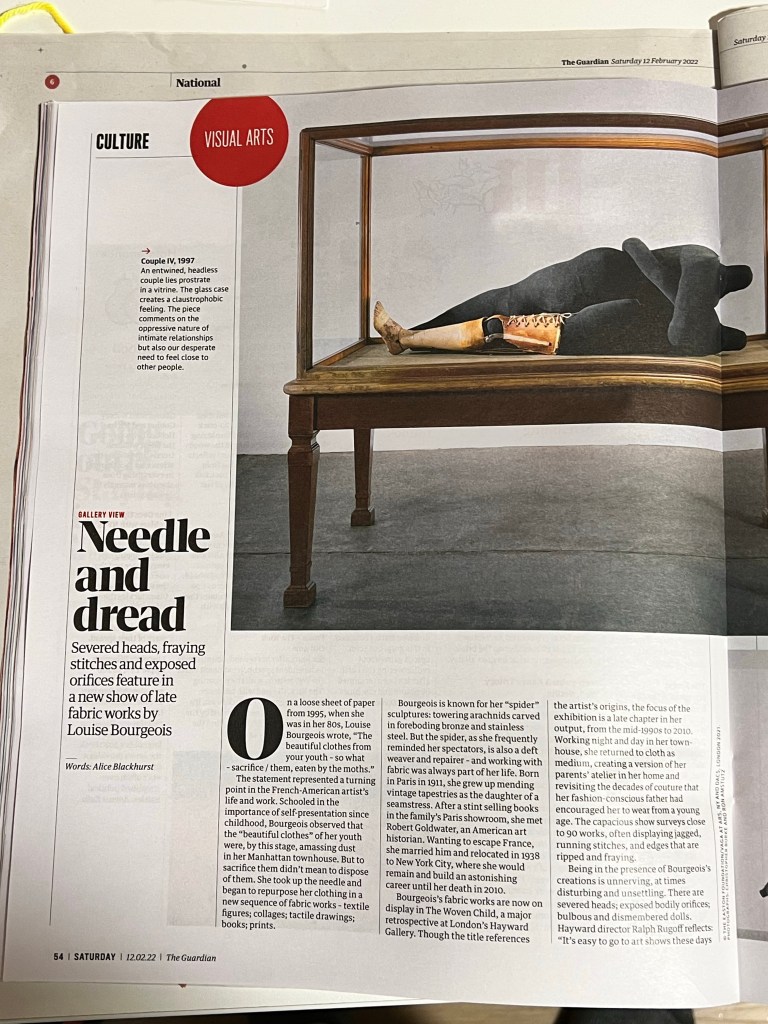
With the opening of the Exhibition Woven Child by Louise Bourgeois at the Hayward Gallery in London this week there are several articles about the show.
On-line platform maker membership (Ruth Singer)
This week I also joined Ruth Singer online platform Maker Membership “for textile makers who want to be inspired, creative, imaginative and making work with meaning” It is a research, idea-generation and finding your own voice in creative making, it is not a taught course or workshop, there is a monthly series of prompts, ideas, techniques, tips, suggestions with much more focus on the meaning behind the work, Ruth guides participants through the way she researches new projects, develop ideas, test and trial things and refine her finished work to be uniquely hers. This is a huge difference from other textile platforms that I joined as fact finding missions, the participants are all involved in their own practices and areas of speciality. I viewed the previous zoom meeting as it had been recorded and this group crit scenario was refreshing, sharing of ideas with hints and suggestions given, unlike Textile.org, where you are given a materials list, and you follow the tutor exactly in the chosen activity without much room for creativity, and possibly this is the fundamental difference between these two platforms, the absence of research in the latter lending itself more to dare I say ‘woman’s work’ cross stitch patterns, samplers that follow the pattern and dare not veer from that, I even found the commentator’s both men, on Textiles.org condescending, you were not allowed to enter any part of the site until you had watched all of the annoying instruction videos as if I was not intelligent enough to find my own way around. I have discussed this further on the main page. I have ordered the Criminal quilts book from Ruth Singer.
Seminar on Visual Research
This week we had a seminar on Visualising Research, what I found really interesting and fired up about from this seminar was that I can totally relate to this, can research be visualised? material exploration, testing through making. Art based research stages of visualising the research, ON, IN, FOR, past, present and future respectively.
How far can just visual research be done without written material, labels, explanations, rational, contextualising the research with visuals. Creating time management visual plan?
What Methods, drawing, diagrams, pieces.
Contribution to culture not science, how would we articulate the reflection, could this also be done with visuals. I used to produce mood boards such as they use in fashion but these always were verbally explained? For me my methods within my practice lead to material thinking then further research of materials, con this constitute research as in depth as a science paper, would it also need a co existing written explanation?
My Initial thesis question:
How can visual art research methods heal the reactions to memories of childhood trauma?
This is evolving as I research my interest in this area, what works what doesn’t, initially I felt that my area of research would be predominantly trauma led, however within the process of this module, I am less interested in theories around trauma, more interested in how having faced traumatic events as a child young person, I respond emotionally within my responses to the events that had a profound traumatic effect on me, but shaped the differences in the way i see the world, I now celebrate those differences, my artwork practice continues to be an emotional response, it is a guttural response to the memory of the event, it ebbs and flows through my psyche. at its worst its an overwhelming insecurity that tells me i am not good enough, its a knot in the stomach, a sickening bile that raises to the mouth, at these times I can draw it into the practice to fuel the emotive, or I can suppress it back to the shadows until I feel brave enough to open the lid again.
Ty Pawb critique of current ideas from research exploration of current papers in academic papers.
I shared my printing experiments and how I had been angry at the paper I had chosen, I felt that nothing had changed, I have discussed this on the page. I stated that I am planning to explore this module using textile techniques. The piece above is an image of myself with my mother’s knitting. Gender manipulation or affirmation?
Continuing with the theme of research, I found the earlier workshop on Practice, what is practice, made me question pre conceived ideas, actively listening to arguments for and against what constitutes practice, is it just a new word for work? It made me really think about my own use of the word practice, what does this mean, what does it mean to me? After my academic tutorial, I made notes of what had been discussed and it helped me to contextualise my practice, such as, Why Artist not Arts for health, my use of material thinking, tactile, visual research, my idea to use fabric for my poster, at this point. Making by thinking by pushing boundaries.
This week we looked at these themes and explored the differences that I have commented on my main page for this module creative research methods.
Research into art and design Research through art and design Research for art and design
Statement of intent workshop in the afternoon, we discussed as a group what needs to be included, the format for this and then discussed it in small groups, we were then given 20 minutes to write out statement.
Statement of Intent
‘How can visual art heal memories of childhood trauma?’
My reason to explore this area is that it is a personal journey. I aim to research through practice; the act of making as a reaction to the emotional response to the memory of the actual trauma.
I aim to work with Wrexham Glyndwr University’s Psychology unit looking at Trauma in childhood, I feel that my input into this project could add a different dimension, trauma explored through visual art, and I am interested to find out what comes from working together in this area.
I will explore how do other artists convey their emotional experiences of trauma. Through material thinking, tactile / visual research, my intention for this module is to produce a body of work consisting of dolls, prints, drawings, using this physical research methods ‘through’ the act of making art, printing techniques on to fabric, ceramic investigation, stitch and embroidery techniques, the use of sketchbook and mind maps, to embellish and communicate a narrative within the body of work. Reflective writing through the act of making.
I plan to put together an A1 piece of cloth as a research poster presentation, this will be stitched and printed and will encompass elements of hidden research findings and information in the way of pockets/slits, 3D elements.
Using my blog platform, I plan to document my findings, new knowledge as well as, literature reviews, context reviews, visiting exhibitions/talks that are relevant to my practice, attending planned talk by artist Claire Curneen, meeting with researchers at the trauma unit, establishing ethical boundaries. Joining two online Maker’s platforms, Ruth Singer of Criminal Quilts and Textiles.org.
I was not sure if I had to produce completely new work or if I could continue with the body of work that I have already started? I was informed that I can continue with the body of work as well as new work.
Reflective Models
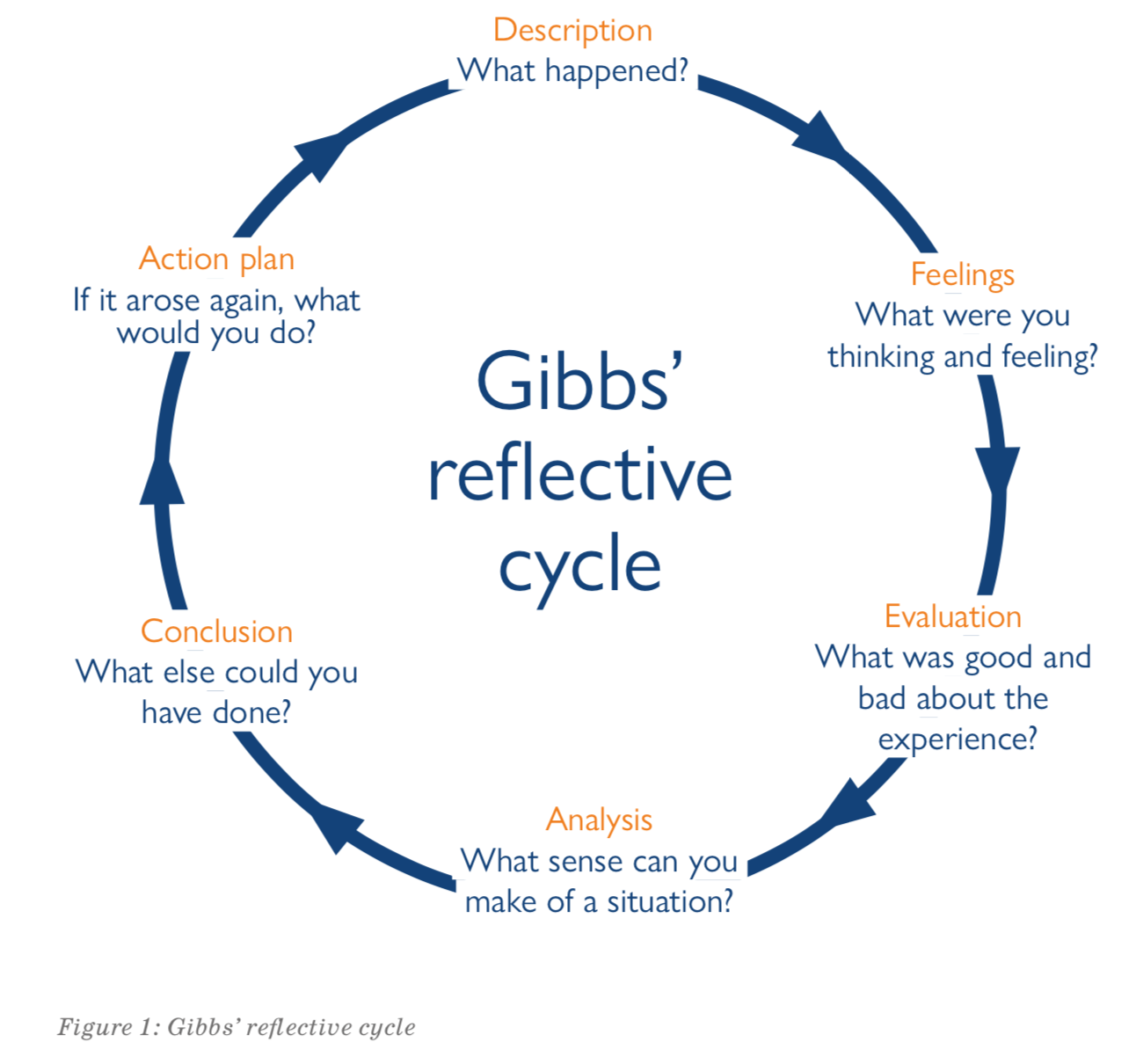
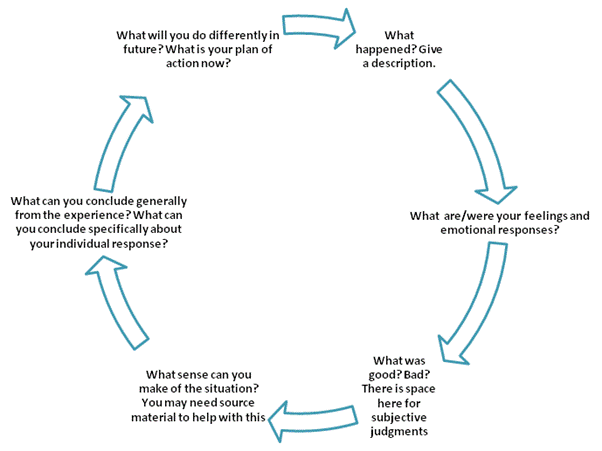
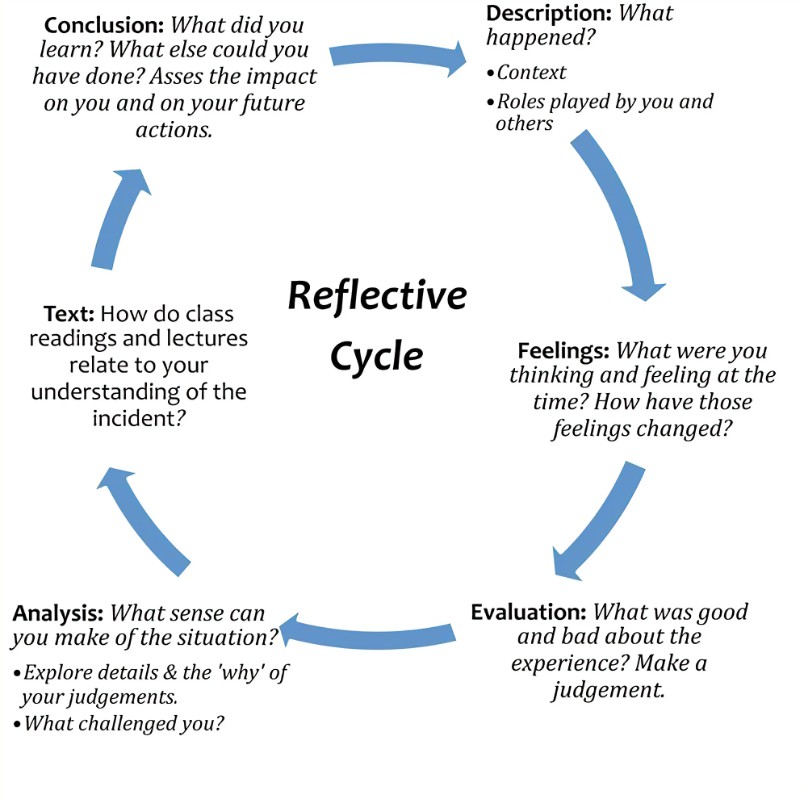
Group crit with Matthew Davies we discussed reflective modules, how could I use these models to reflect on my practice. I found that a combination of different models serves my methodology better than just one model, being able to ask myself what, so what, now what. these theories vary in their complexities but essentially enable the reflexion of learning in an activity with the emphasis on learning.
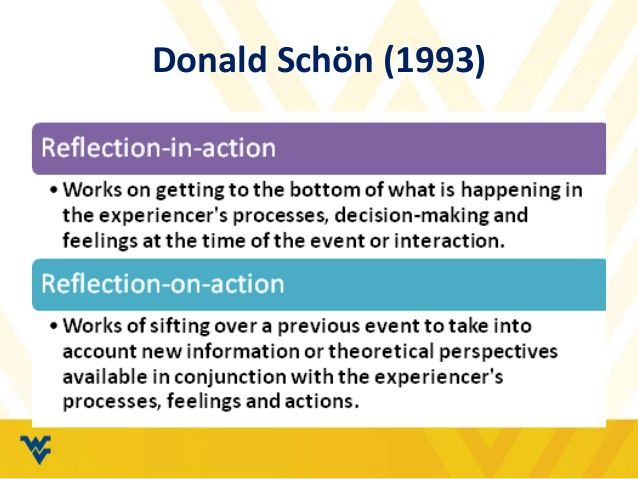
I find Schön’s reflective cycle below extremely relevant in the reflection of traumatic events for me, reflection in action, how I feel in the here and now, reflection on action after the event has happened and how these are different.
This is a Gibbs reflective model, having looked at these models, I conclude that they can be a useful as a tool to apply reflection, the difficulty can be that not all reflection follows every step, and not necessarily in the order here, however it is a good model to adopt to stop, take stock, especially for me, when I tend to flit from one method to another, to the onlooker, it may seem that I am in the process of chaos, when in actual fact I am testing out new processes that trigger further exploration and this quite often involves multi media.
There are many others, they use Driscoll in nursing, I like the what, so what, now what but it is almost too simplistic.
These help to work out where I am and what I am doing.
As I have already stated, I do not work in a linear way, I start new ideas while I am currently working on other things, it is part of the same body of work just different threads.
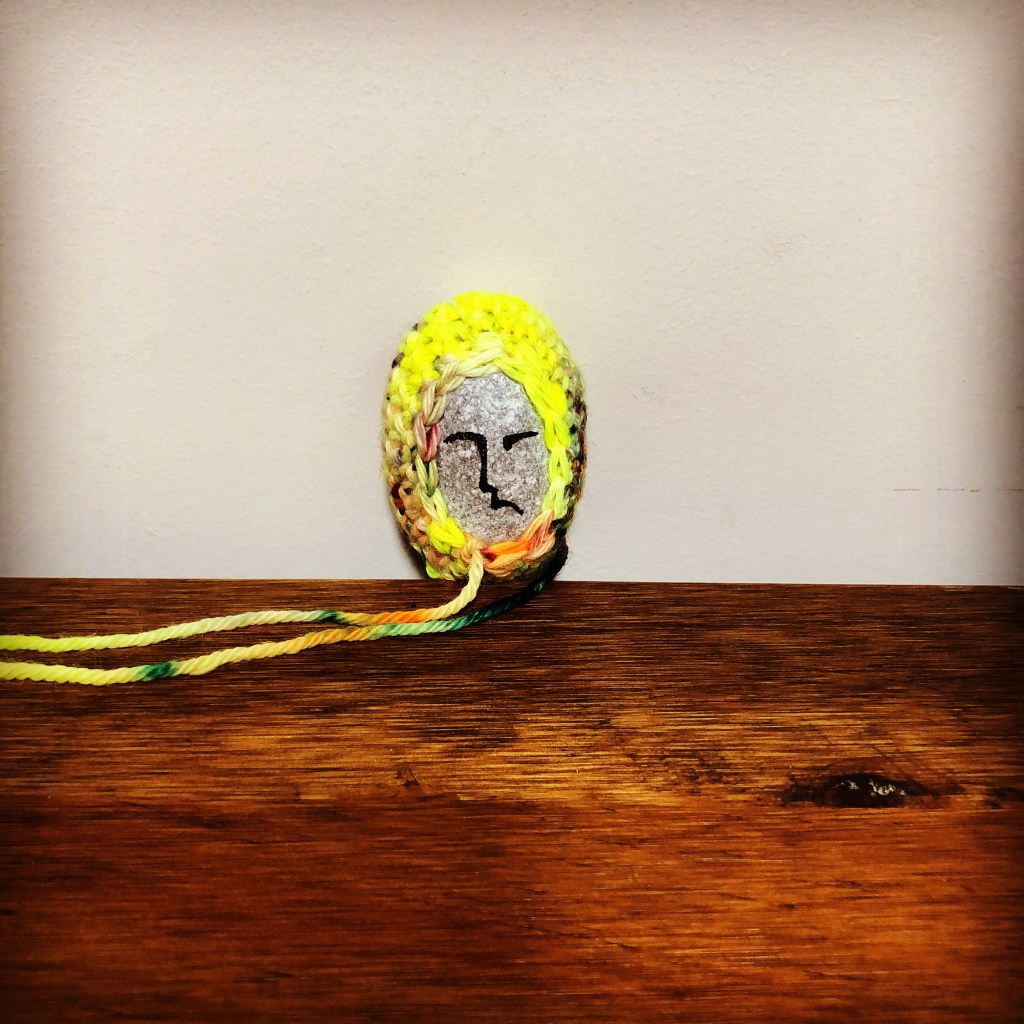
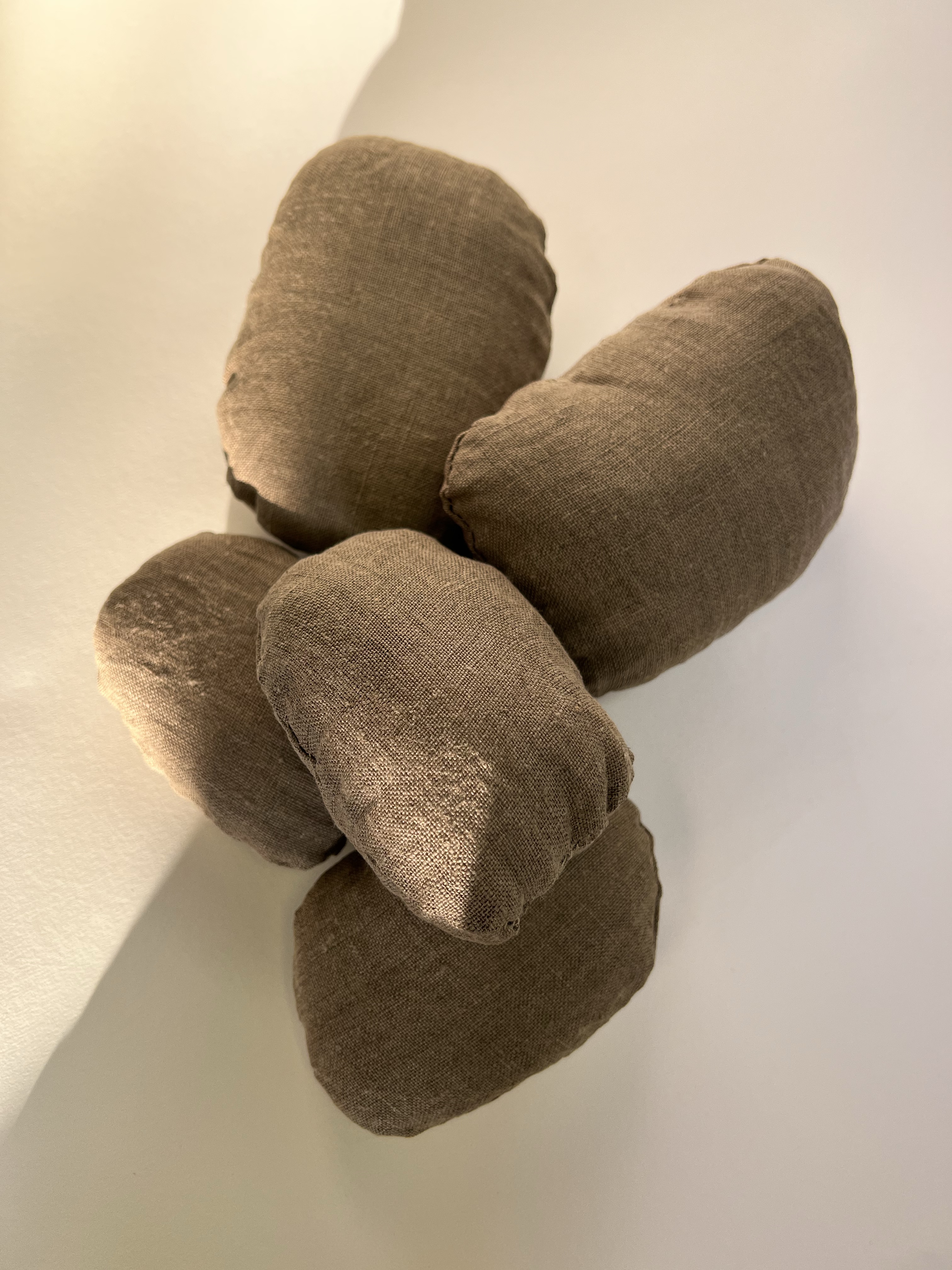
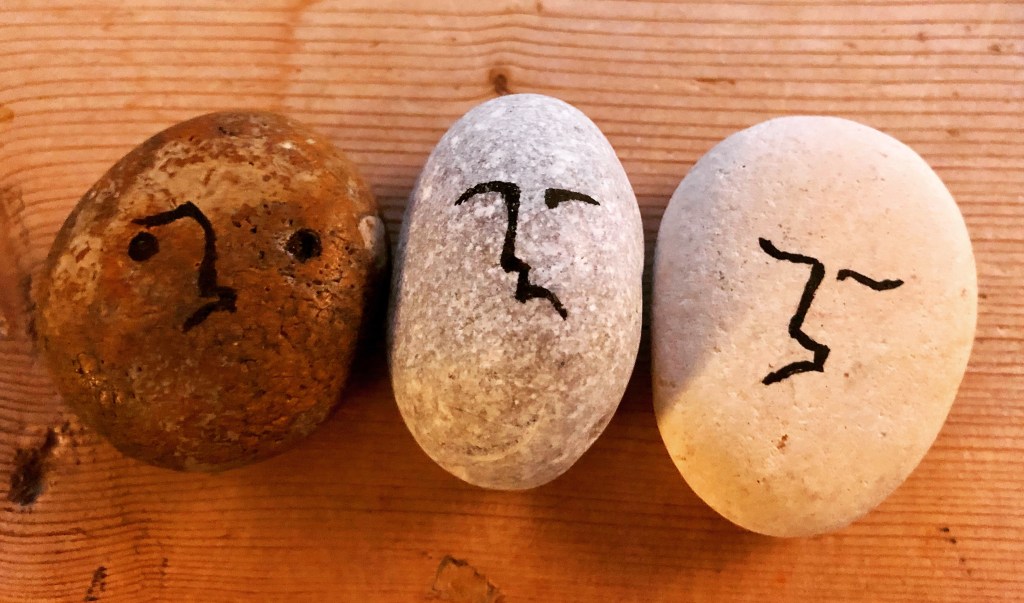
This is a drawn on stone pebble encased in wool which has been hand dyed by an artisan hand dye business, I chose this colour as it is so un-natural neon yellow exploring how encasing a natural element I.e. stone pebble in what appears to be unnatural, it’s also a contrast of hard versus soft and relates to enclosing my plastic dolls in natural wool although all of these are neutral colours.
This stone had a few holes and I could have left the drawing off, the colour of the wool here is variegated but muted and I like the contrast against this pebble.
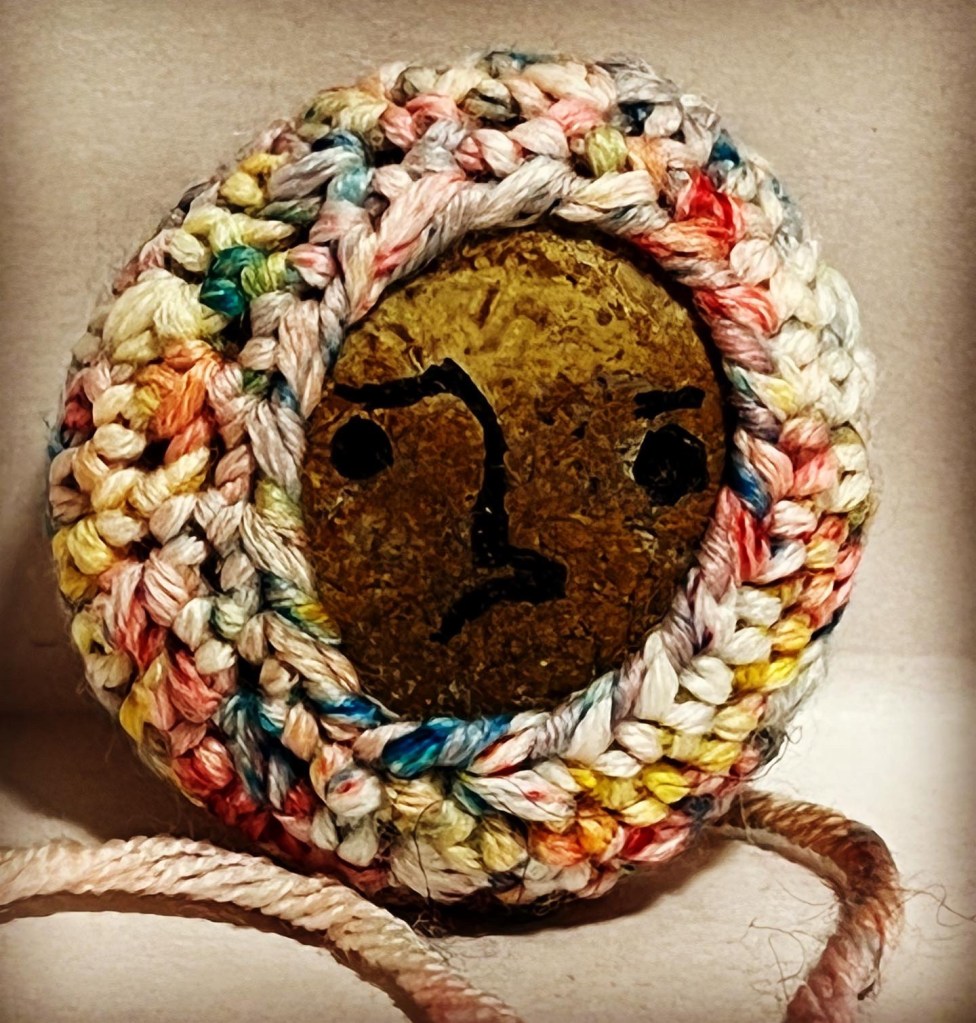
I went a little overboard here adding ears and neck but ignoring that, looking at the colour, for me it just does not work, it is too ‘candy’ ‘pretty’, I felt it was important to include this even though I do not like it at all, I feel it veers towards the are of, without being rude, home crafts? By asking why I did not like this I found out more than just dismissing it.
For me the piece has to convey my message, I find using colour difficult, in the same way I used to find drawing difficult and in this sense I hope to find my way through this! Colour has its own language, avoiding colour has its own meaning and it’s an area I am going to explore.
Having received feedback I decided to think about character, do I need to draw a face on the pebbles at all?
I put this question to followers on Instagram
I have included the screenshot of the comment although my Instagram account can be accessed from my home page. This is a recent post.
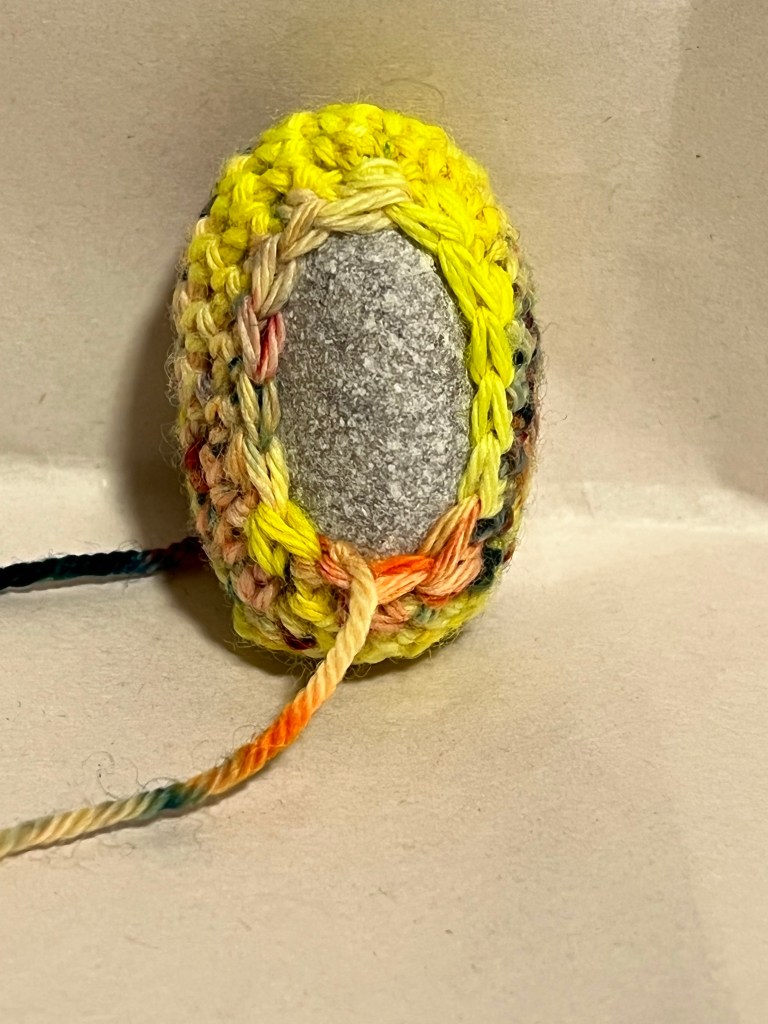
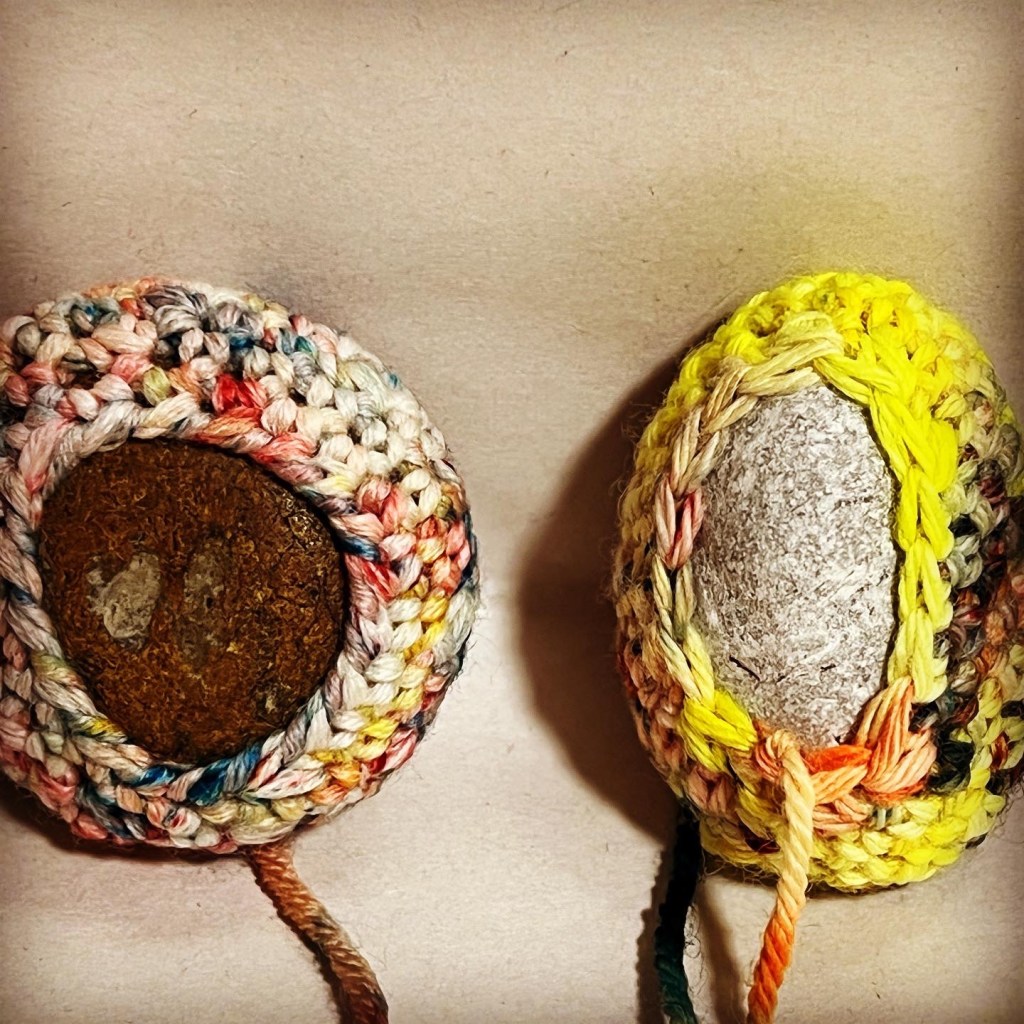
I decided to follow suggestions about finding pebbles that had texture to add emphasis of possible features but for this new piece I have used natural wool in a natural colour.
The image has a contrast of busy background, this is a sample and ideas going further are yet to be resolved.
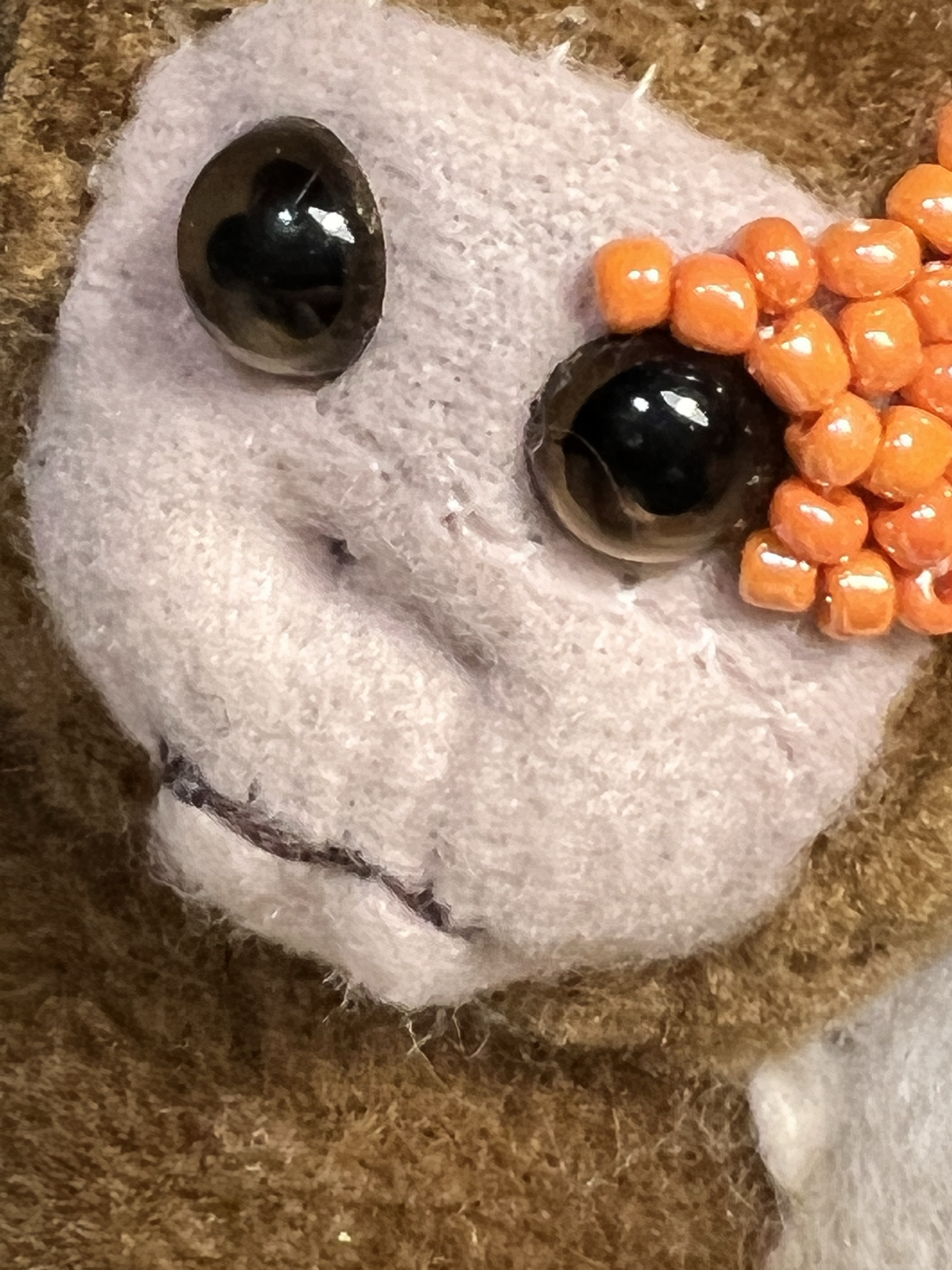
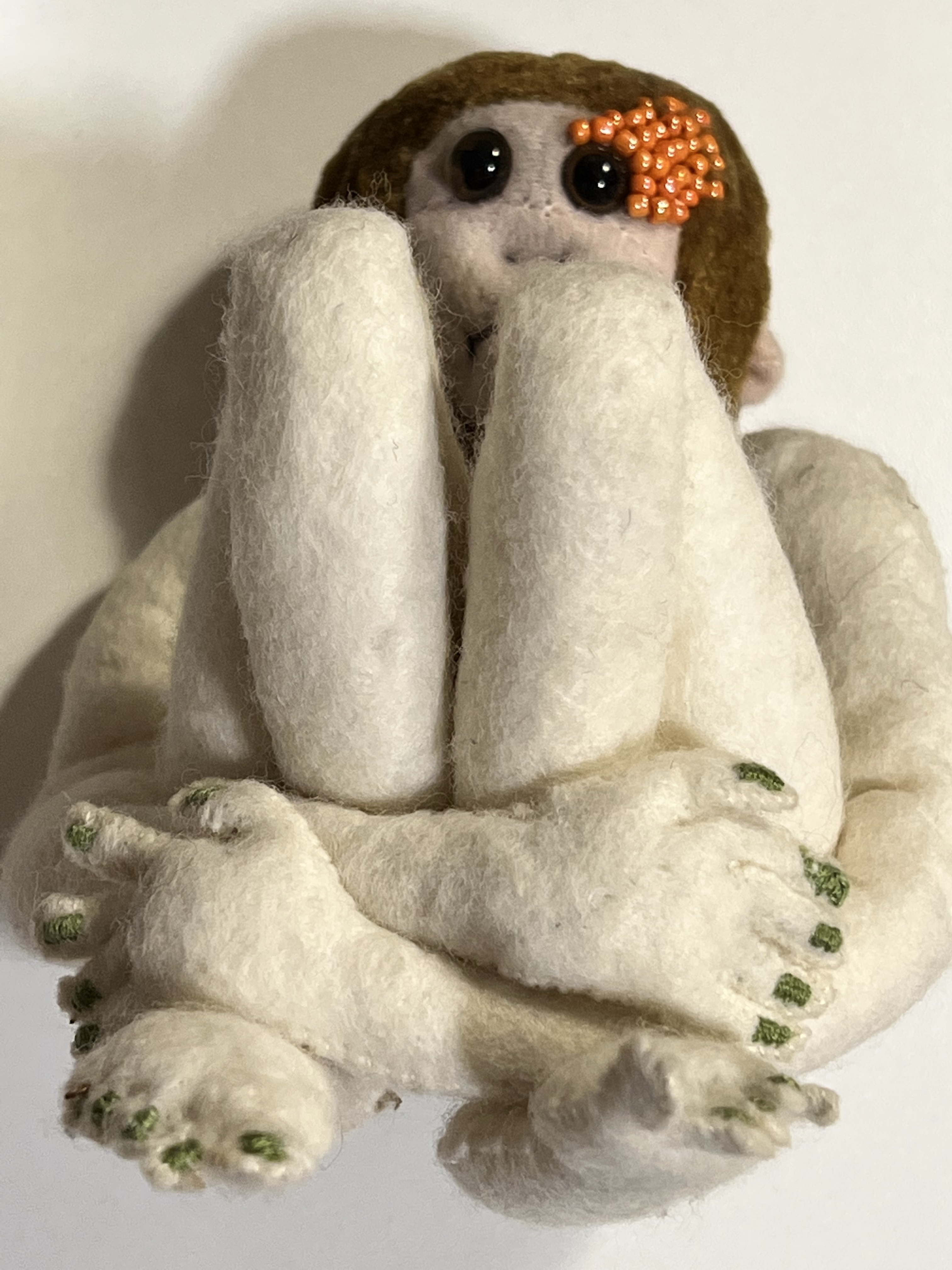
This is not a new piece “monkey” the positioning below however is new, I often use, re use old pieces of work to inform new pieces, it has always been part of my practice.
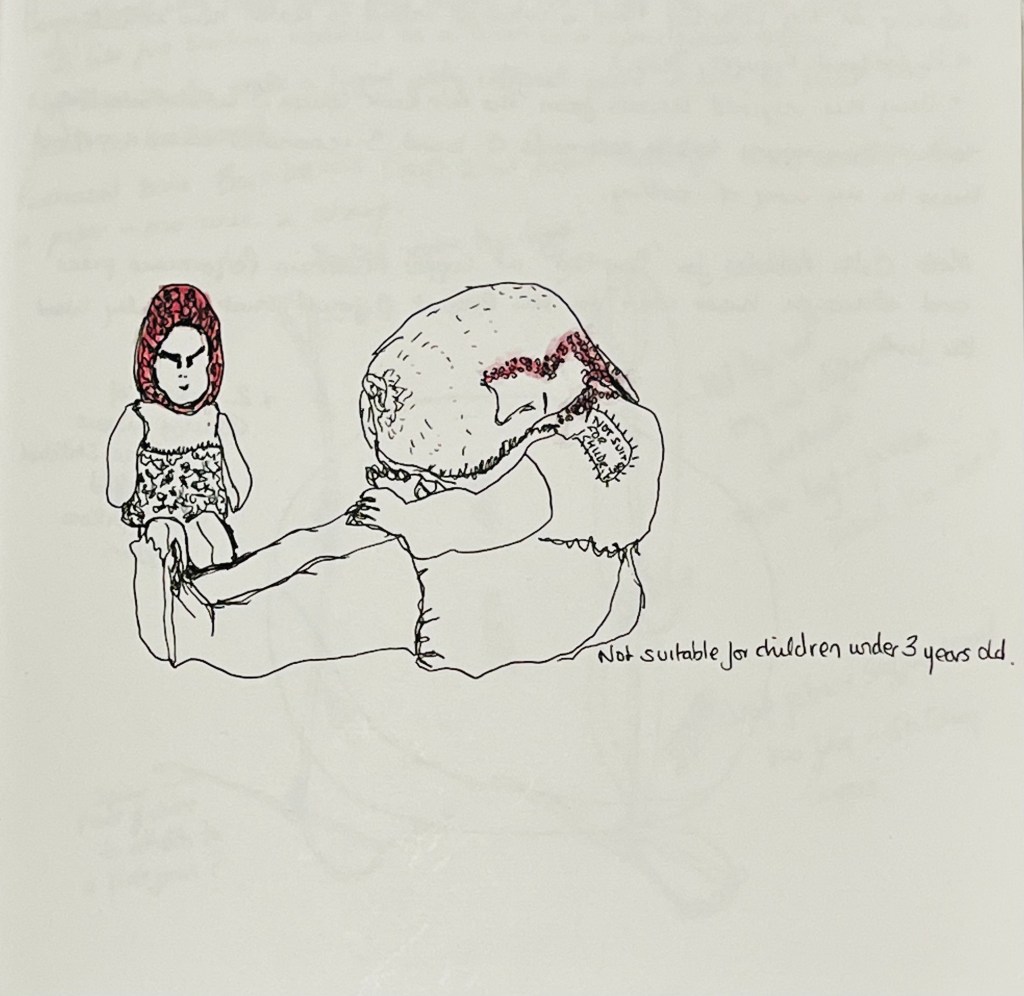
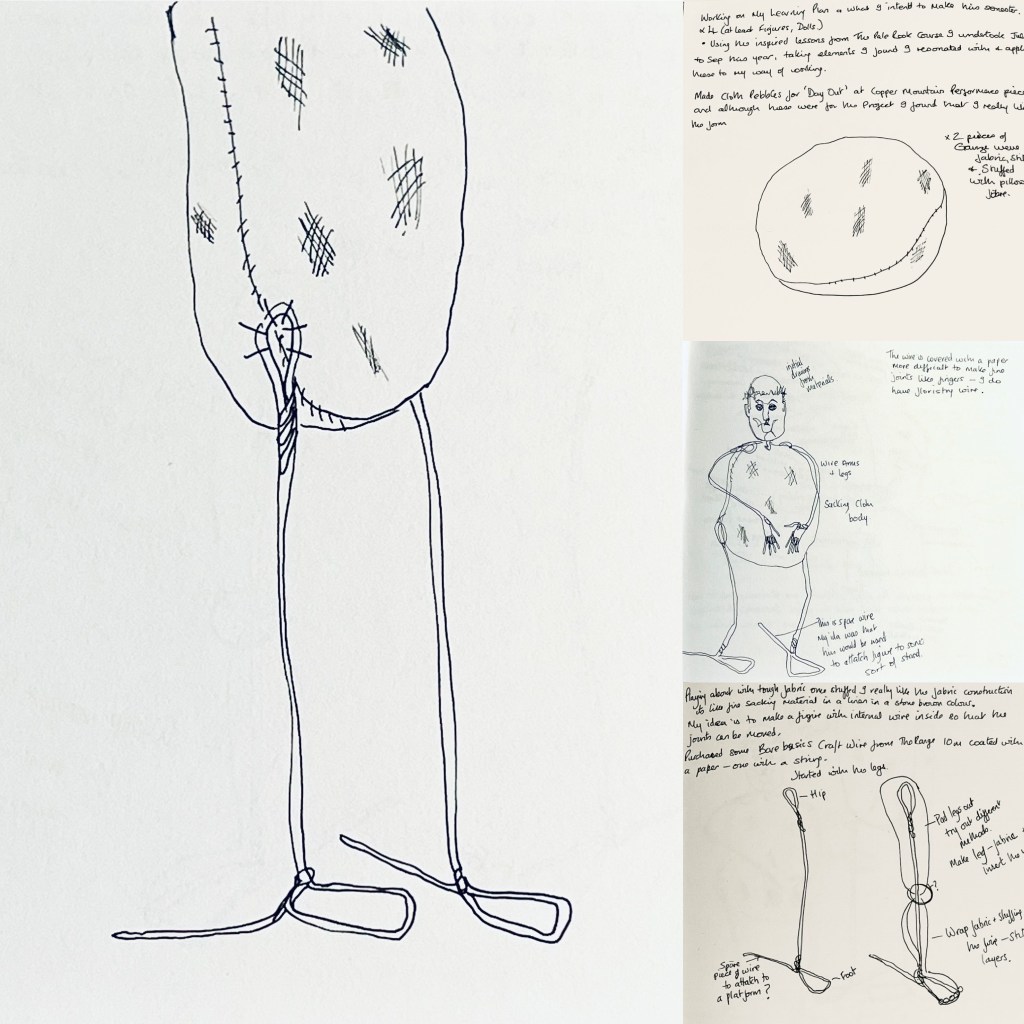
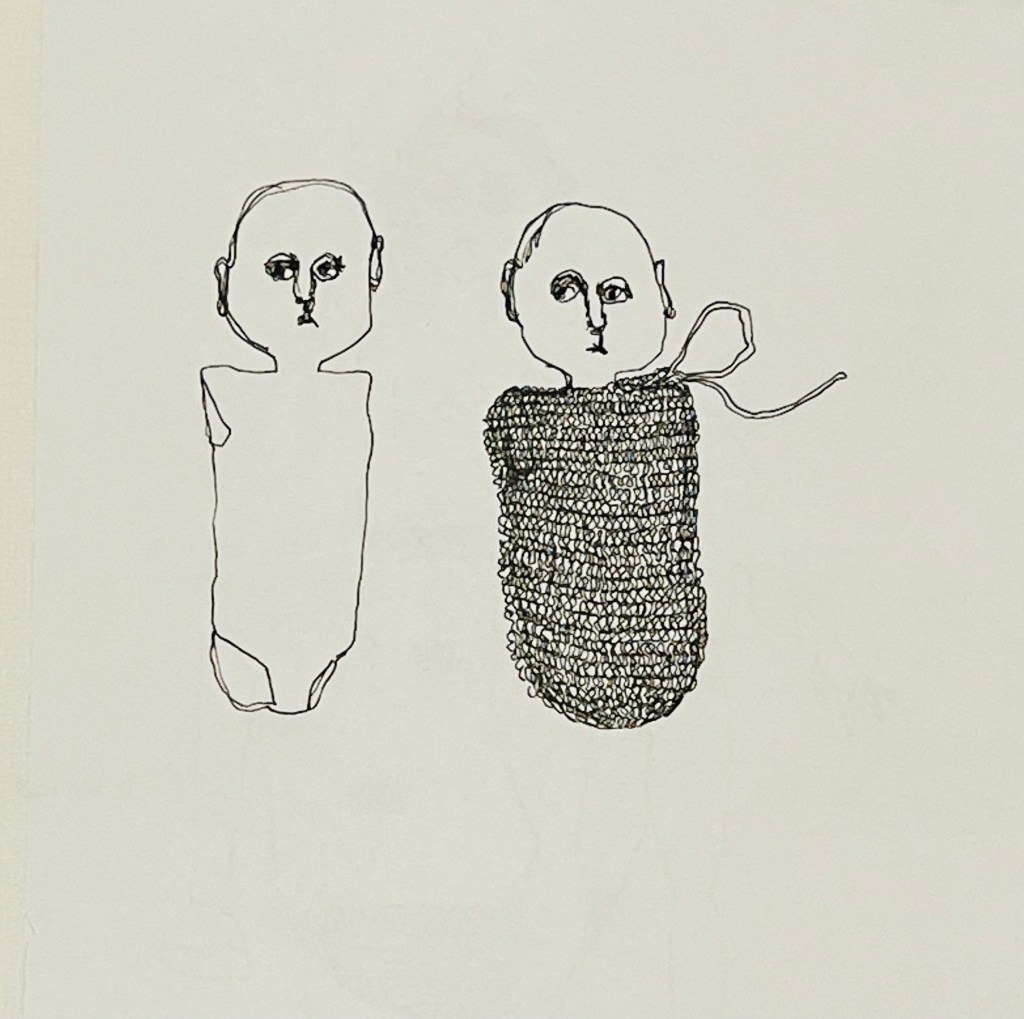
Drawing is an integral part of my practice, it’s where I draw out my ideas, progress and finished narrative.
This image is not recent but informs my practice Drawing in sketchbook of mixed media pieces depicting positioning with the caption “not suitable for children under 3 years old”Part of my practice is to draw out my ideas for my mixed media pieces
I draw my found objects, collected, thrown away toys, dolls, textiles, I choose these by way of serendipity. I see a narrative, it’s often fictitious, however I choose what I feel will convey meaning into my pieces.
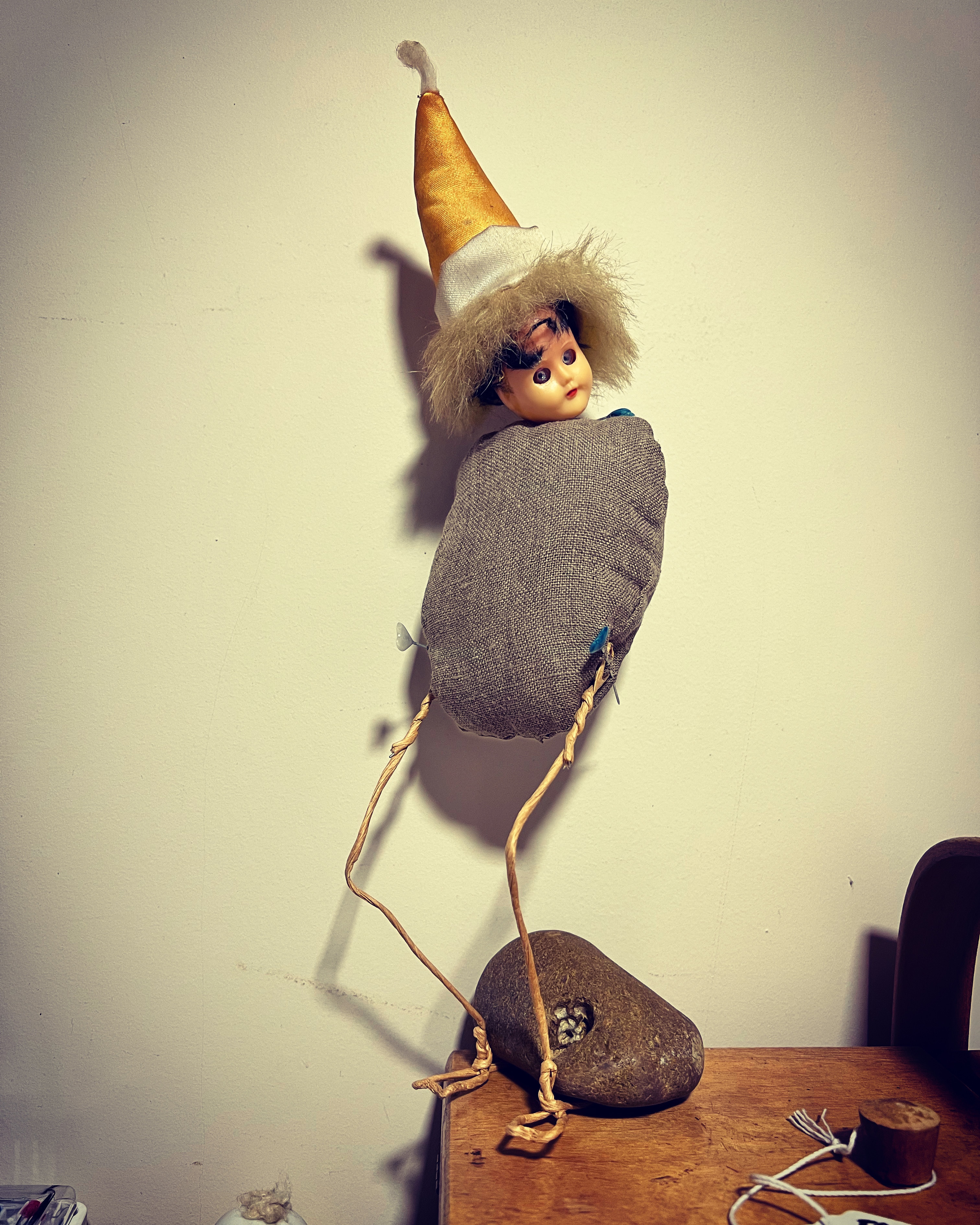
This piece started out from the stone, (on the top right hand corner) I made several of these for a performance with the Wrexham Art school on Paris Mountain in Anglesey, I kept one back. I worked on this in my sketchbook the following picture shows the result
This is the resulting experiment, I have not worked this way before, from scratch be that it was not intentional. This piece is not yet resolved.
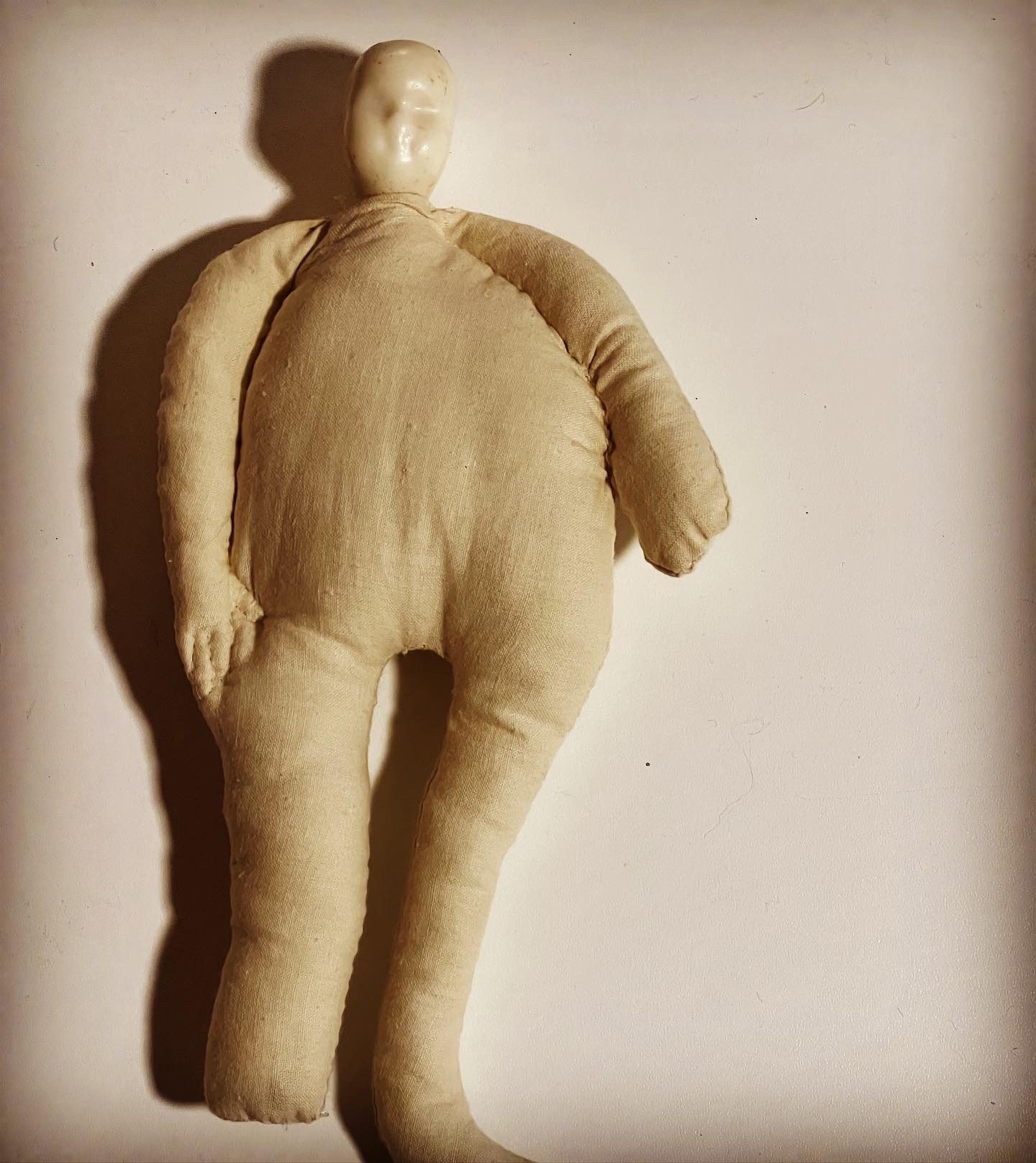
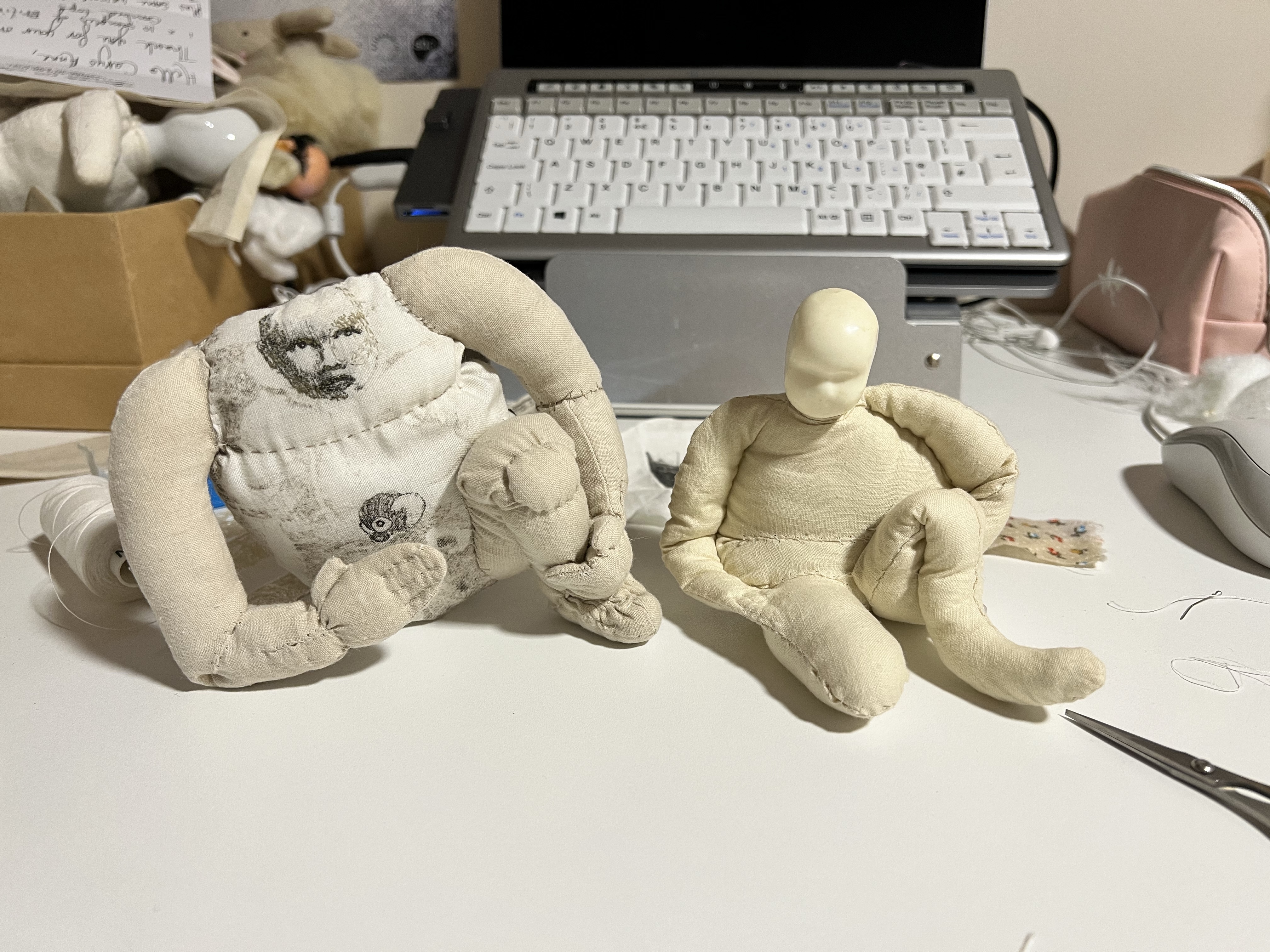
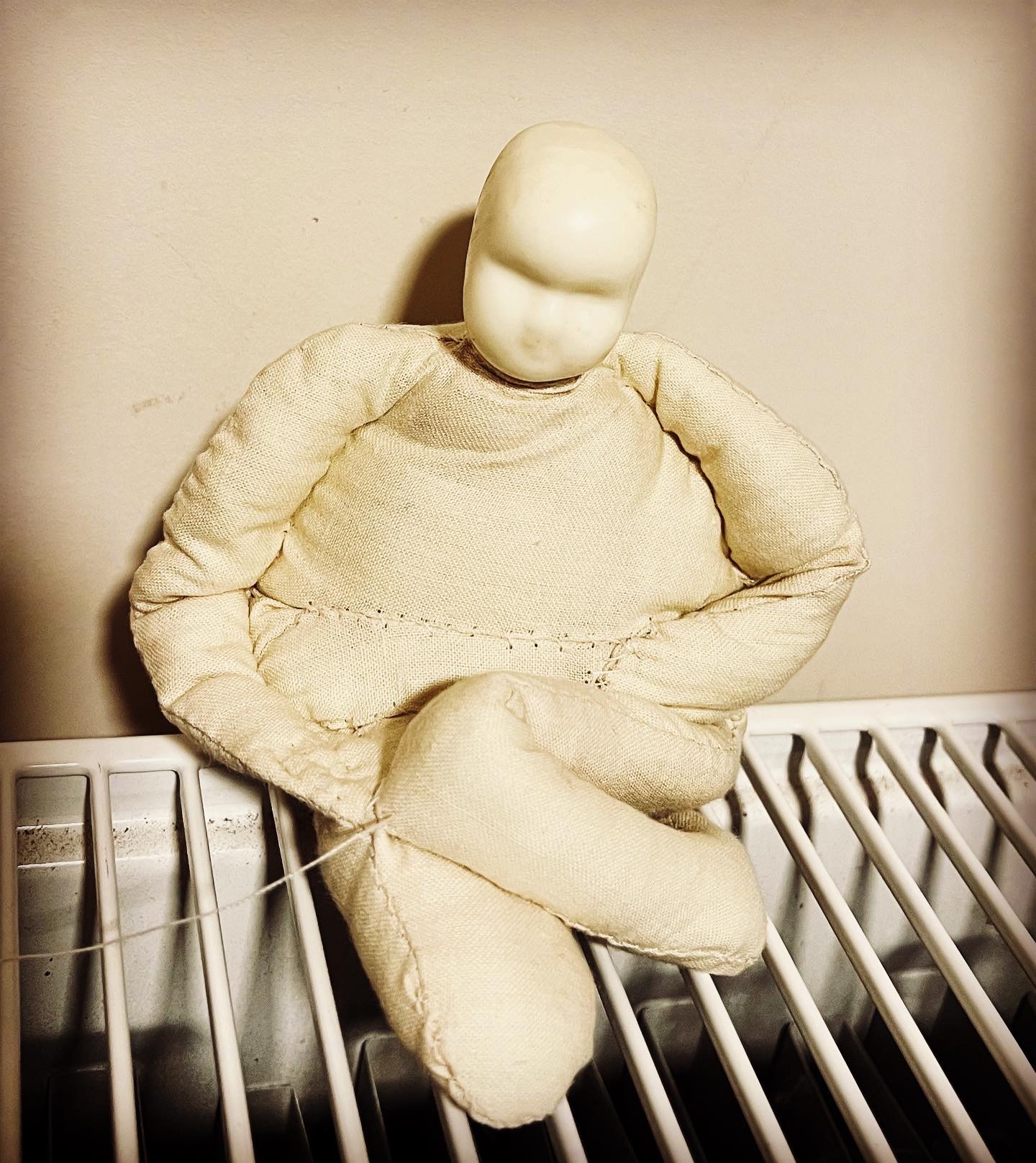
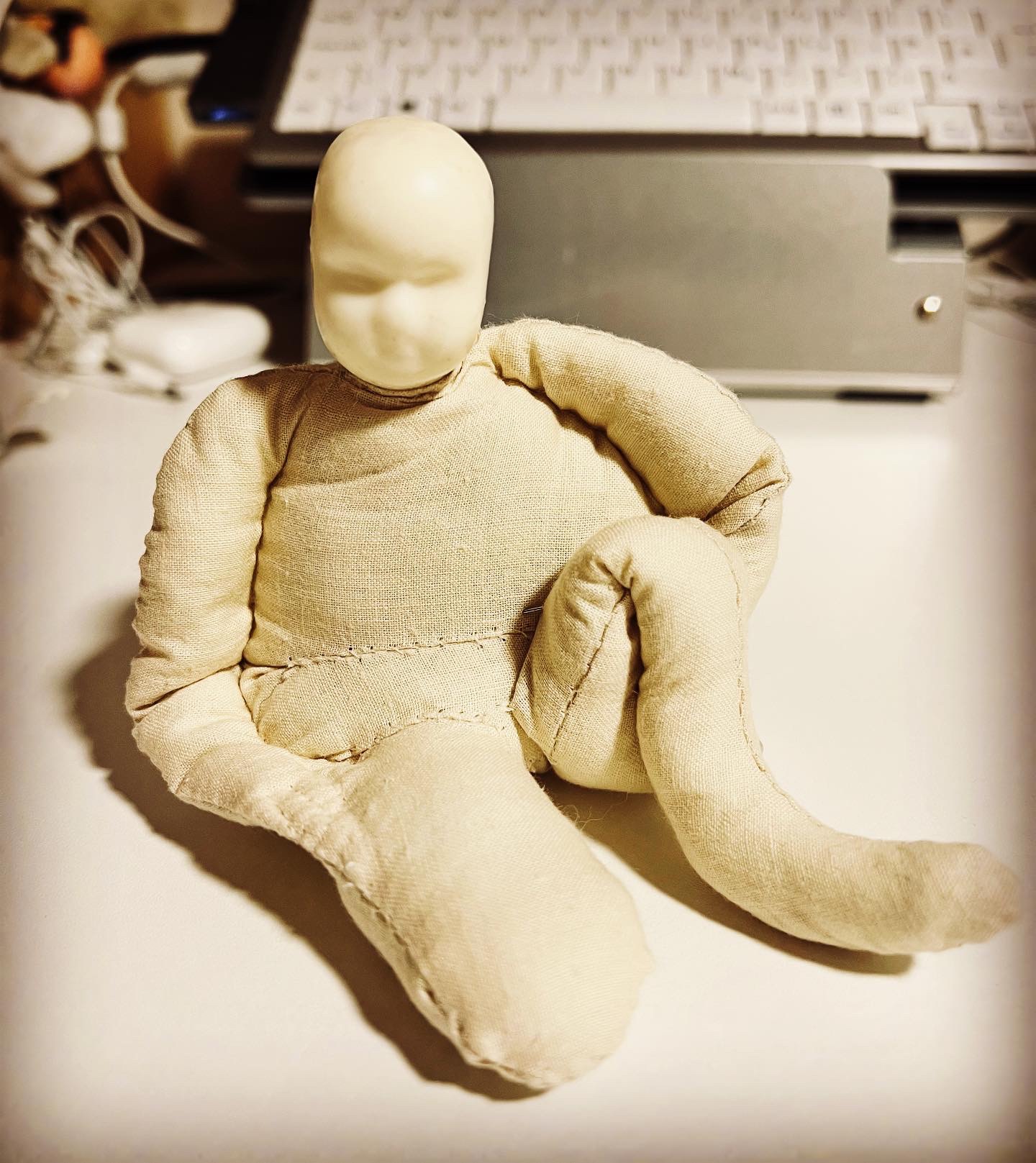
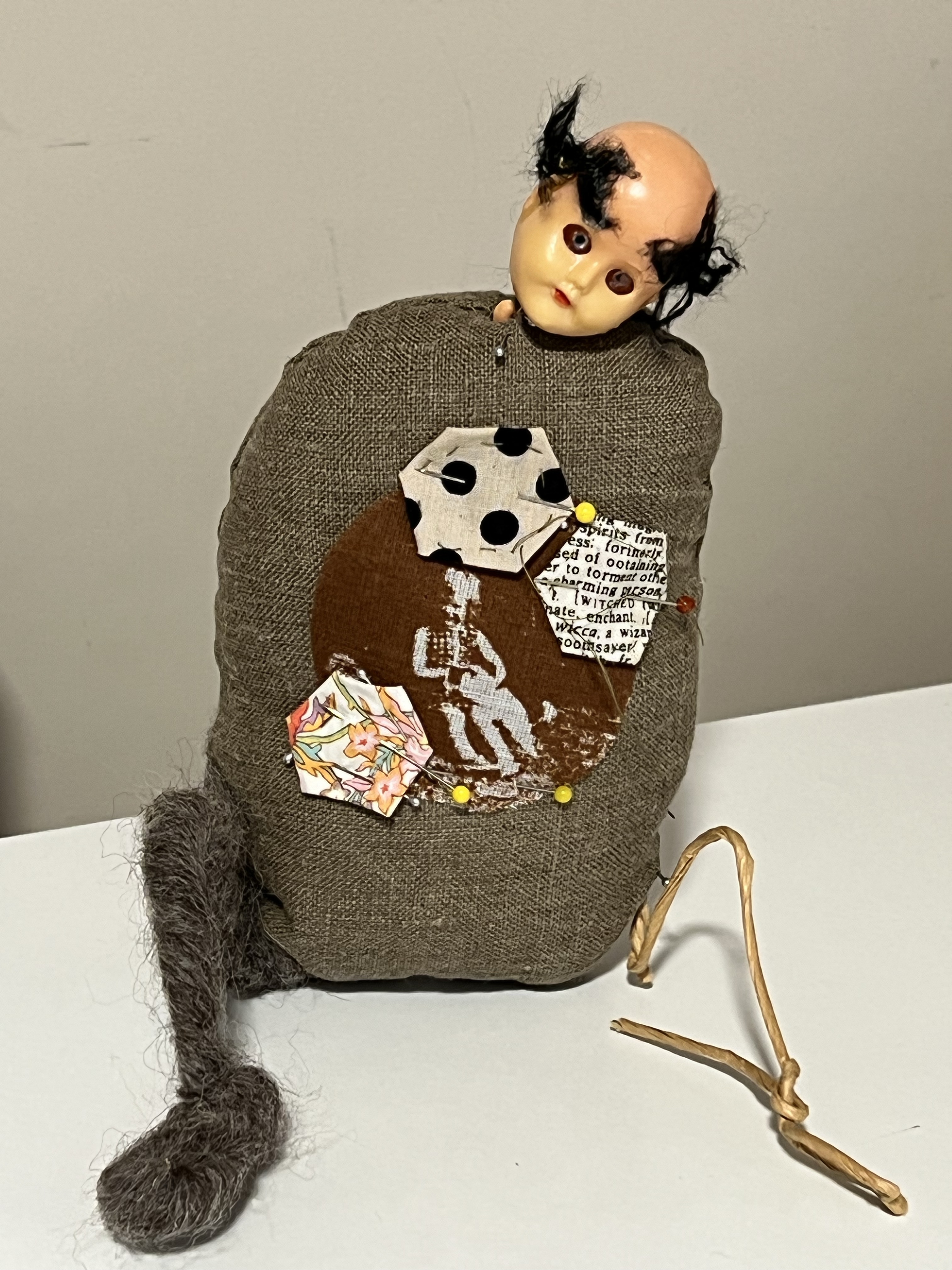
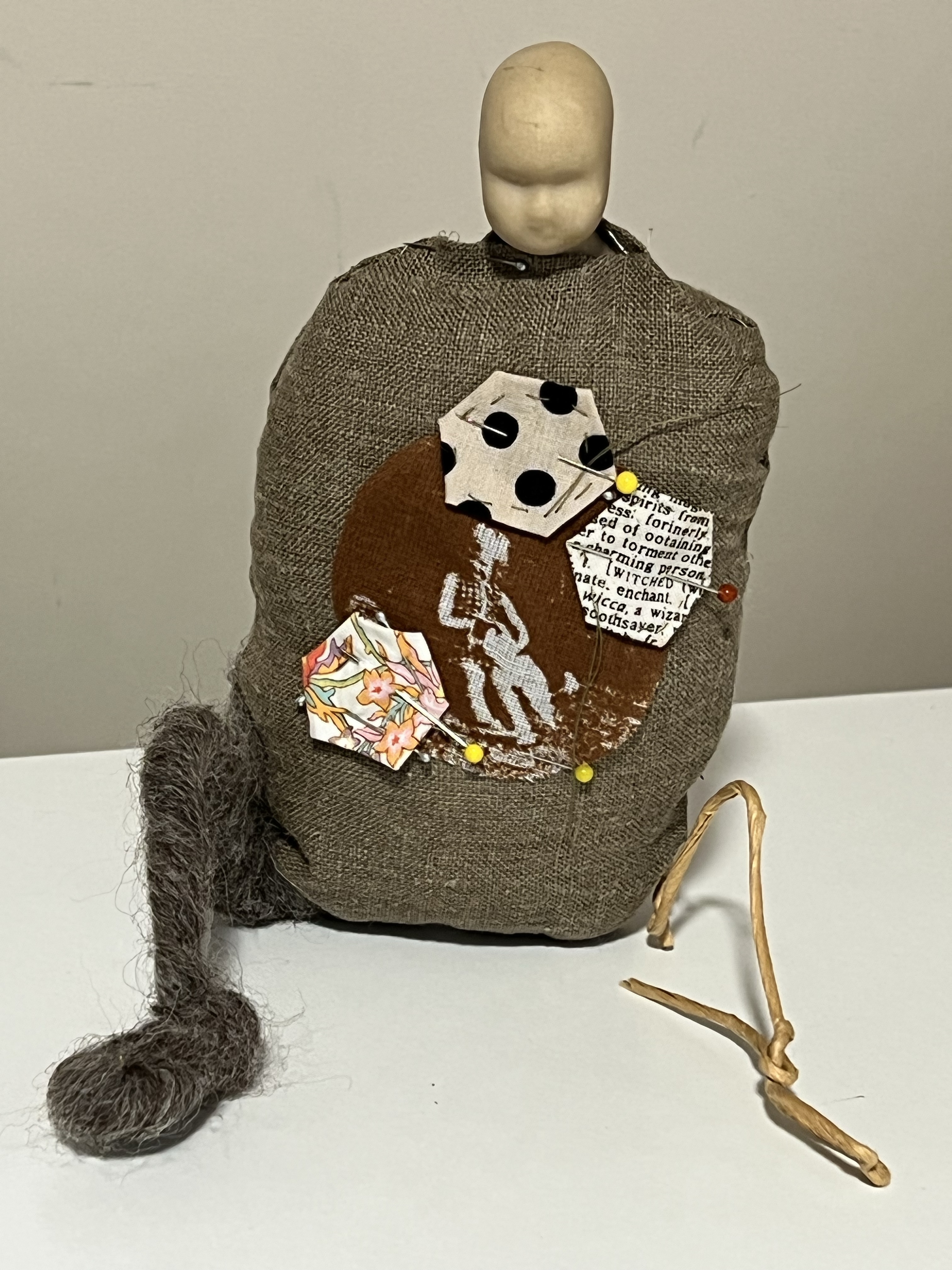
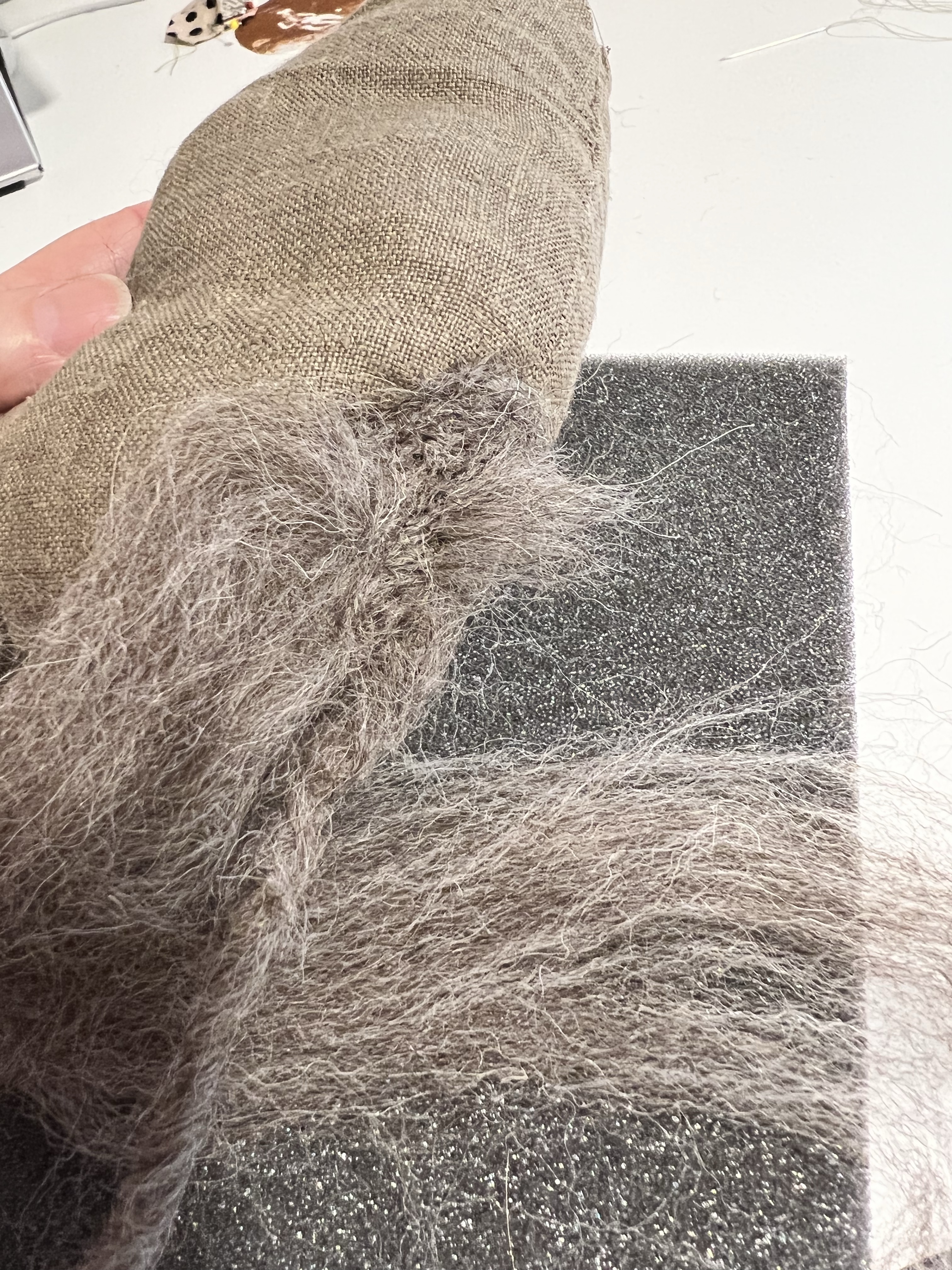
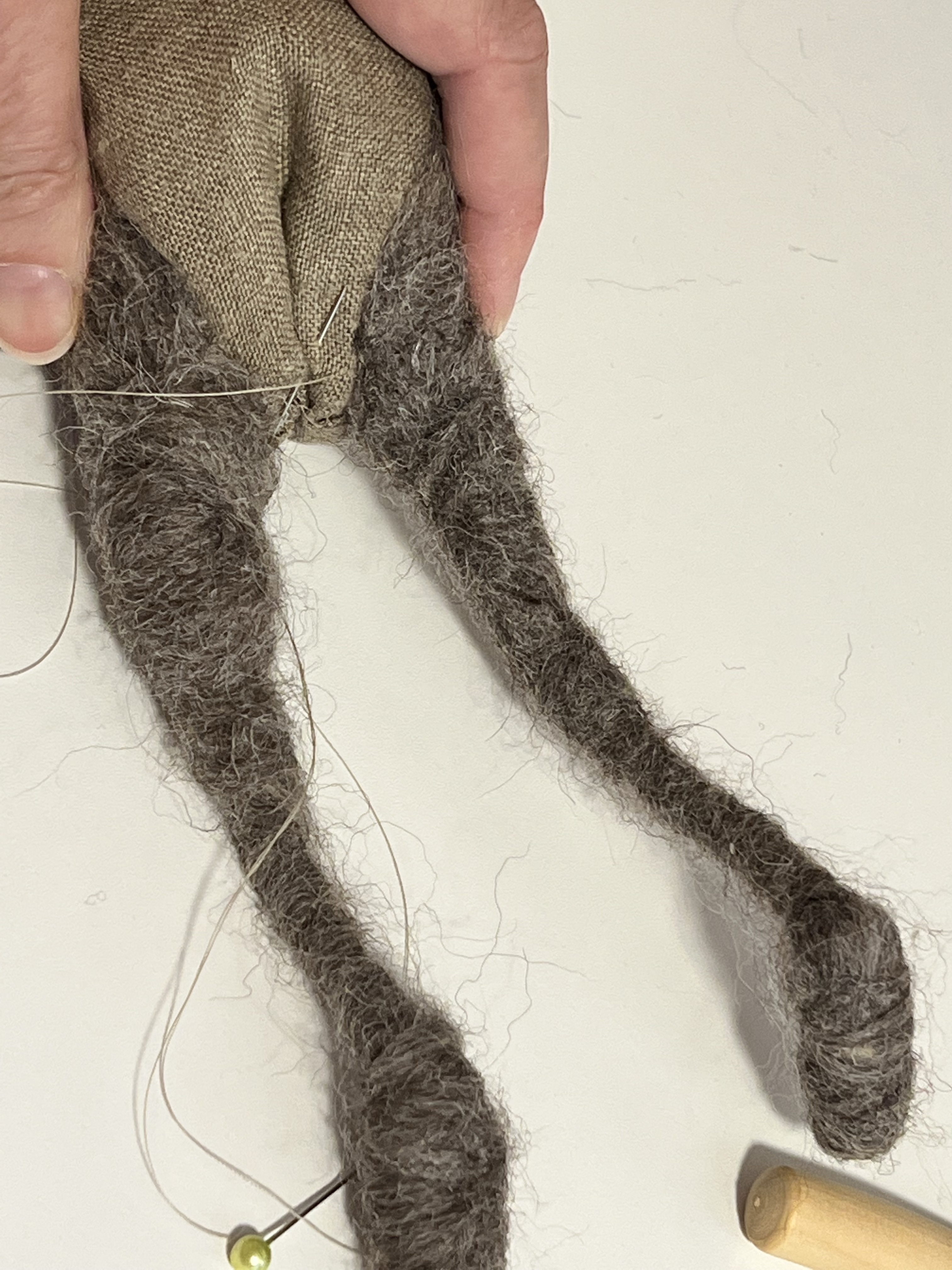
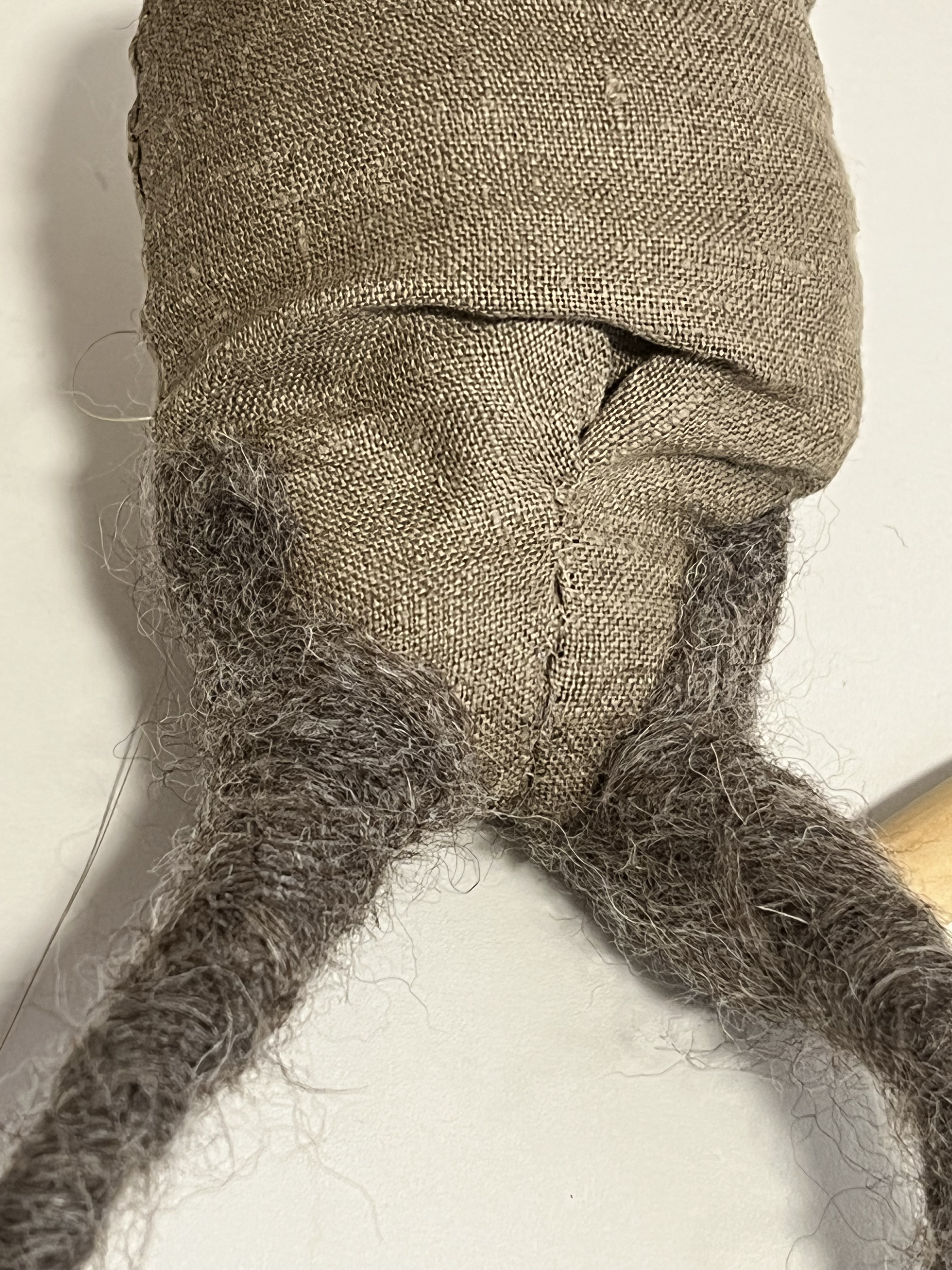
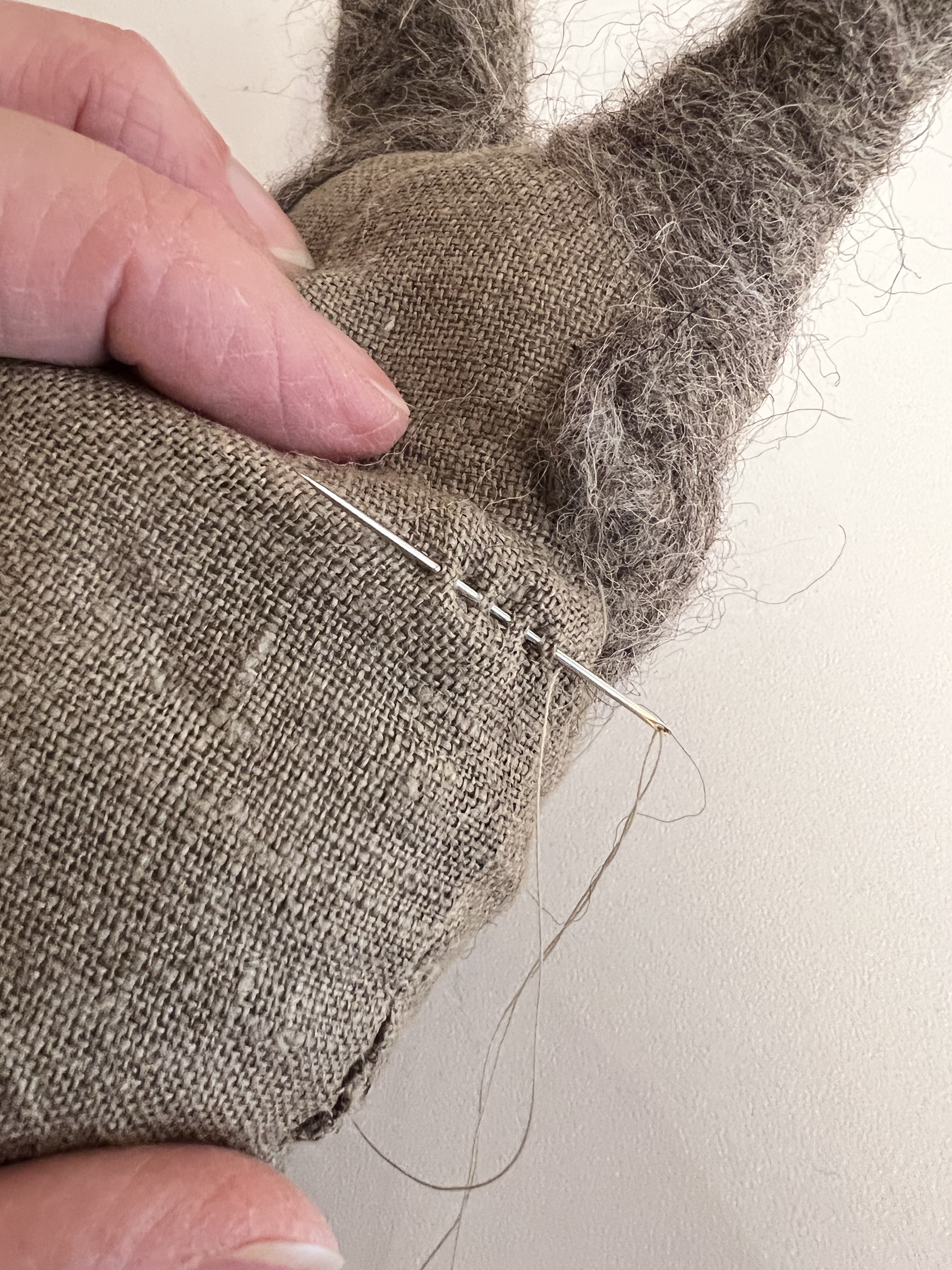
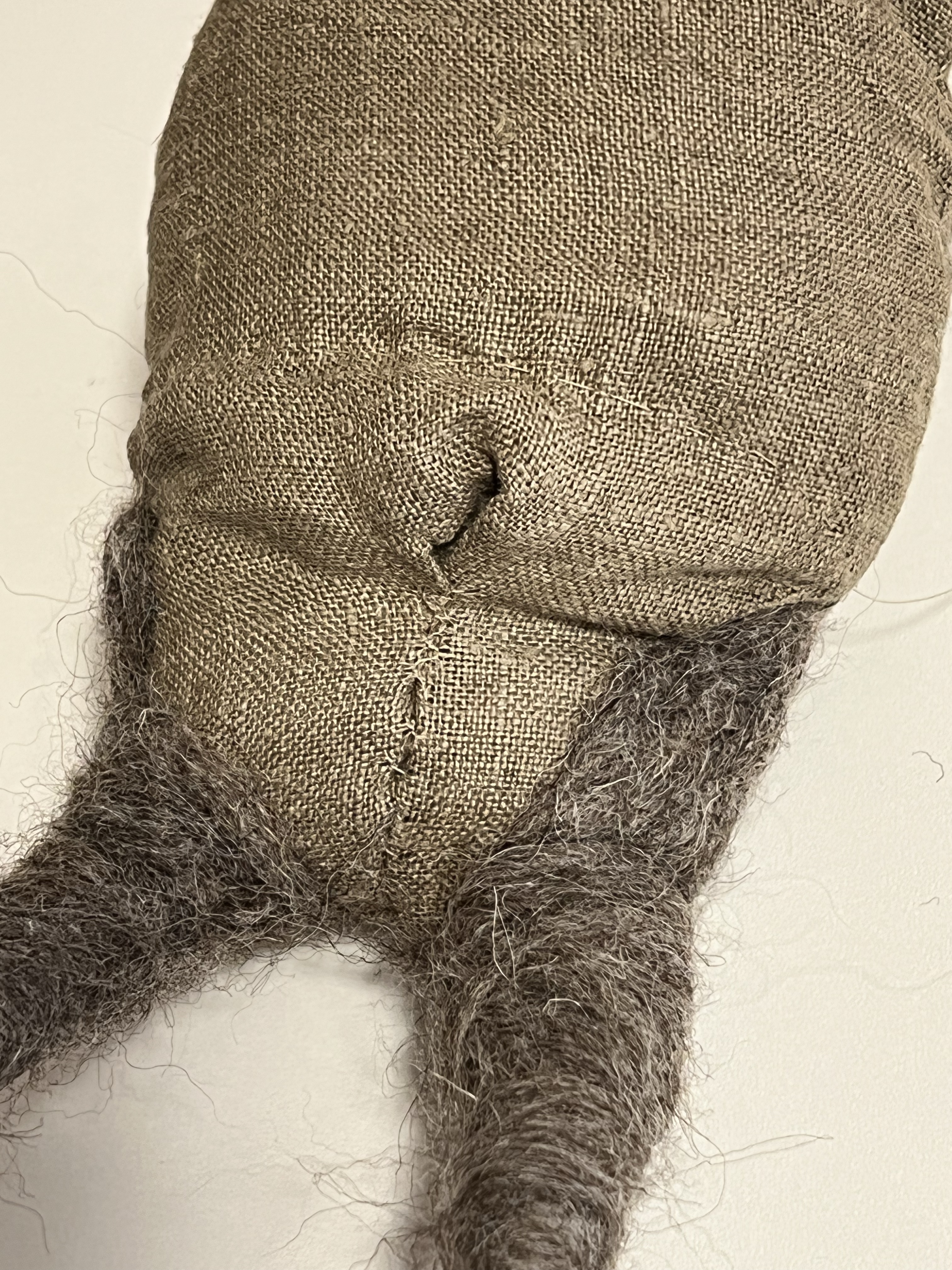
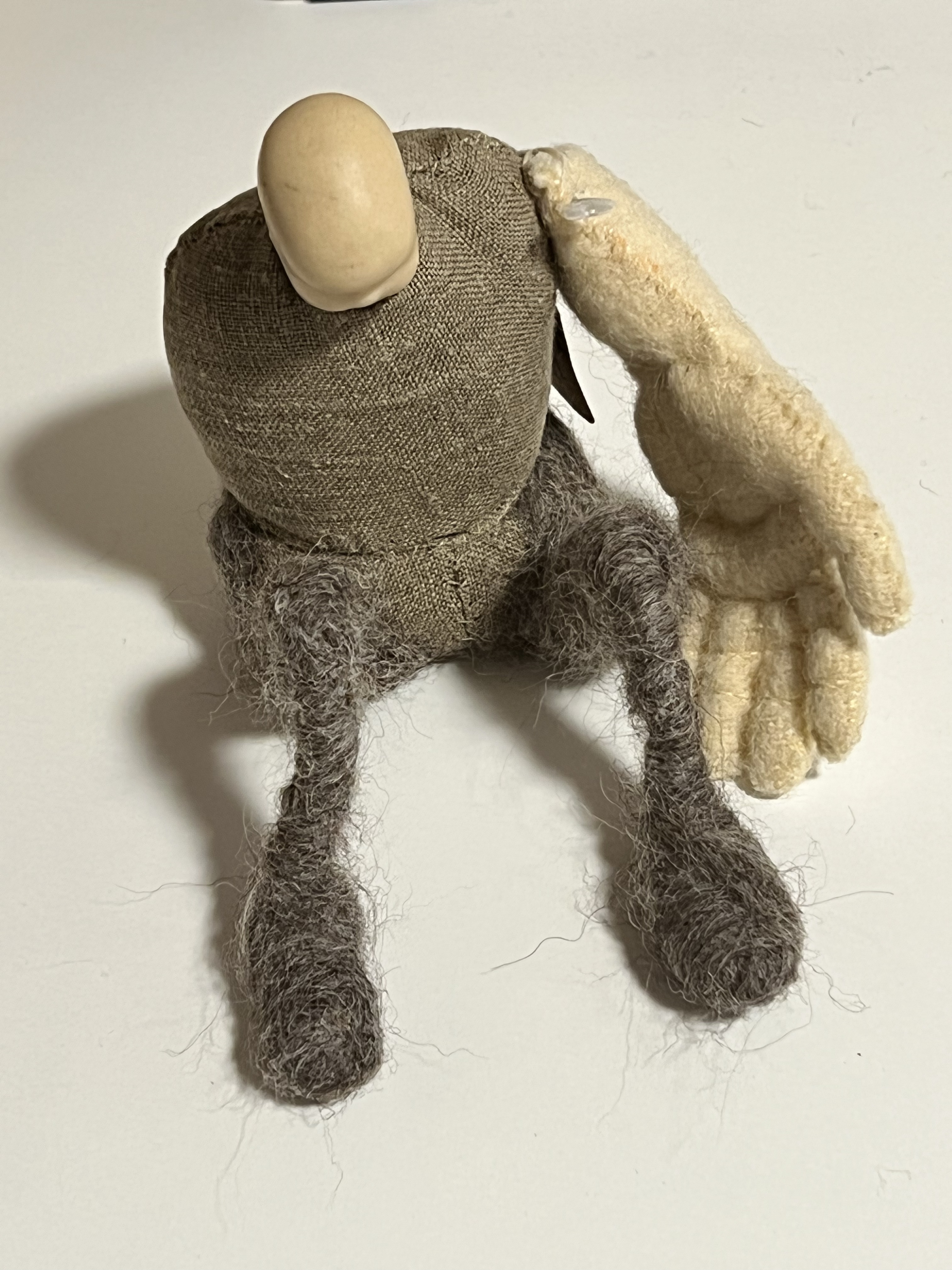
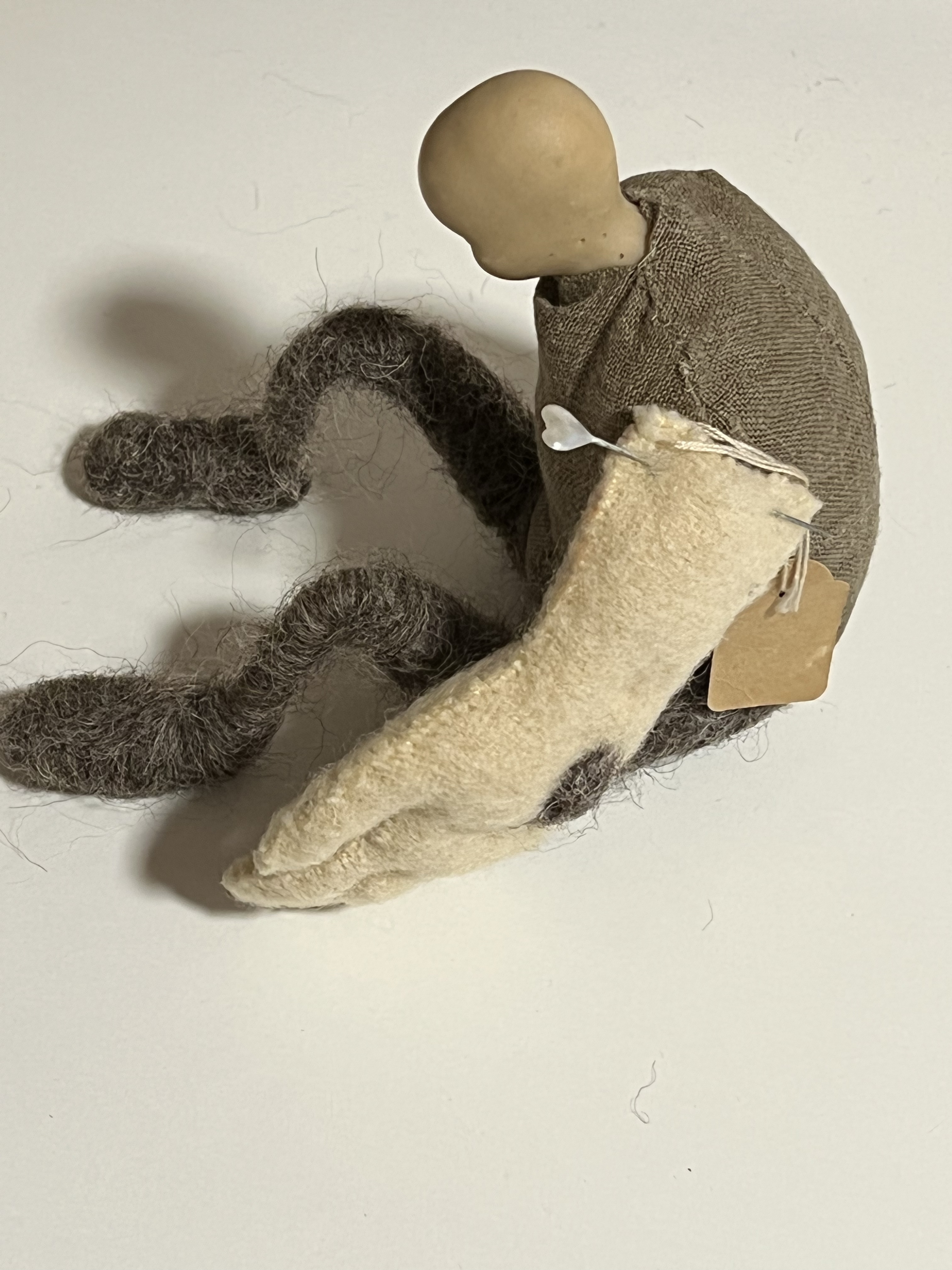
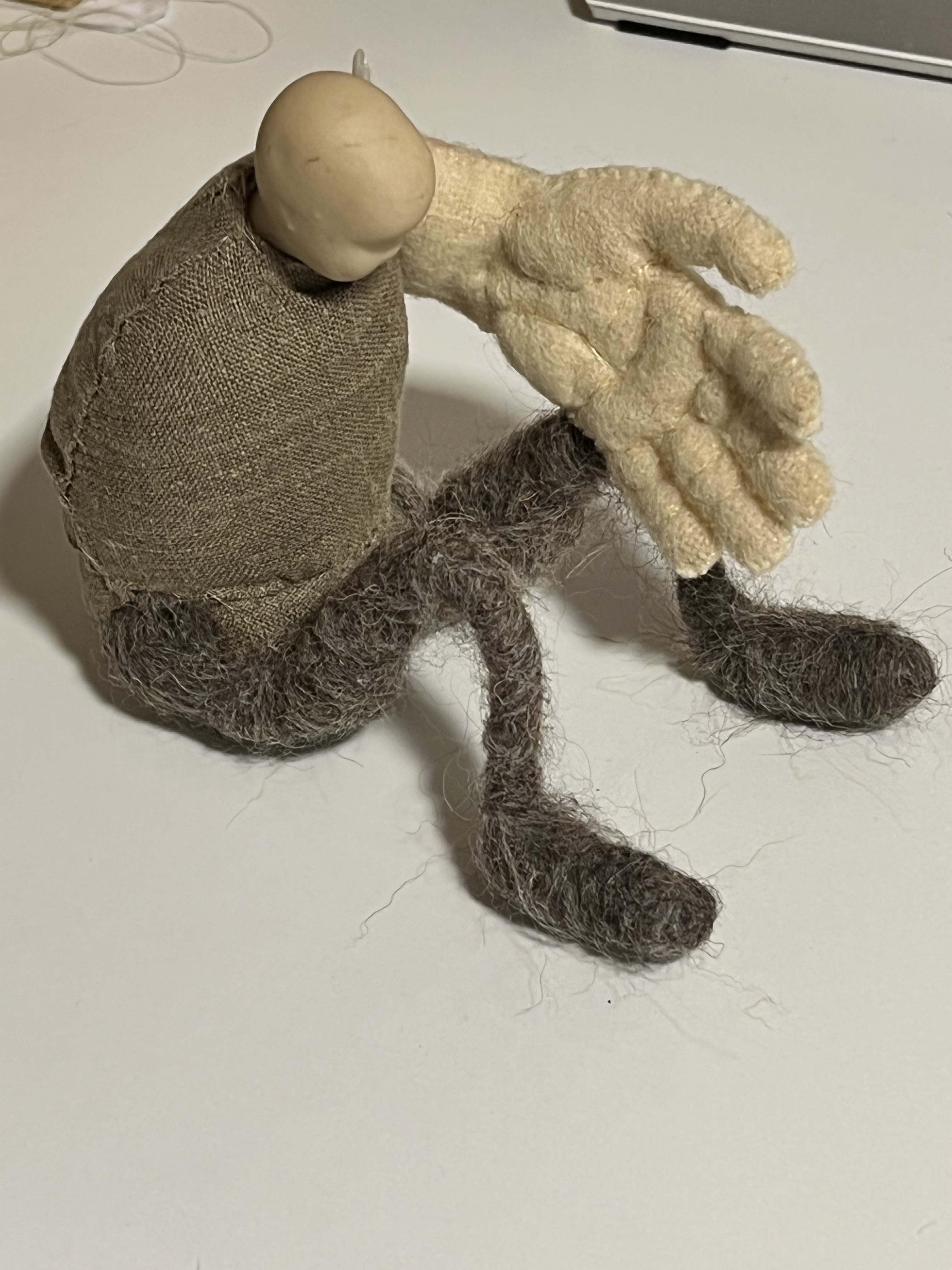
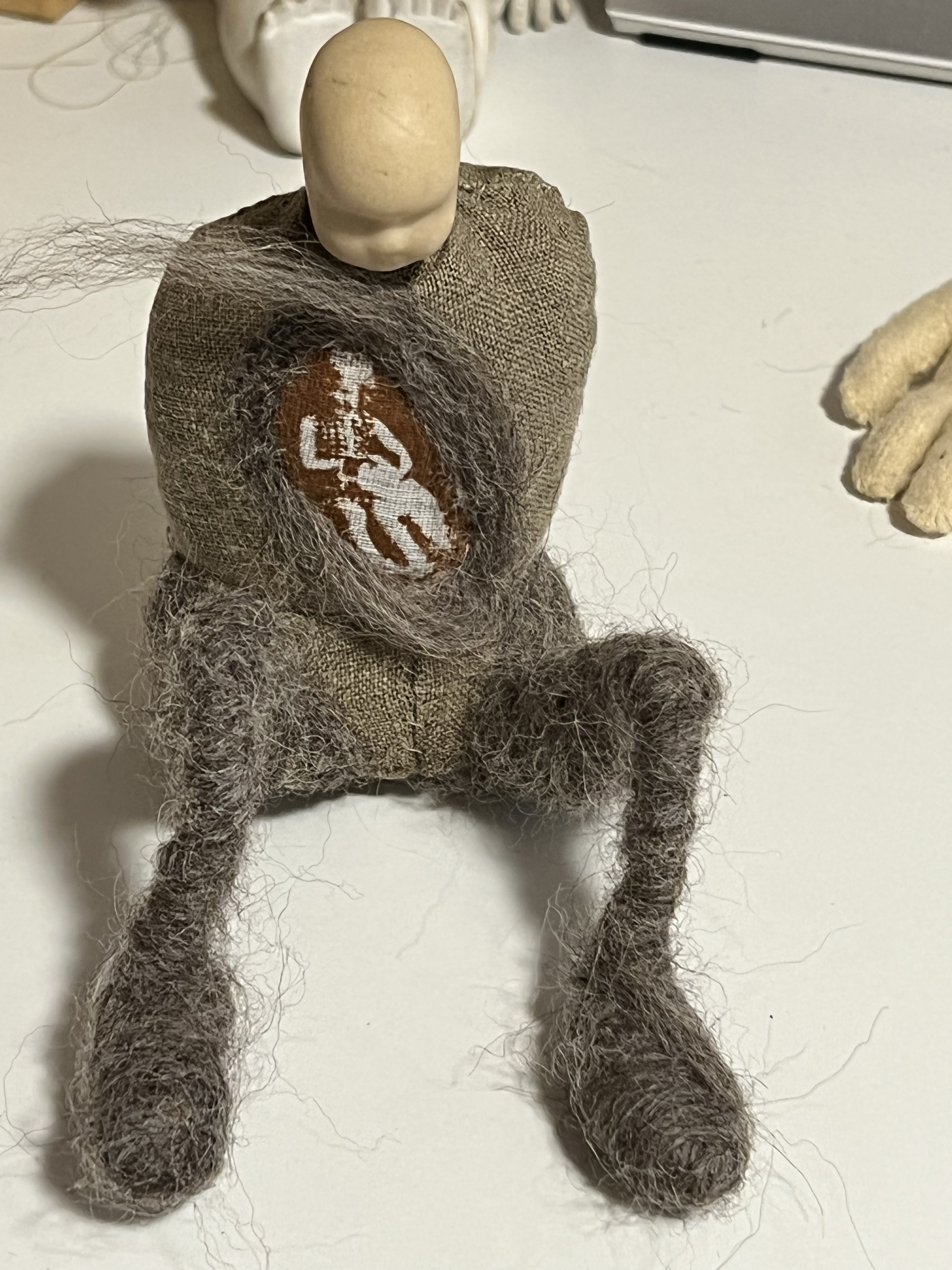
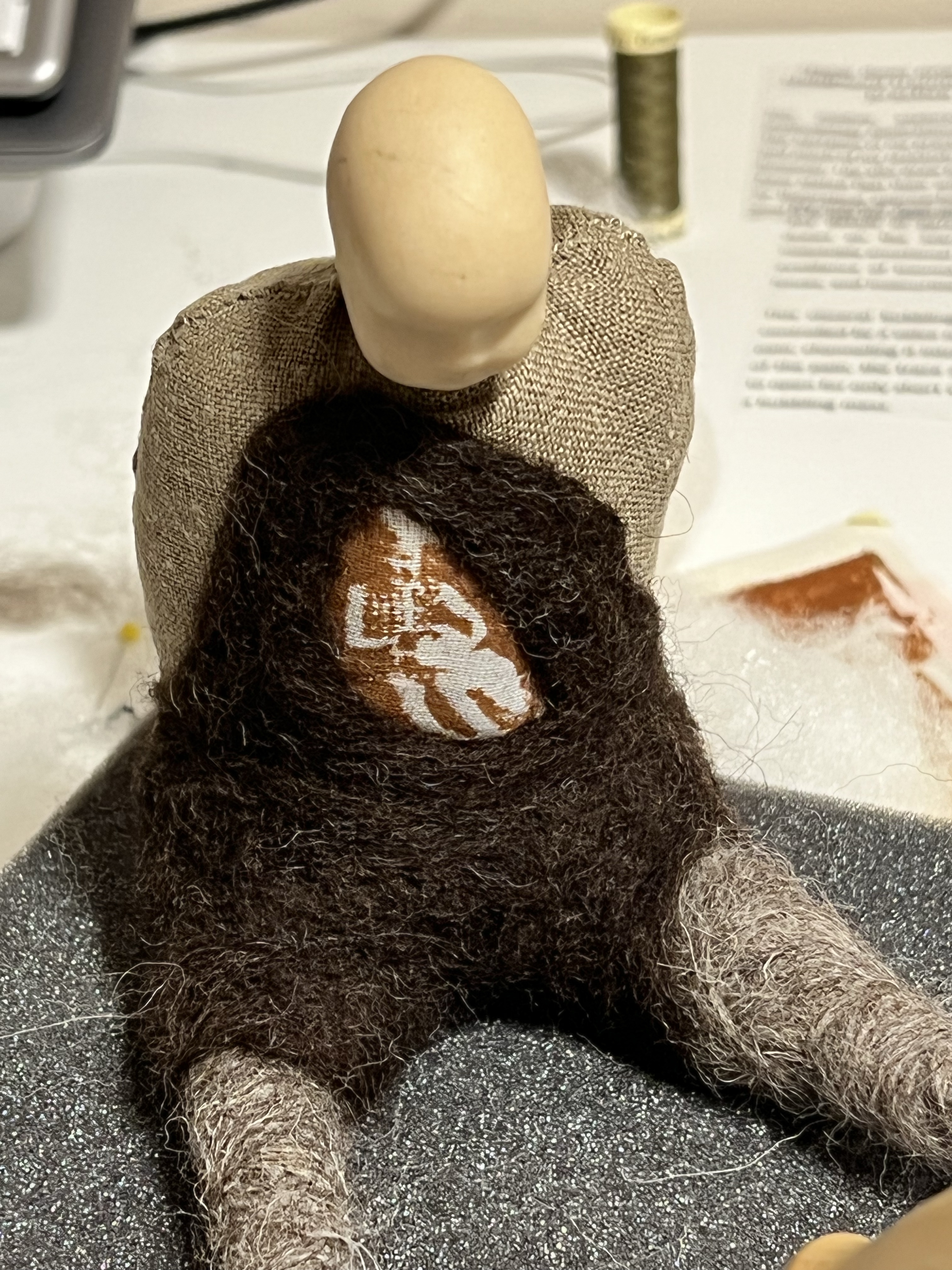
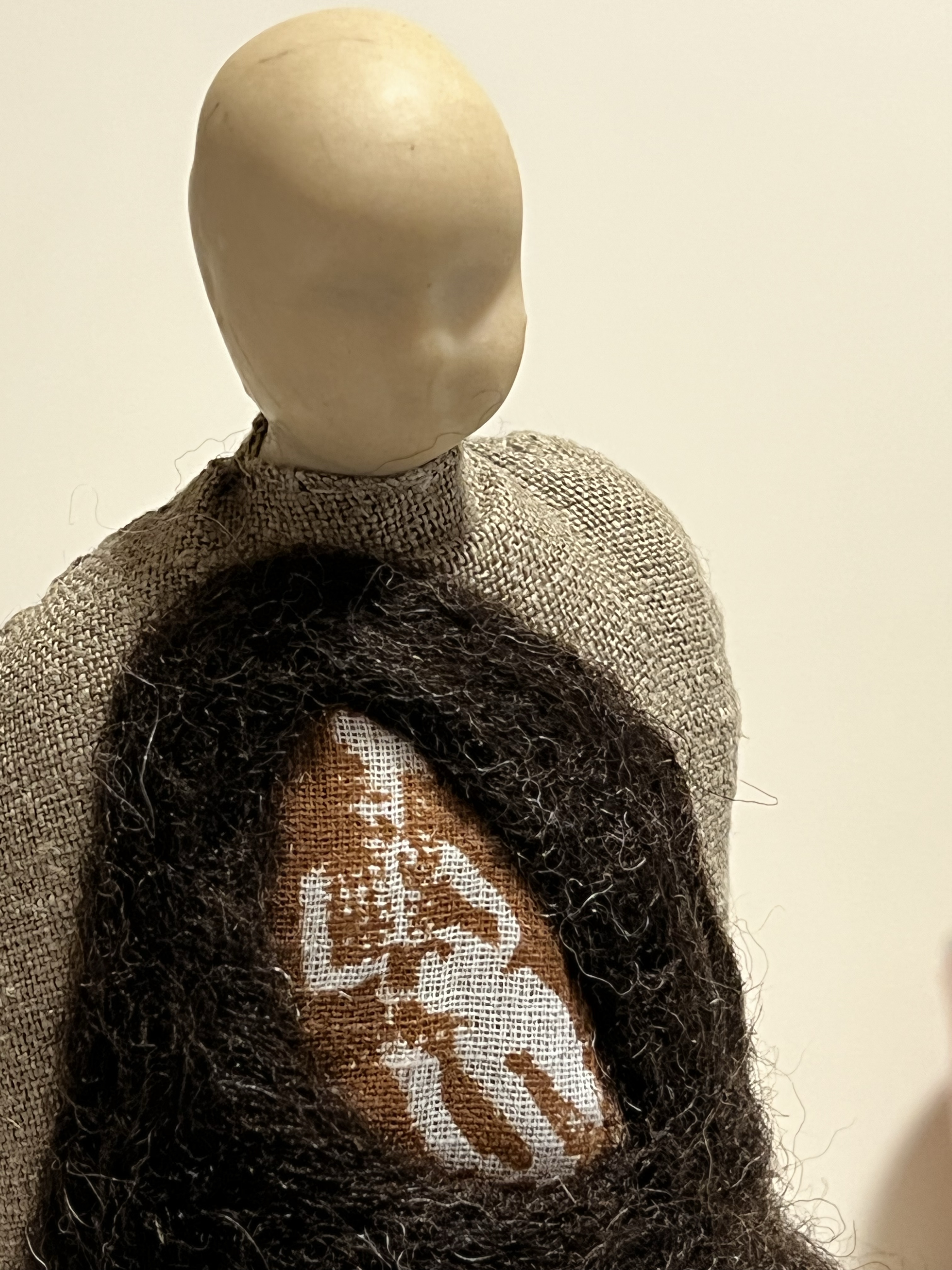
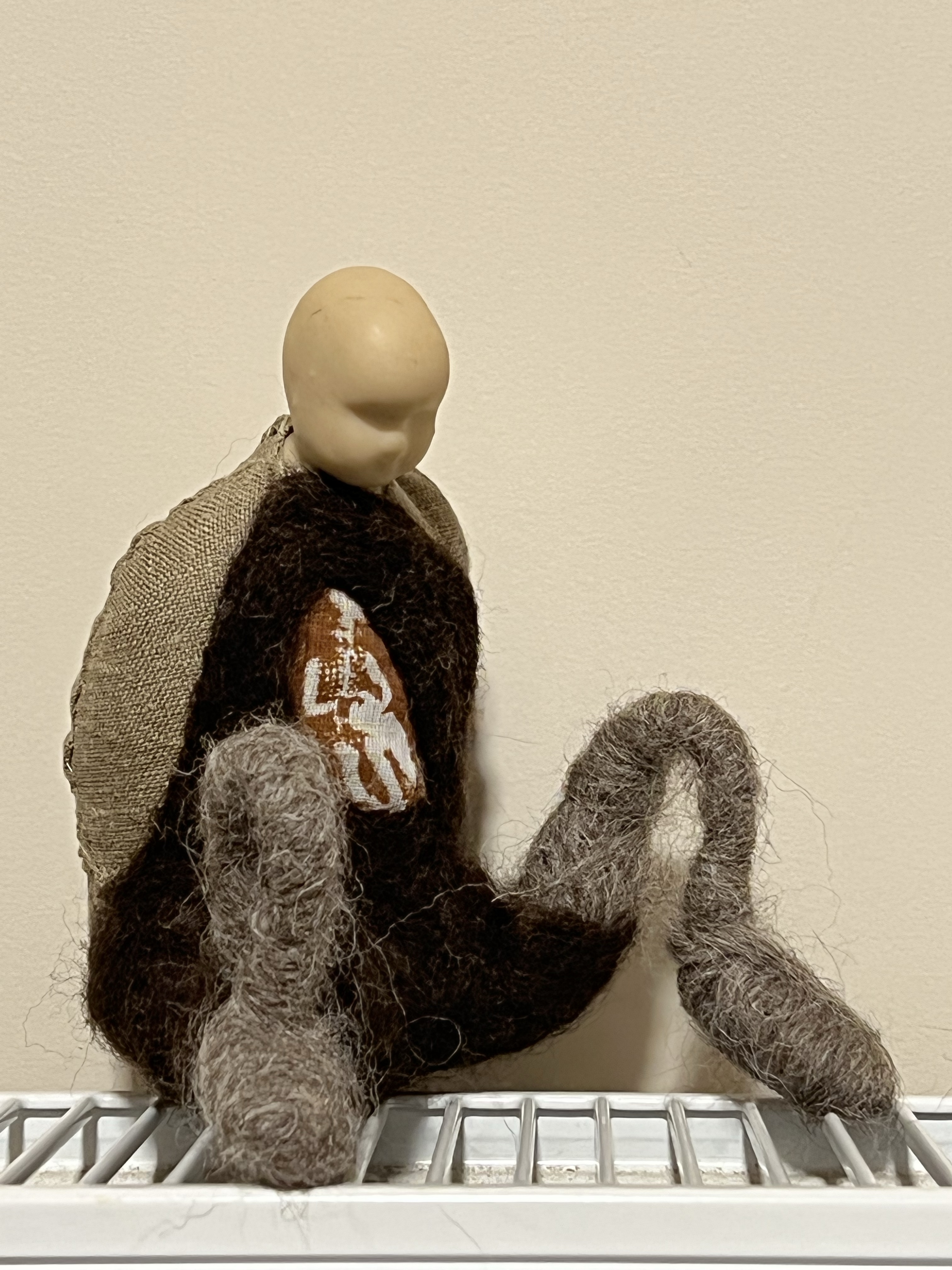
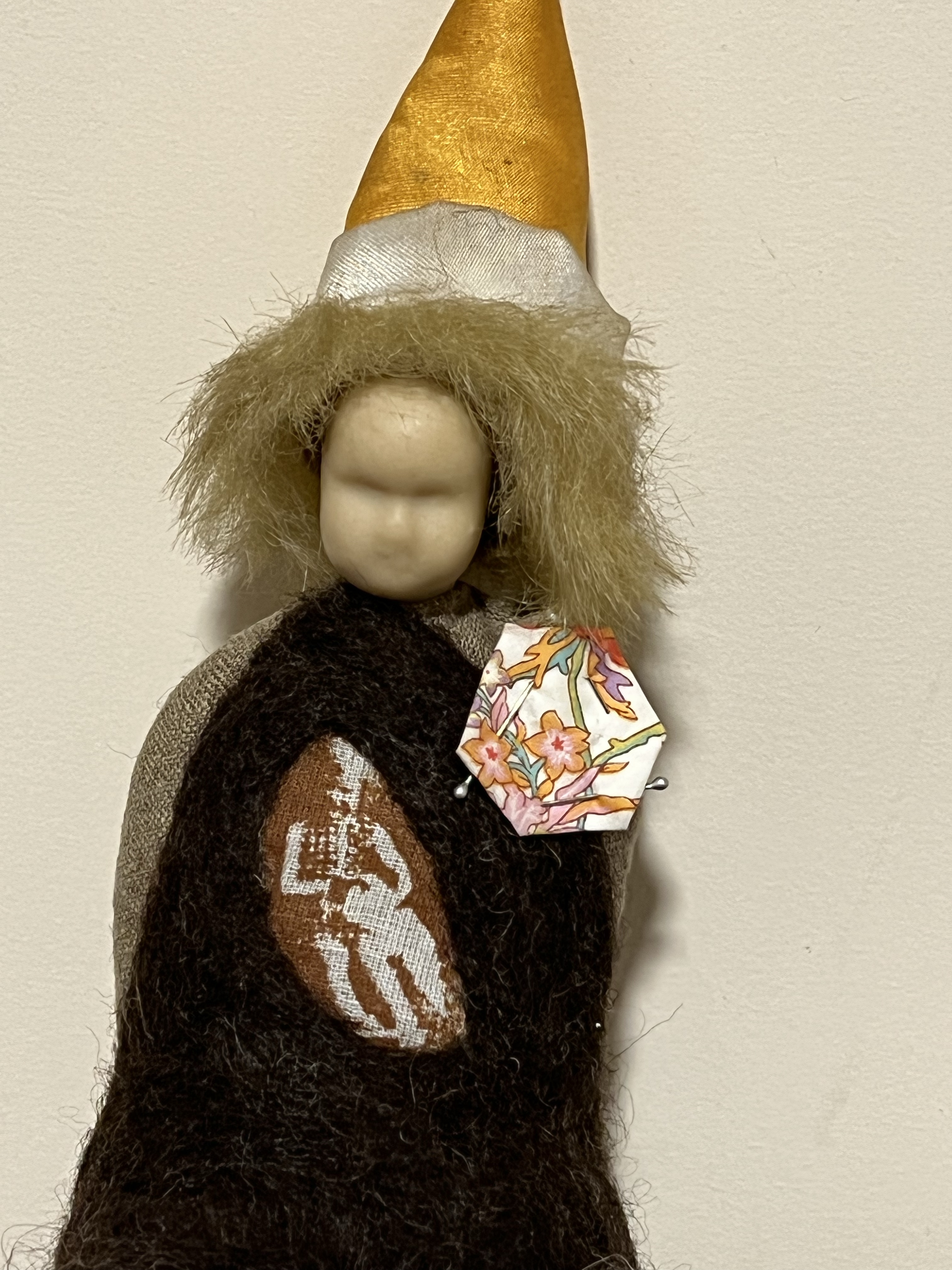
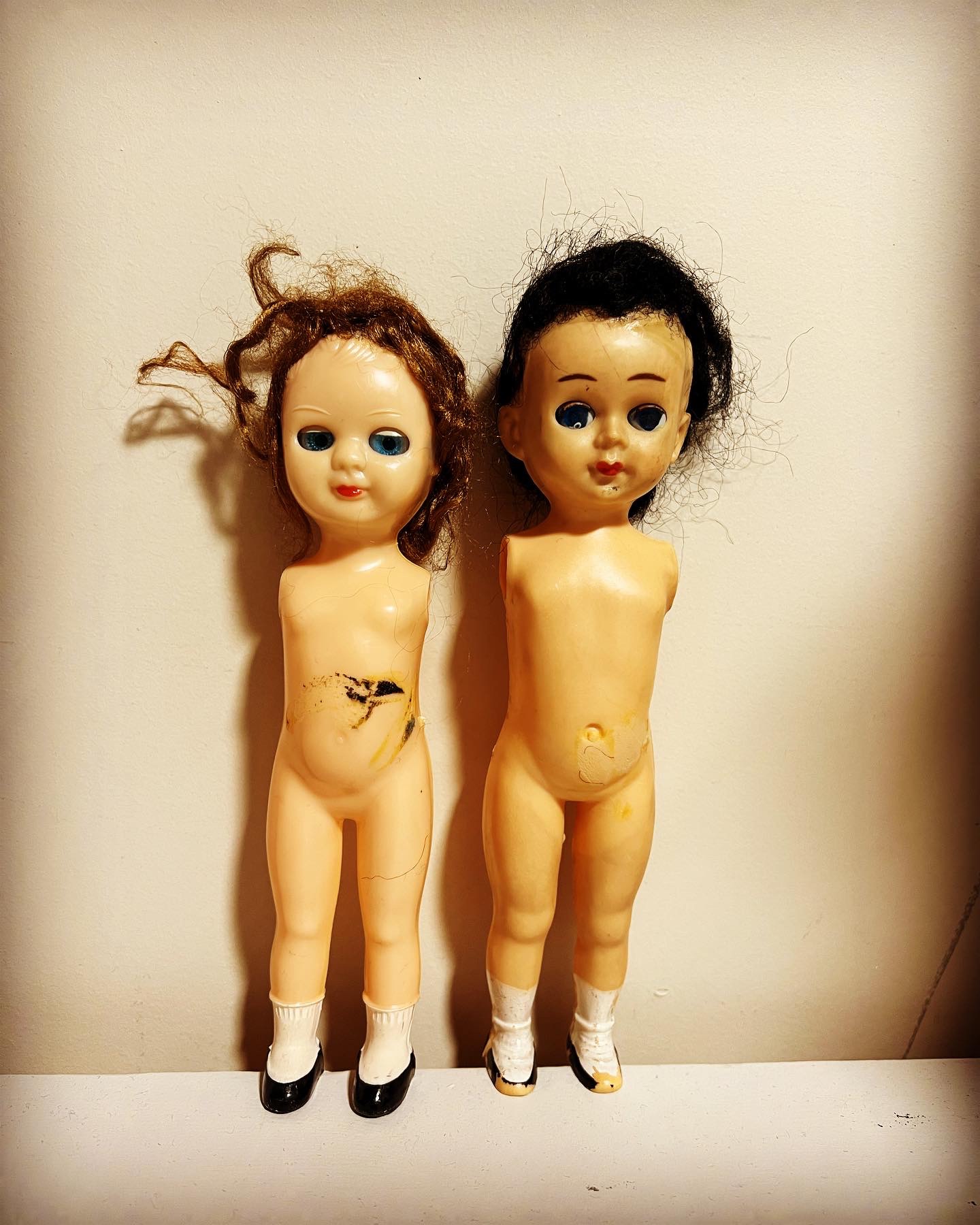
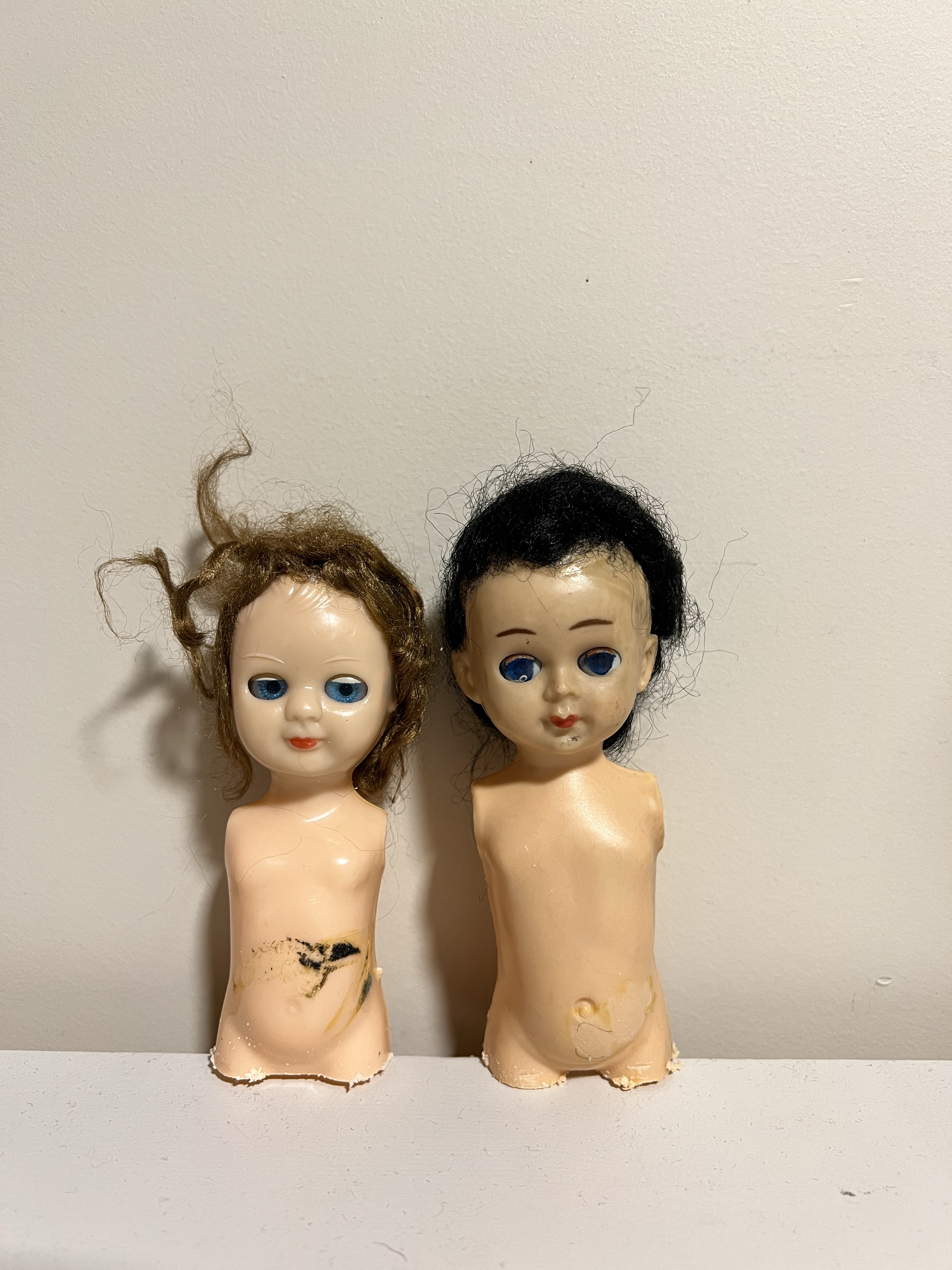
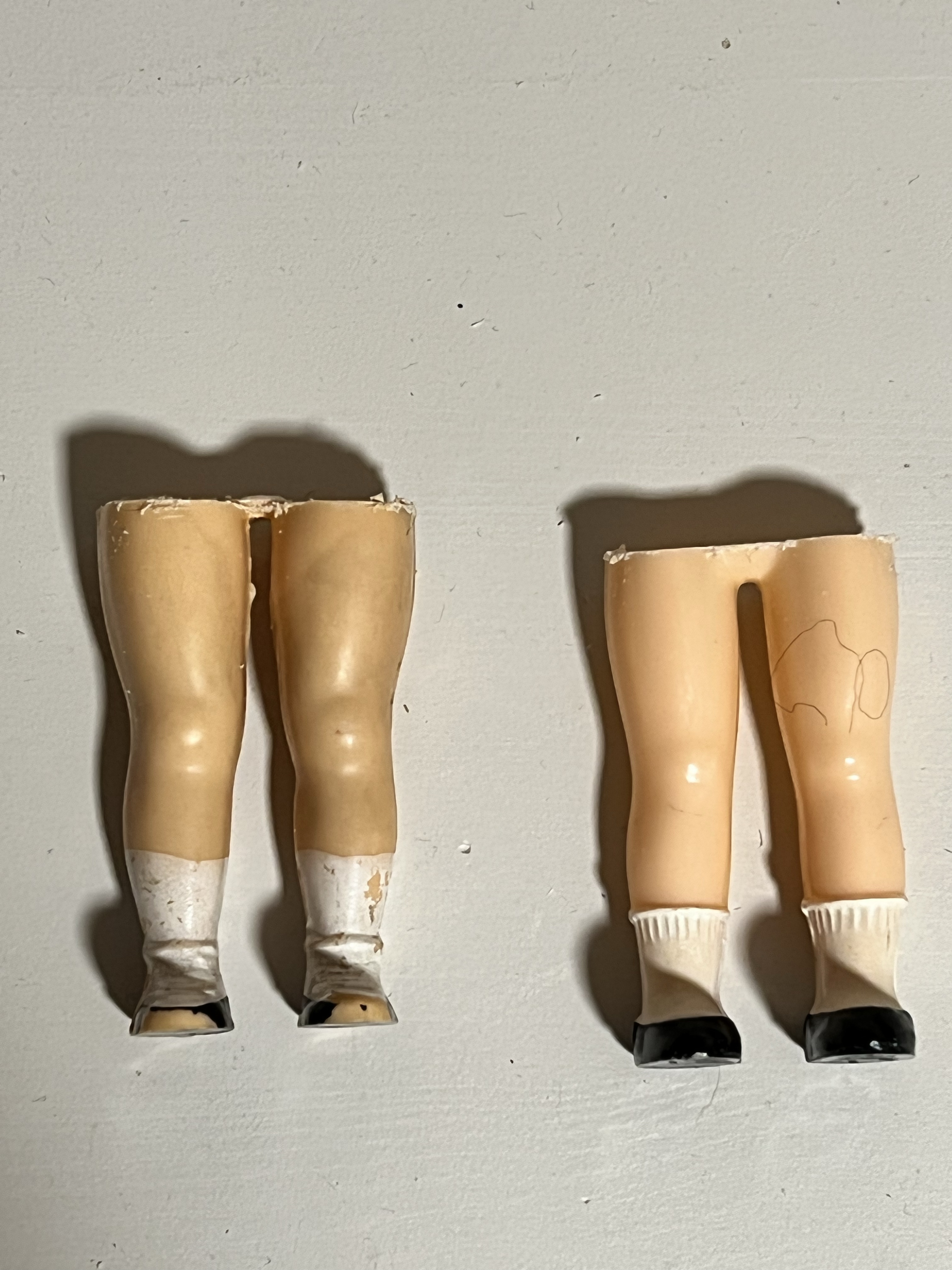
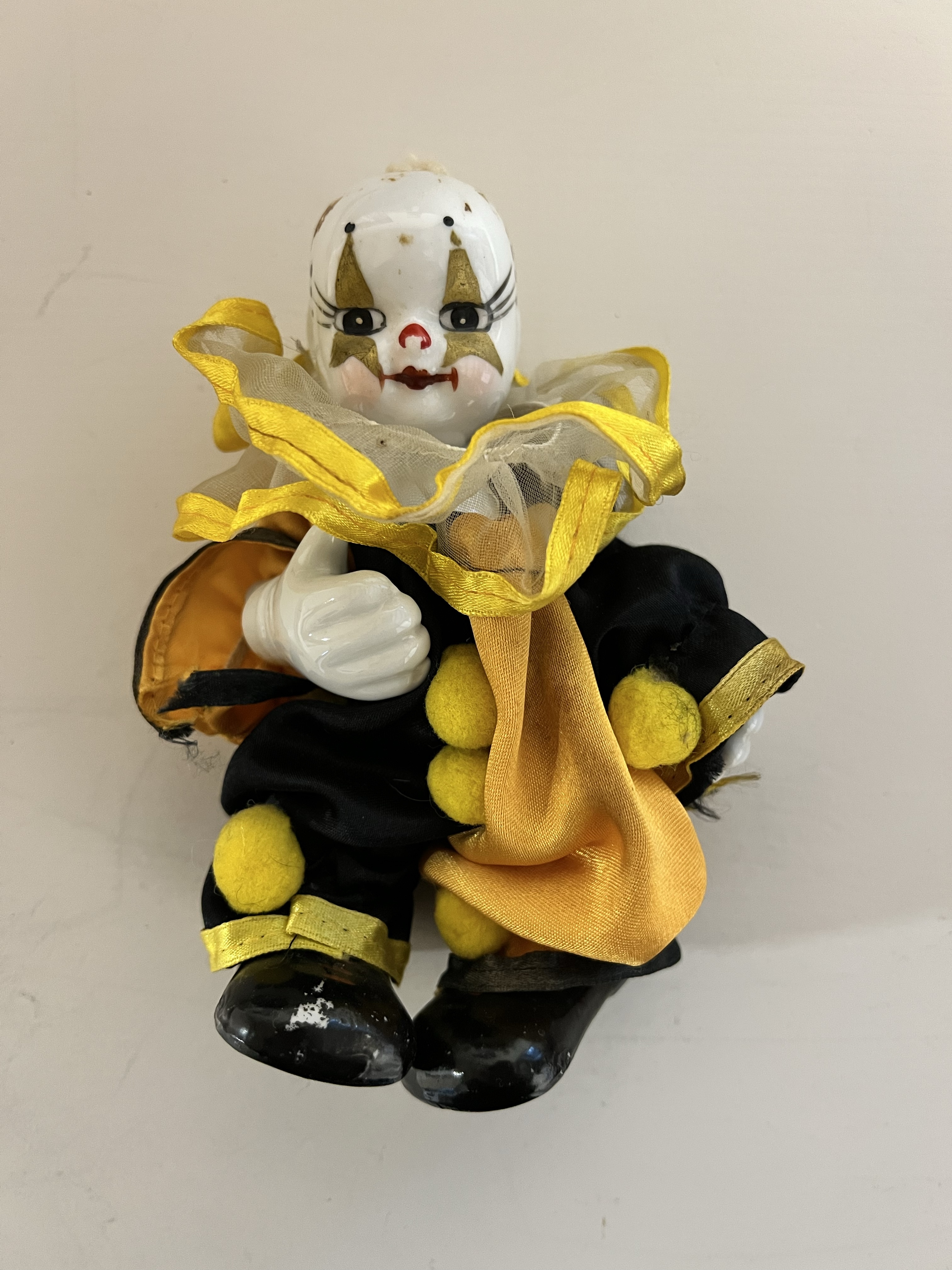
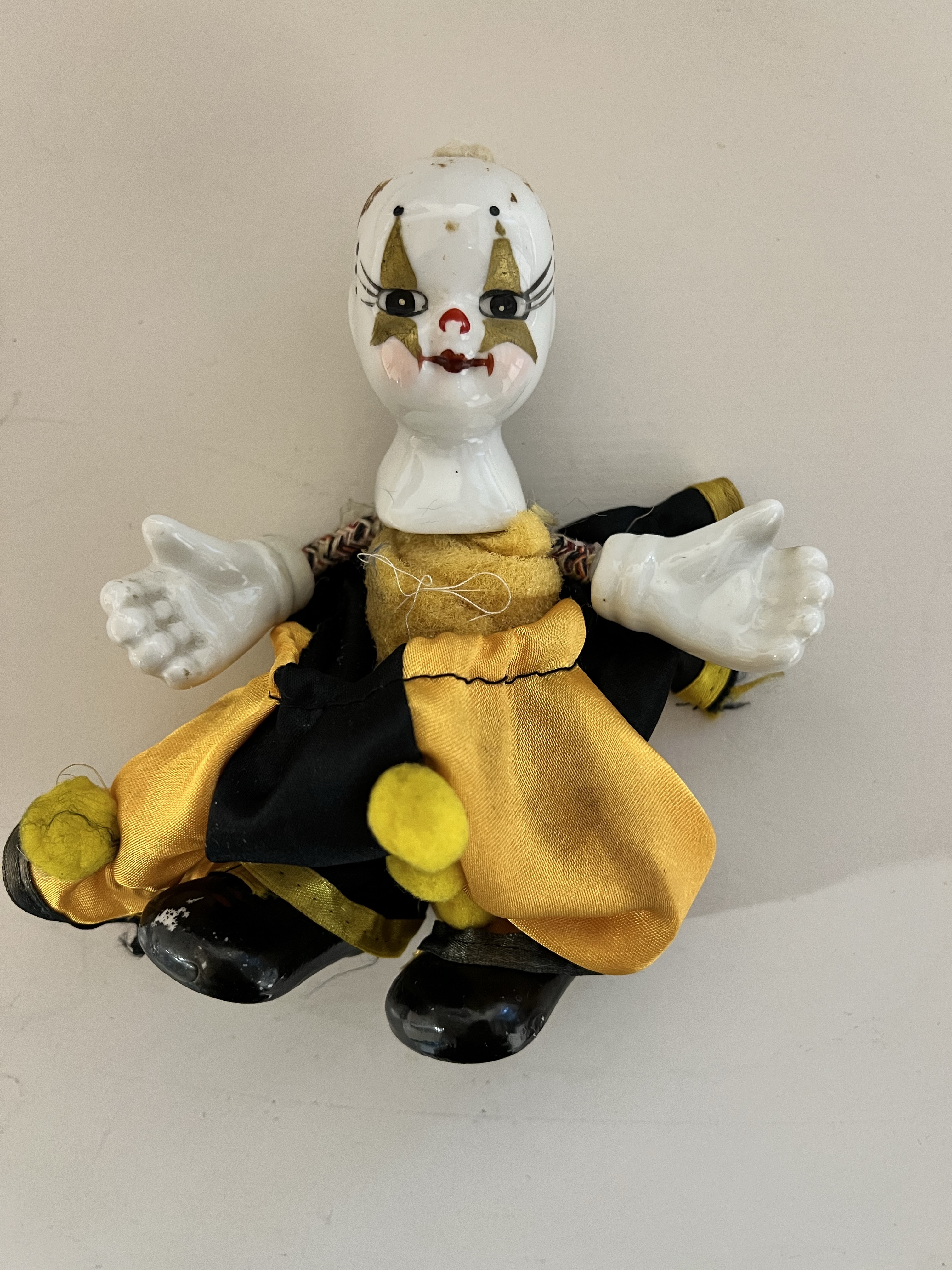
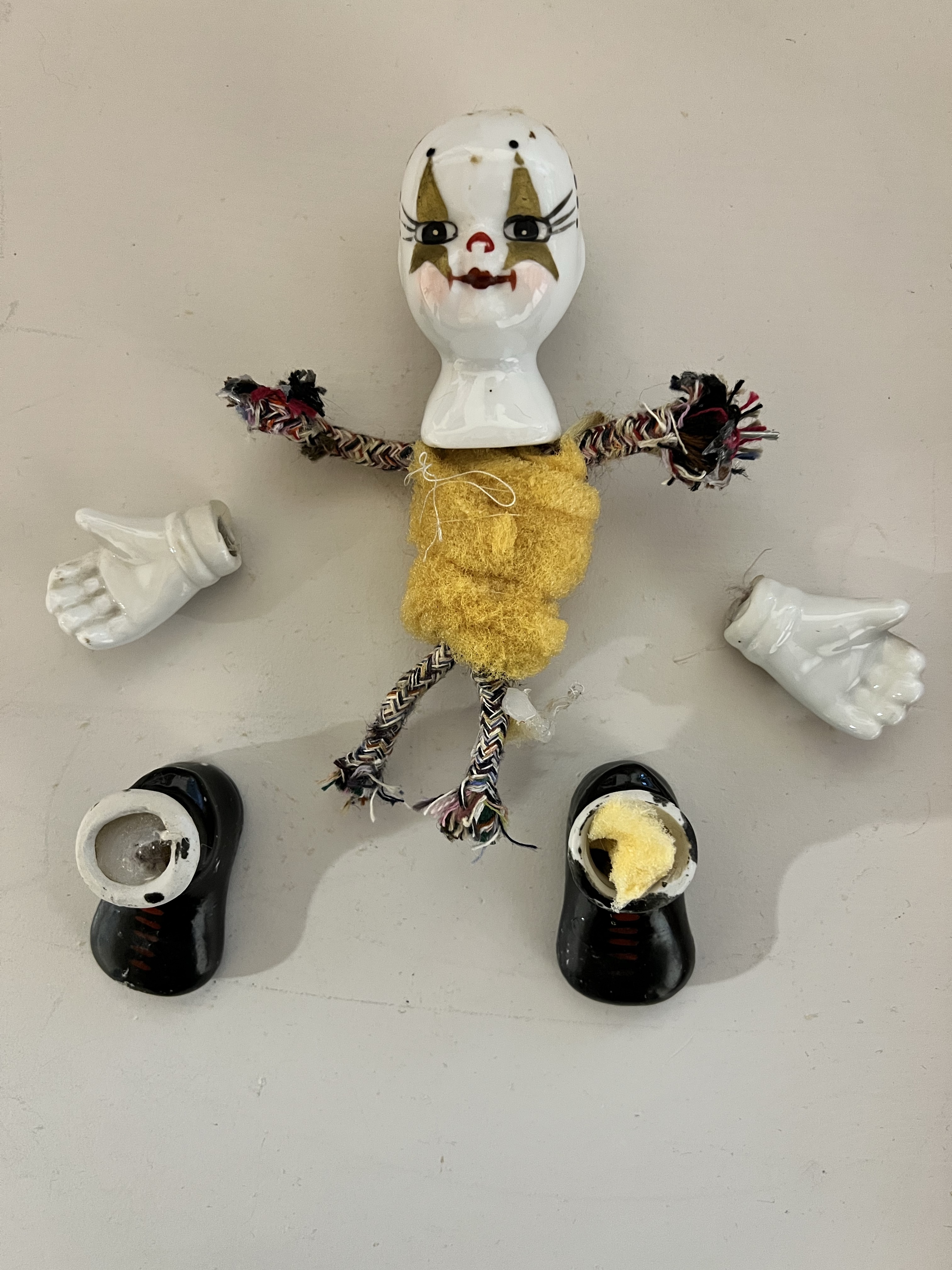
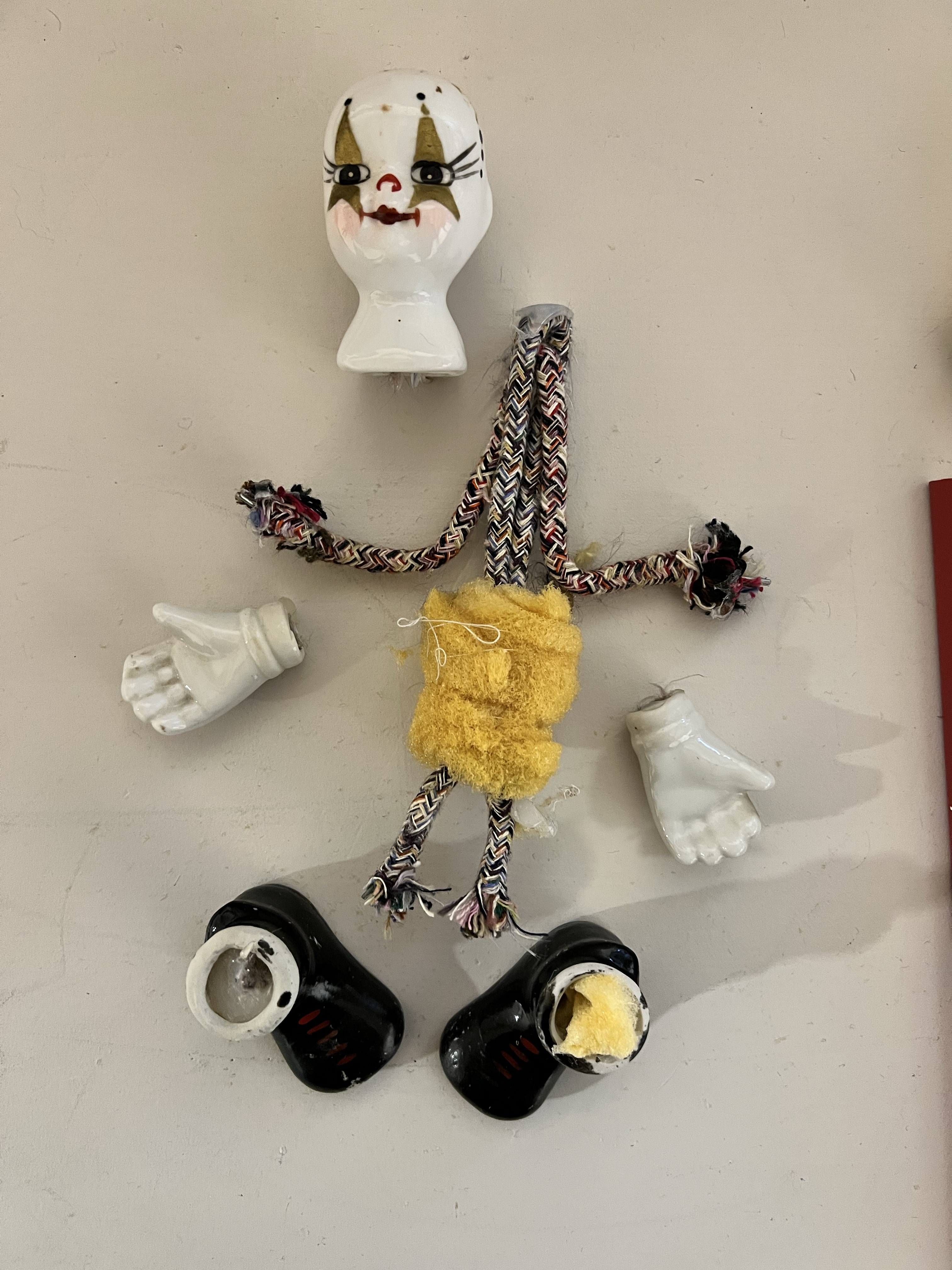
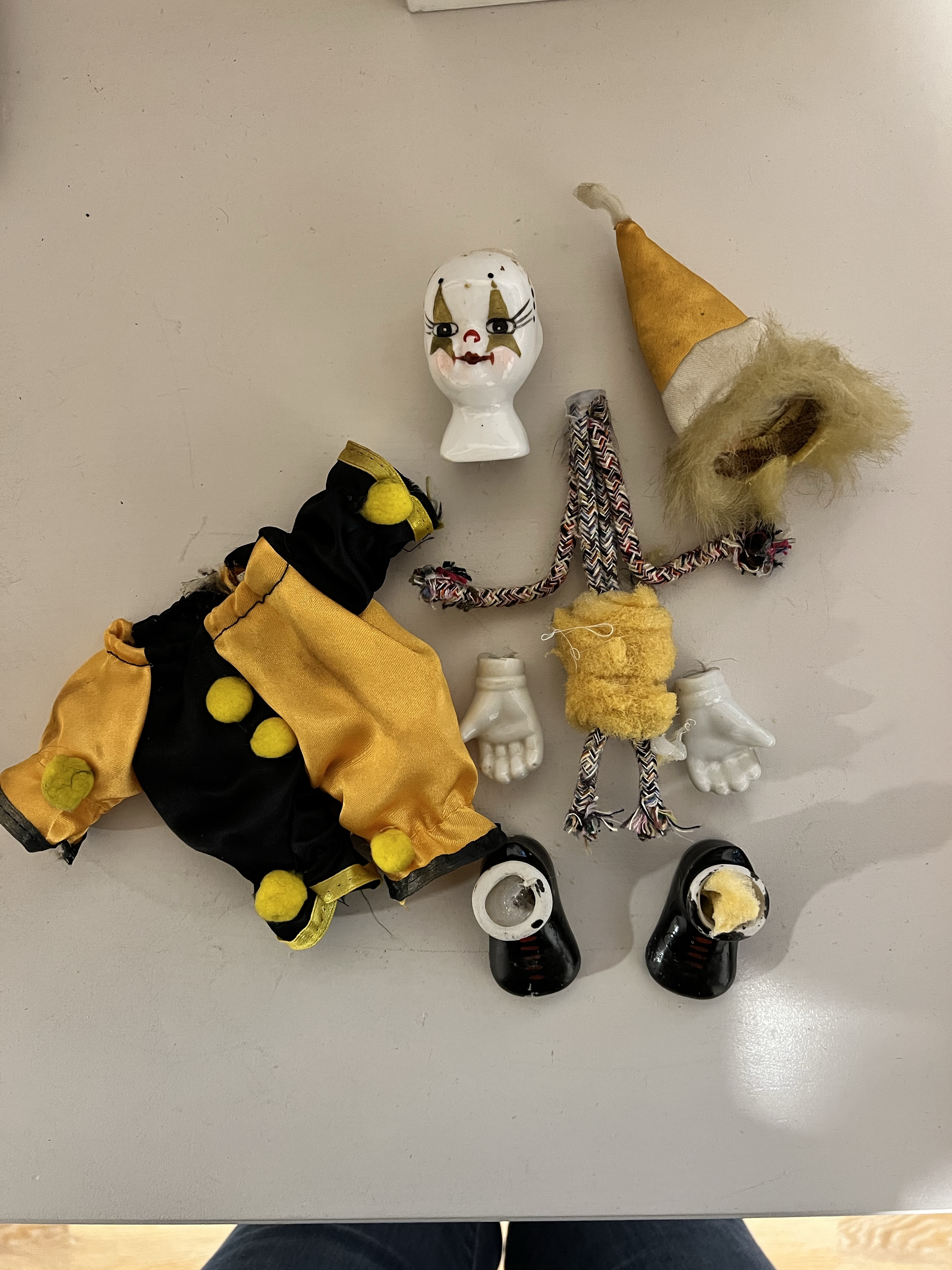
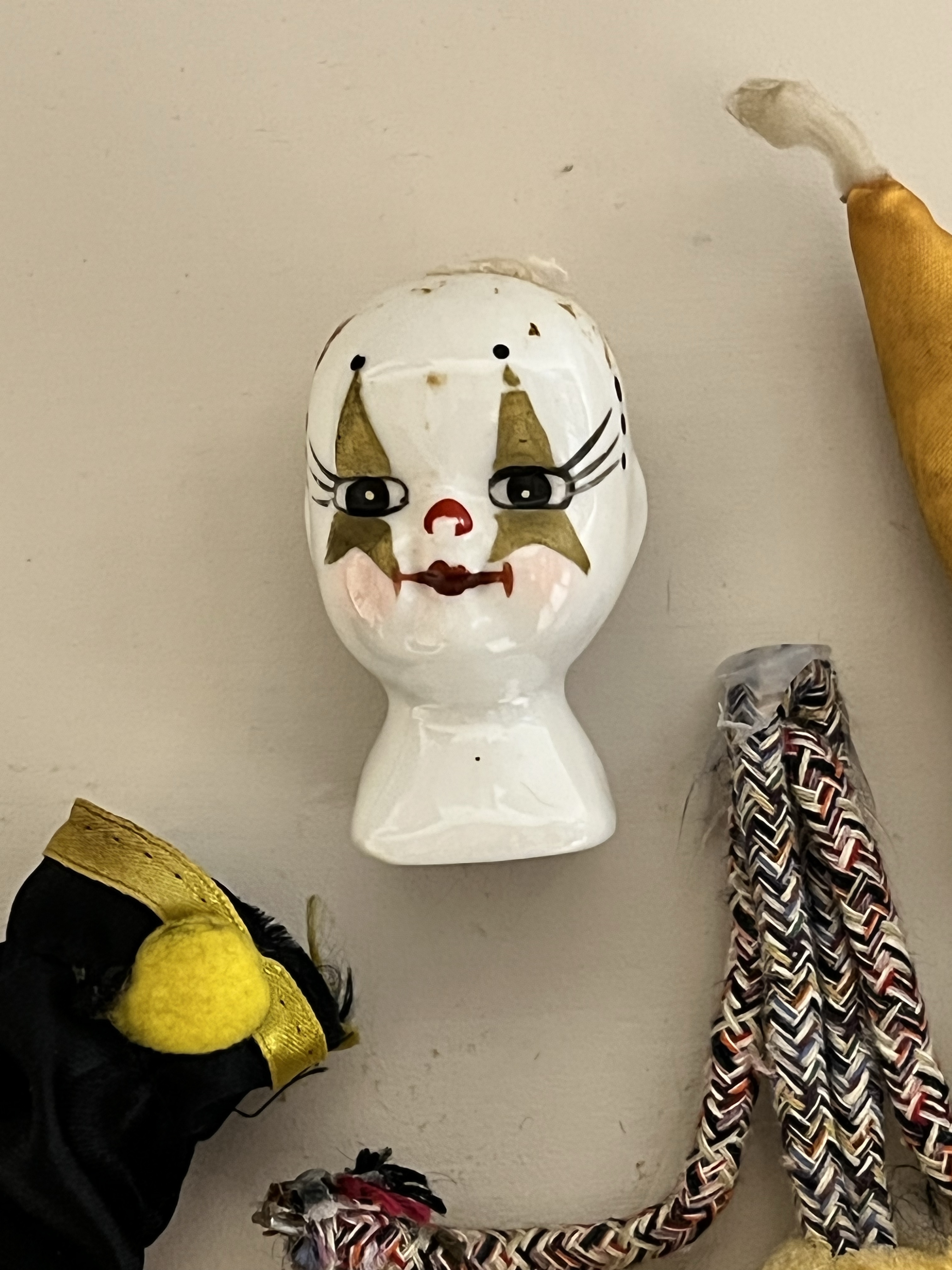
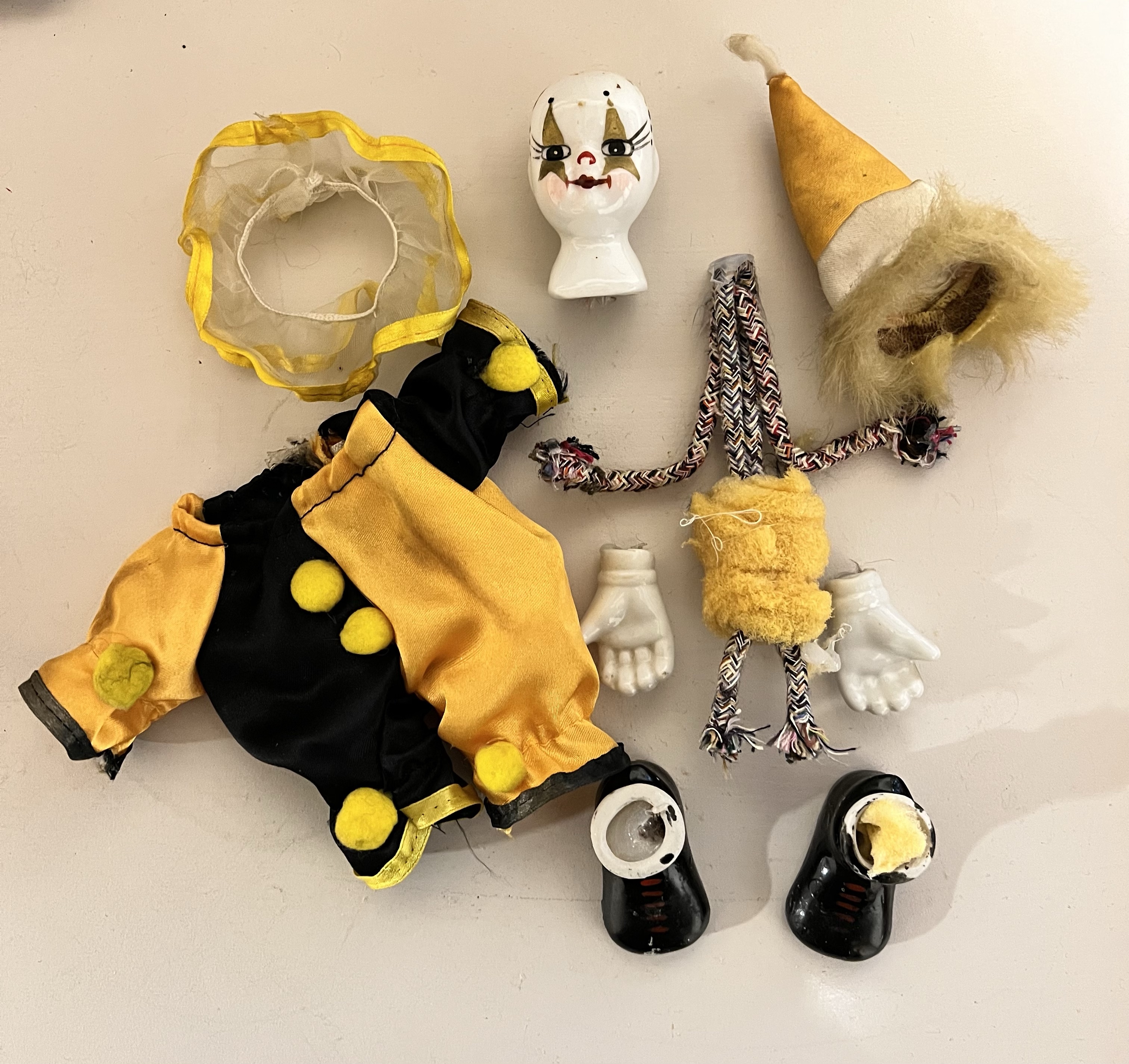
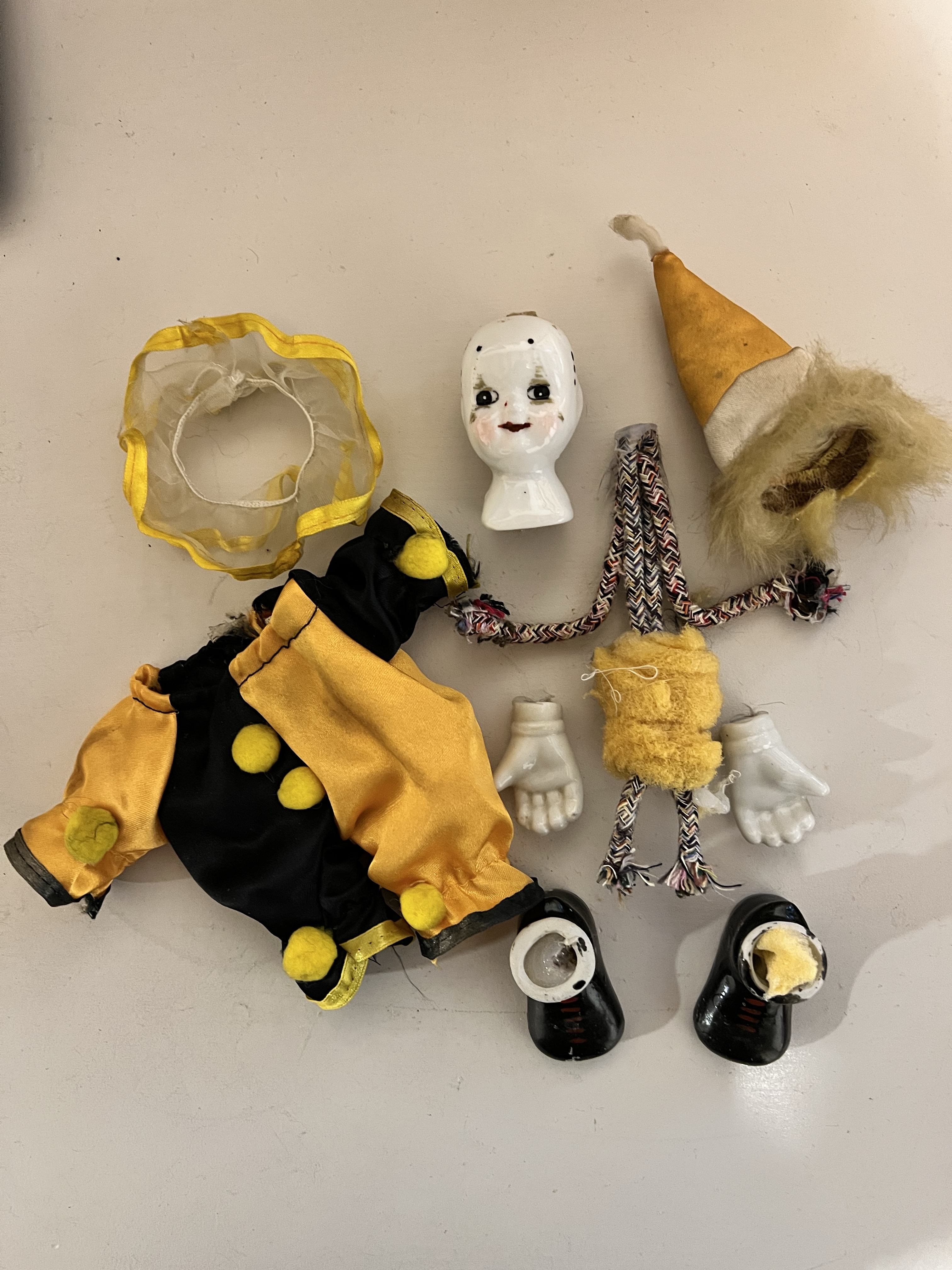
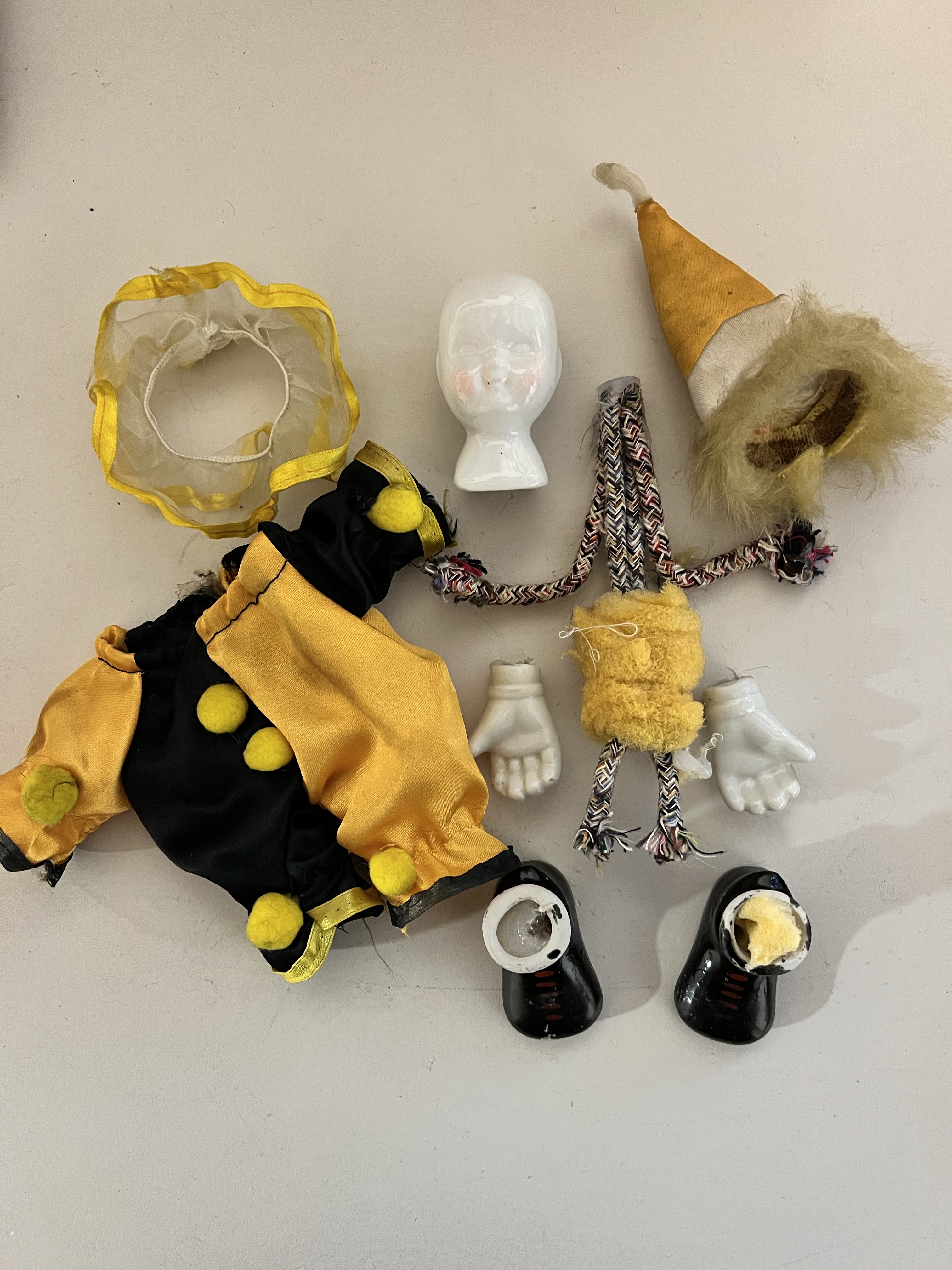
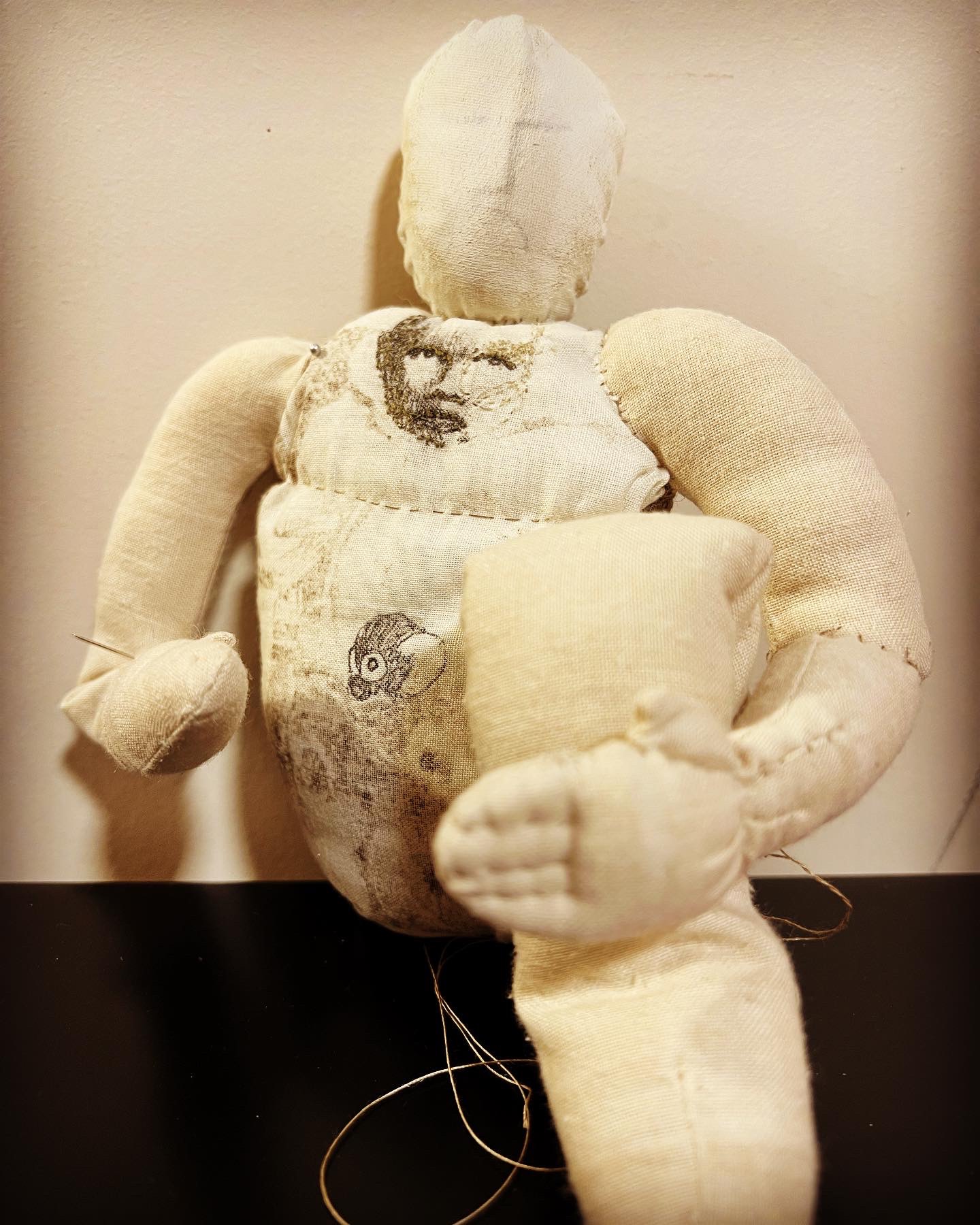
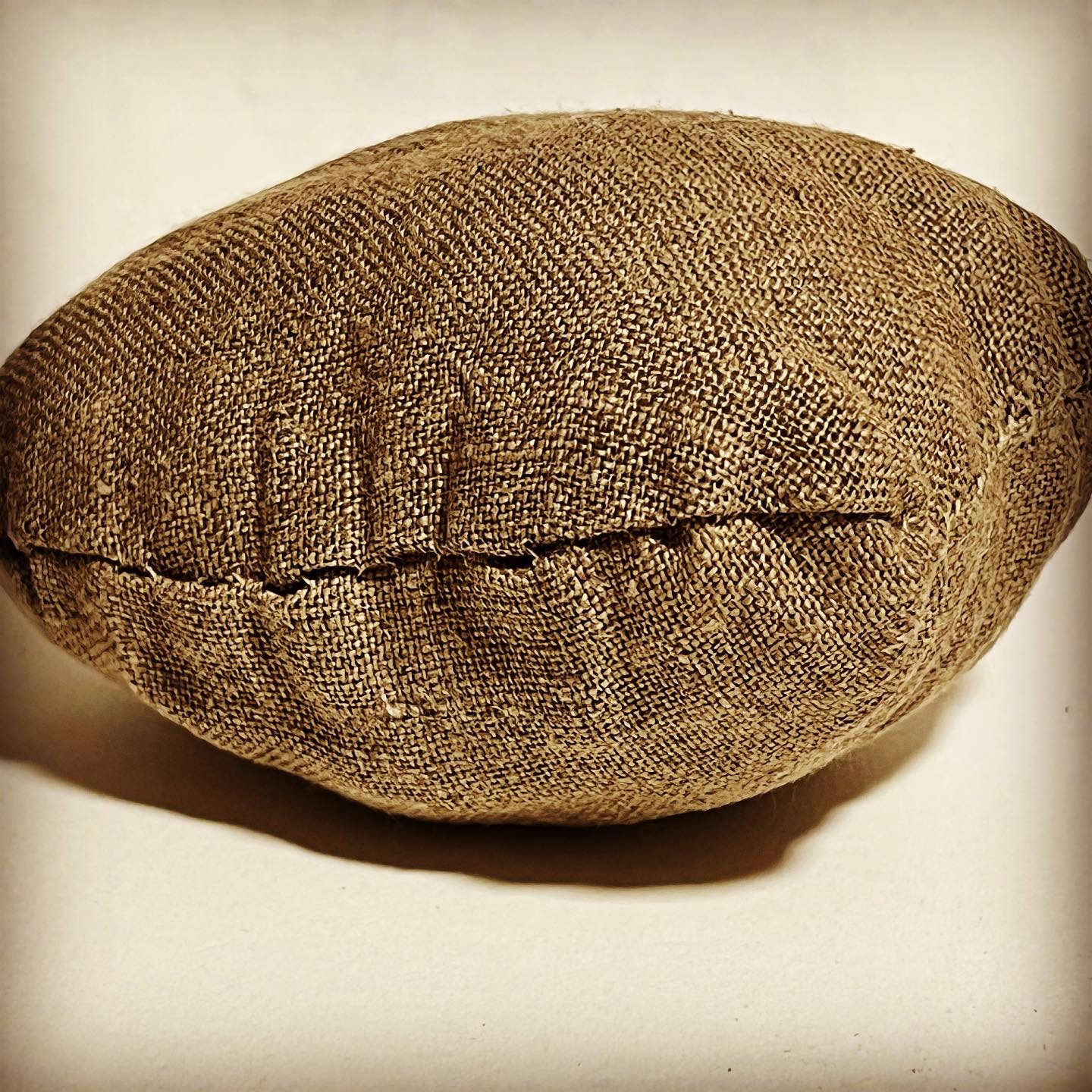
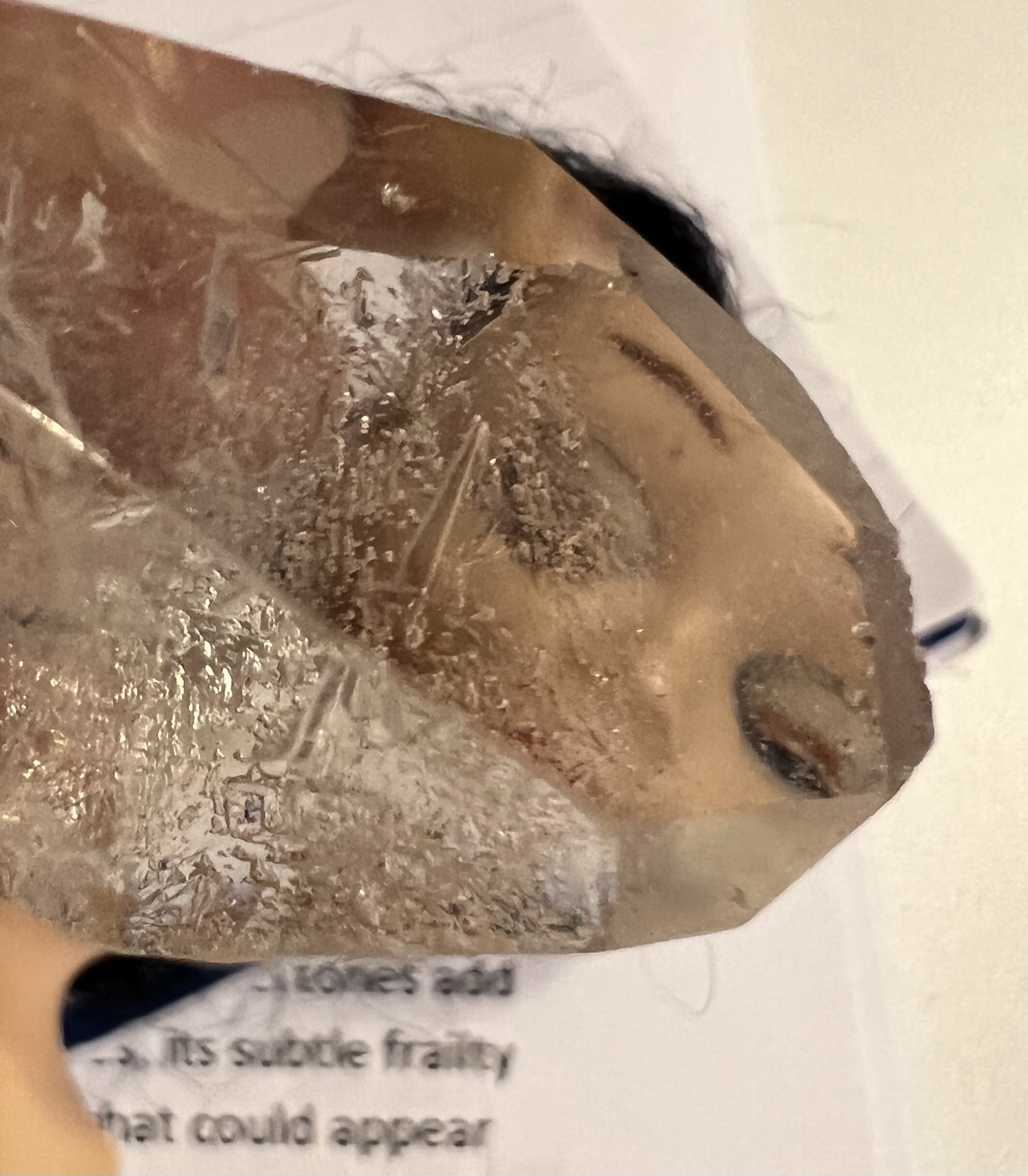
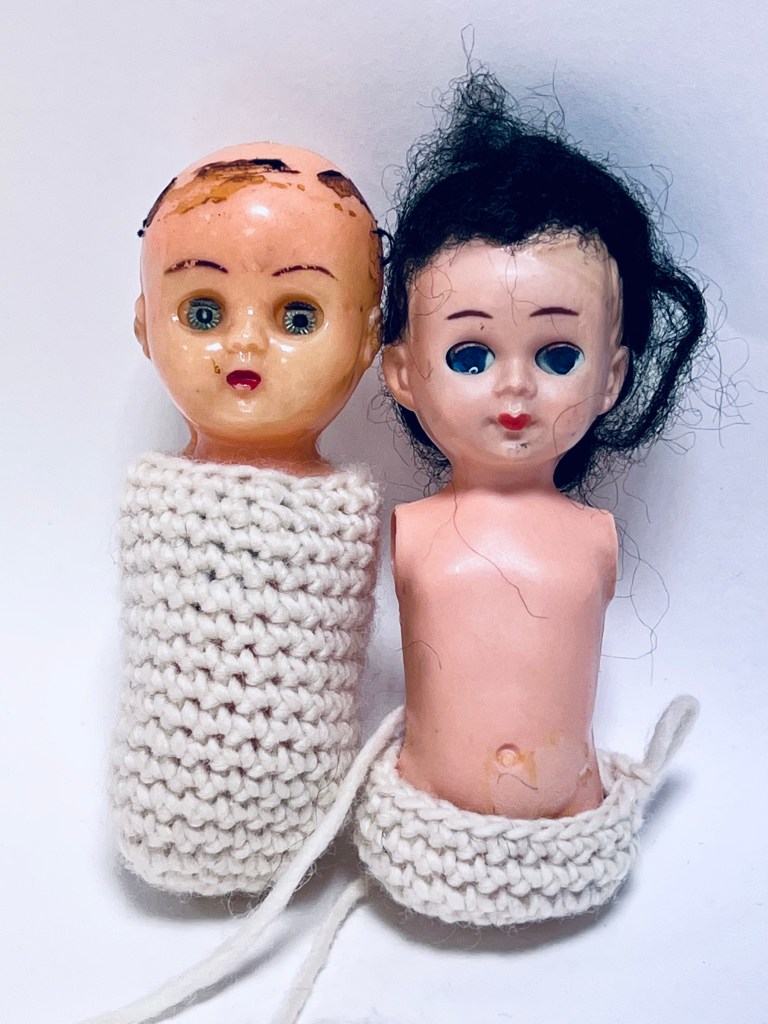
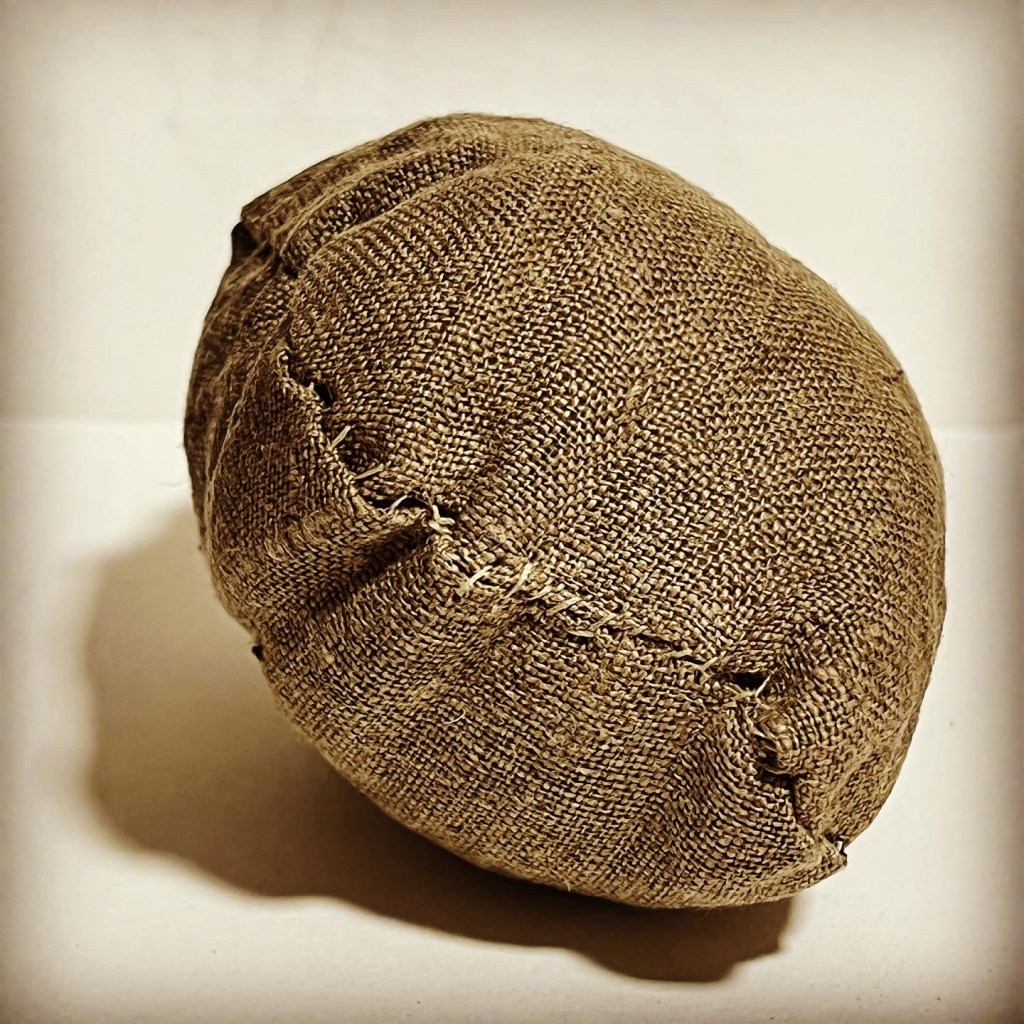
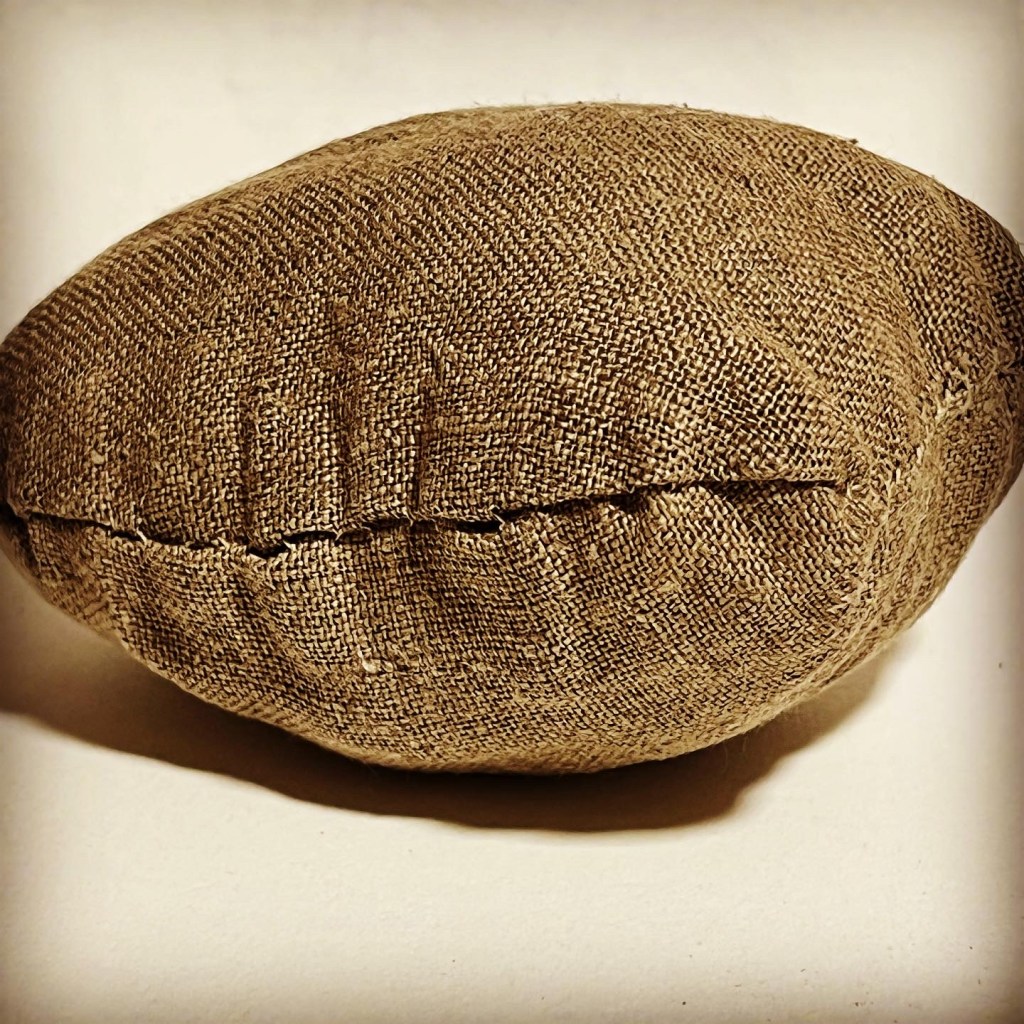
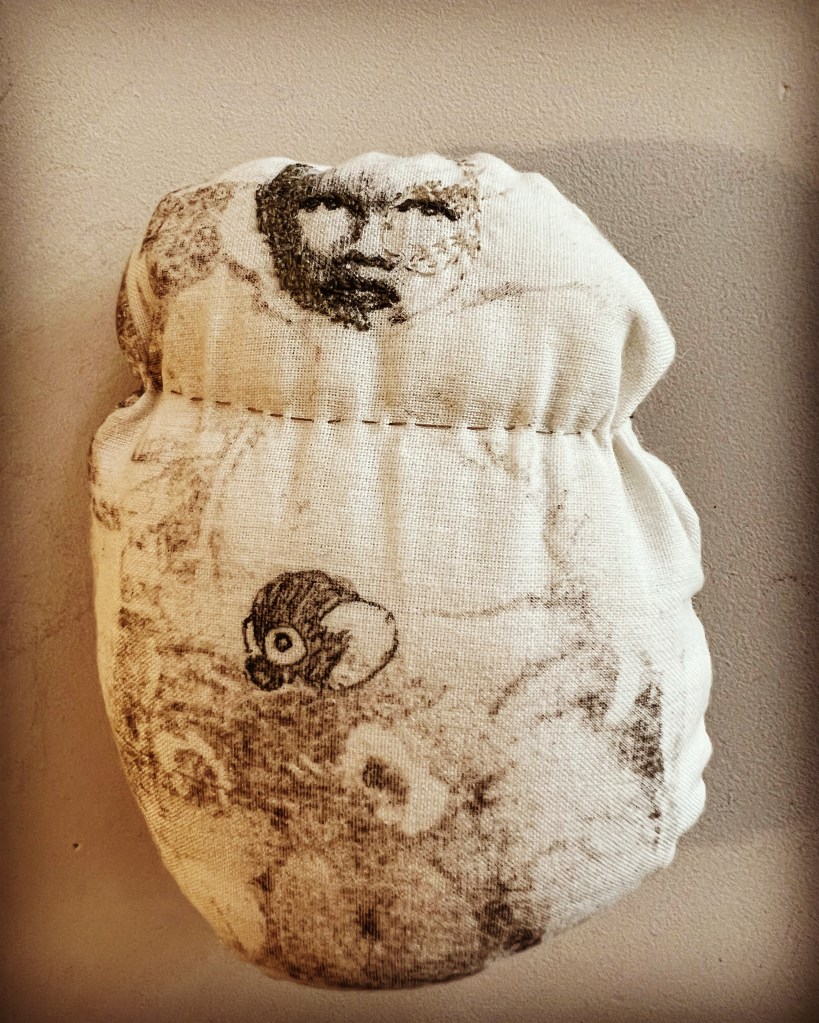
I was given a bag of broken plastic dolls, some had no limbs and arms and legs were missing others just had arms missing, I decided that I would cocoon these with natural wool, a waddling but also a layer to add other layers.
The physical work in progress
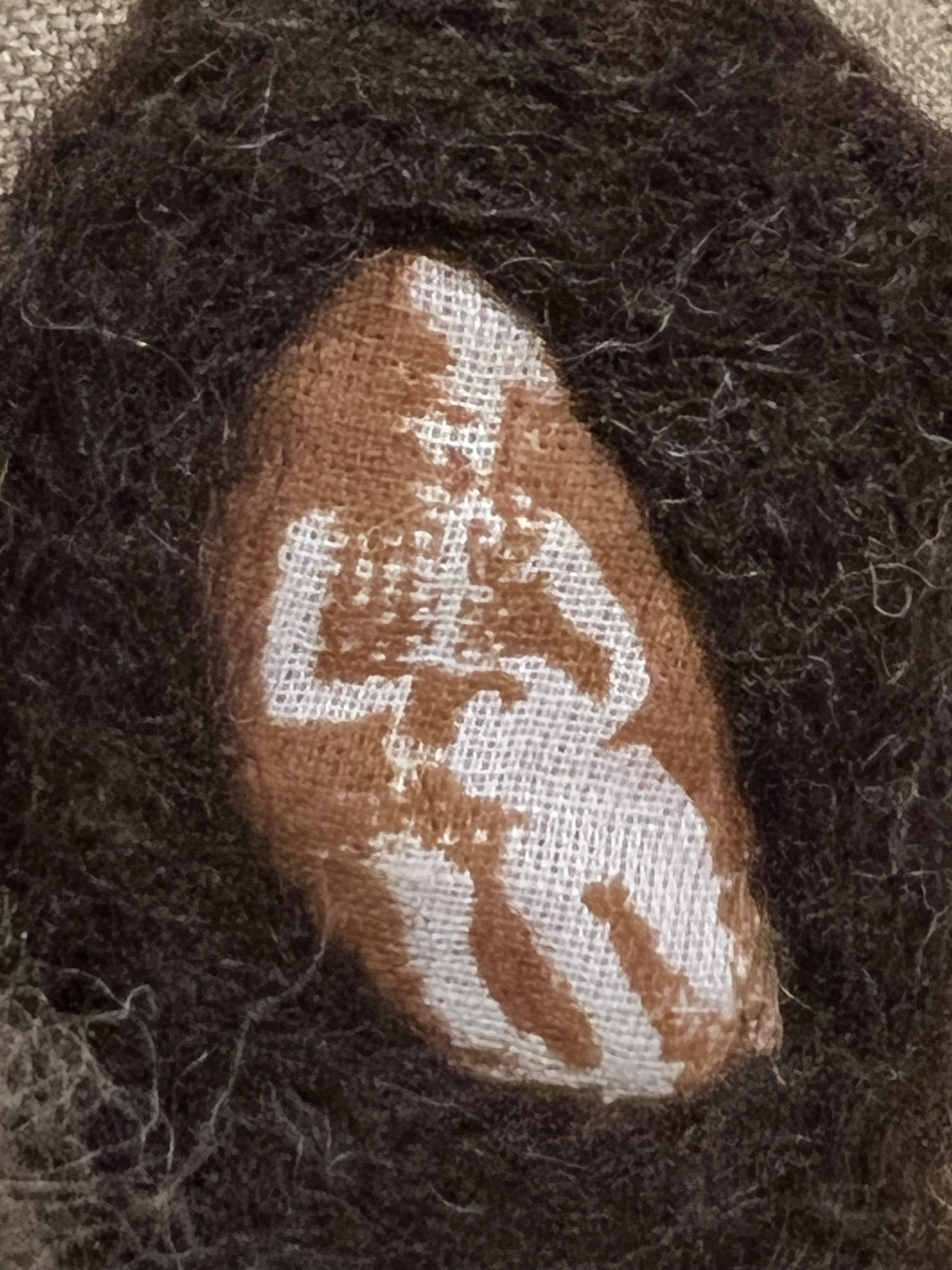
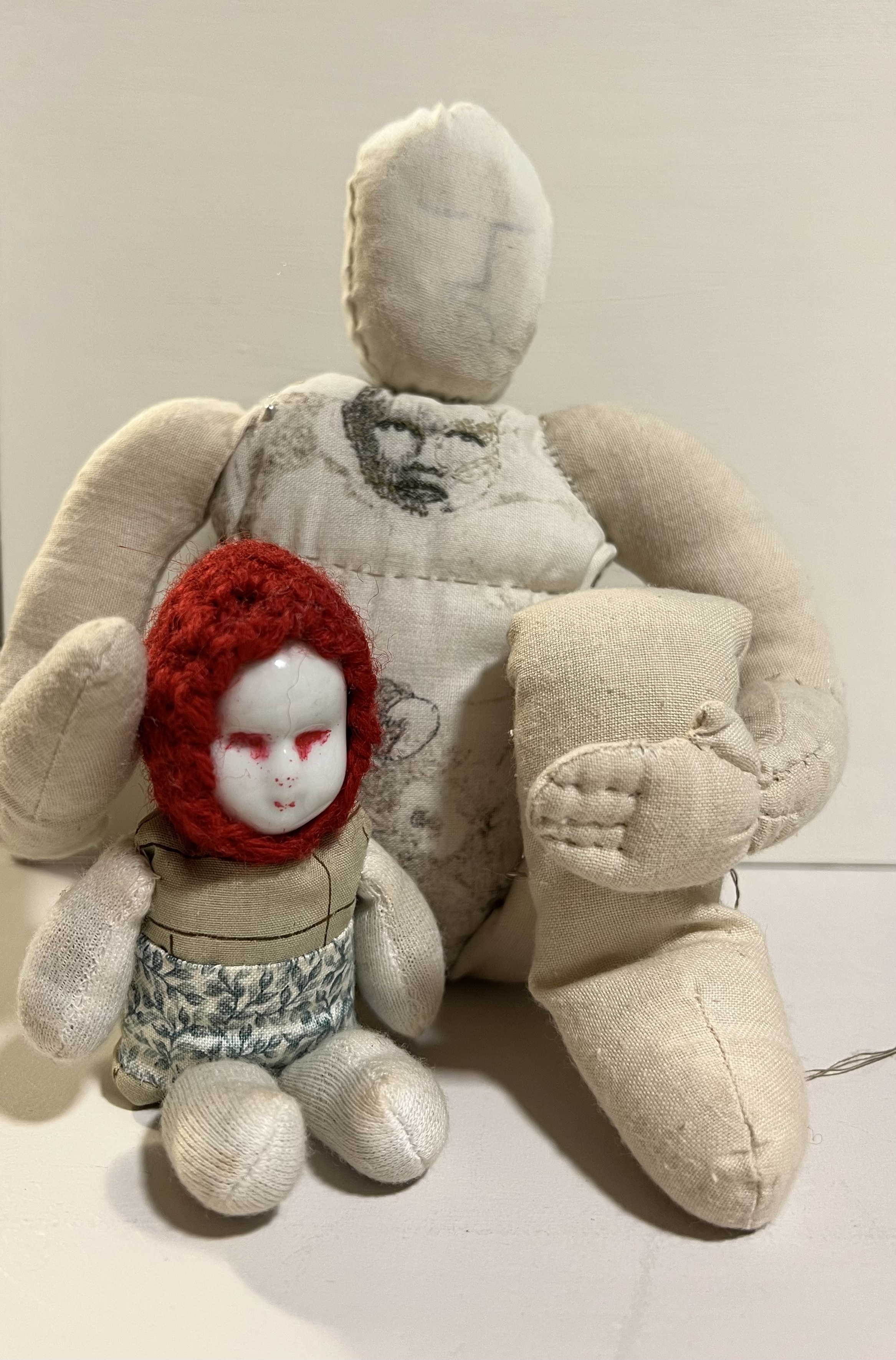
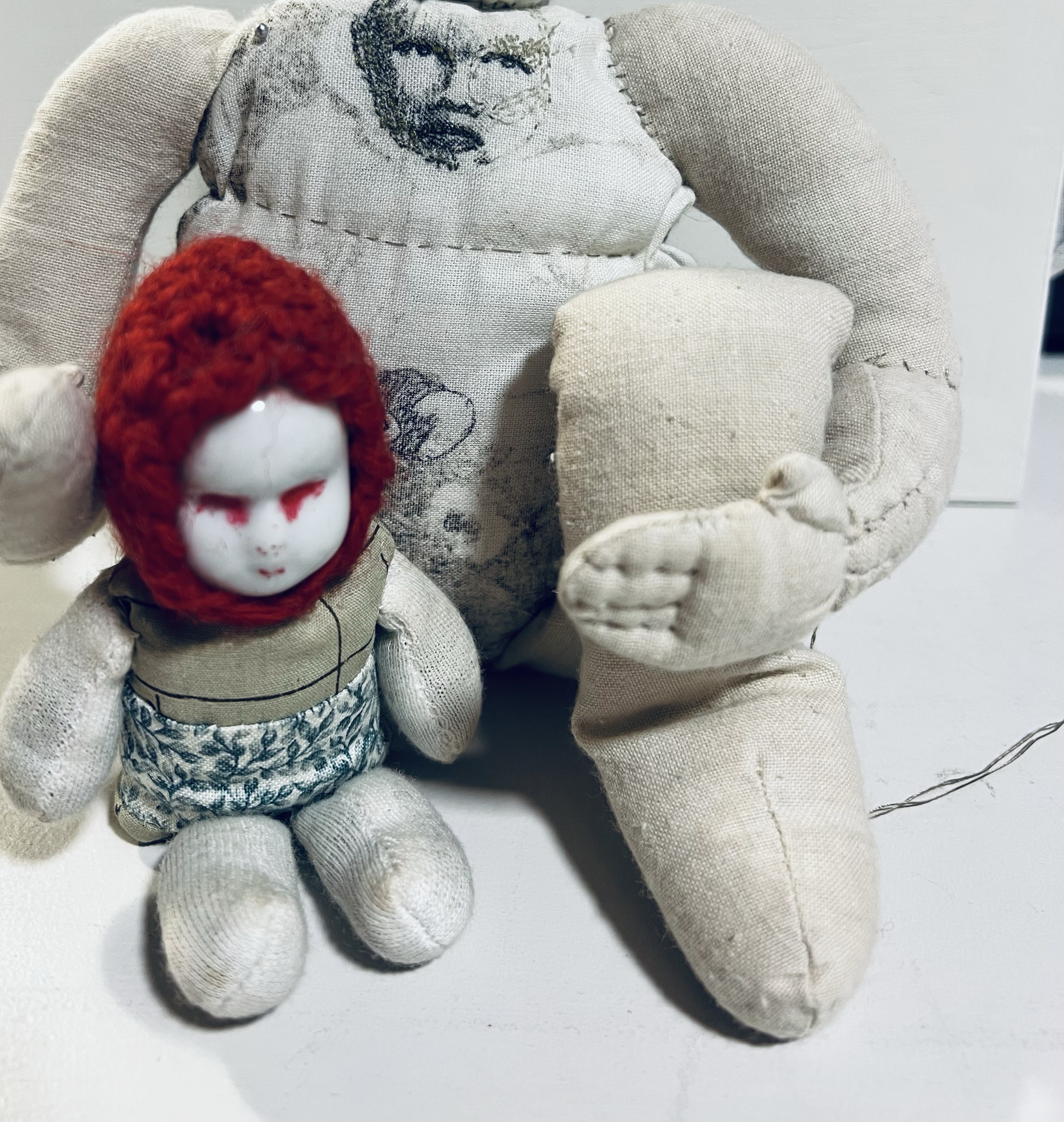
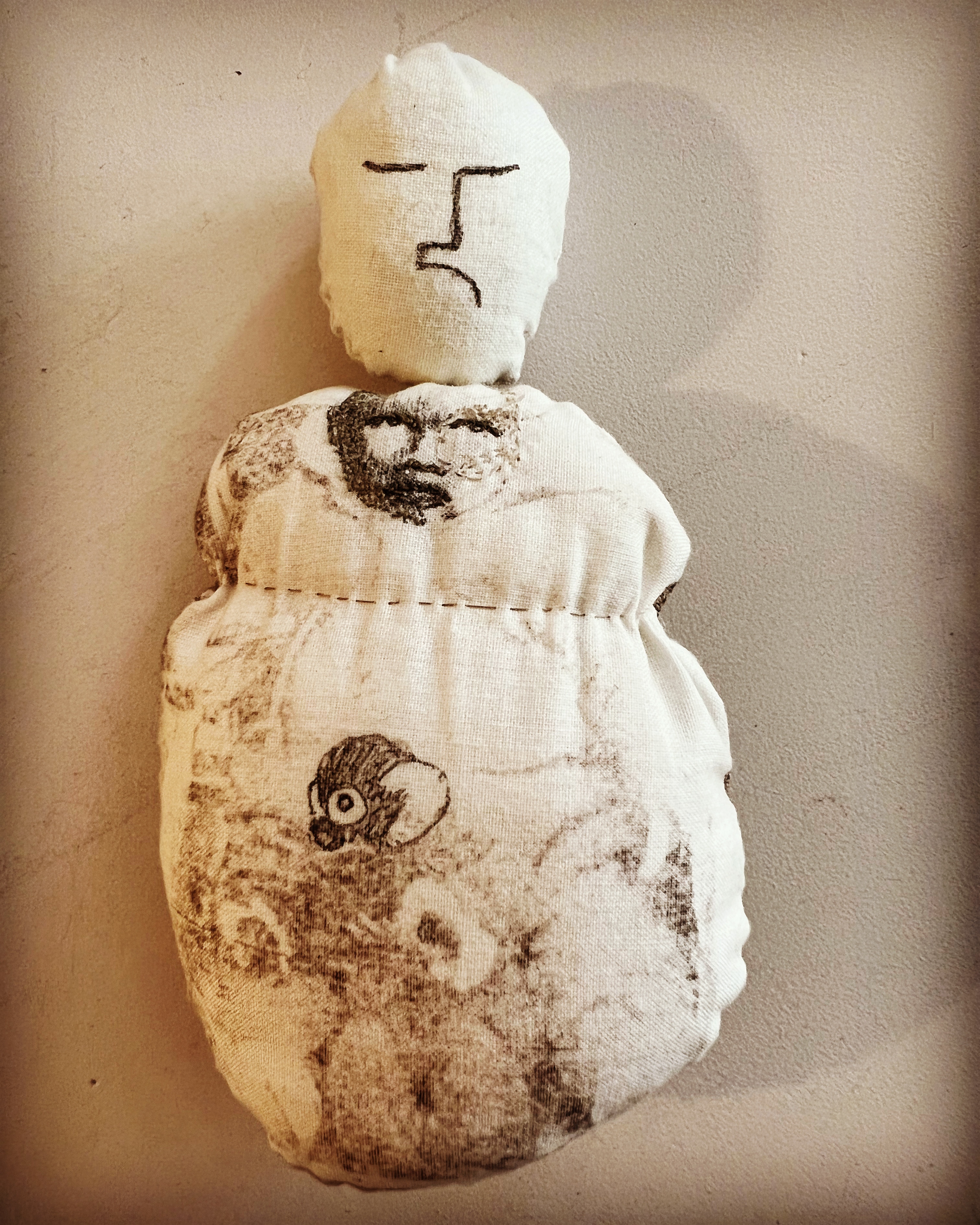
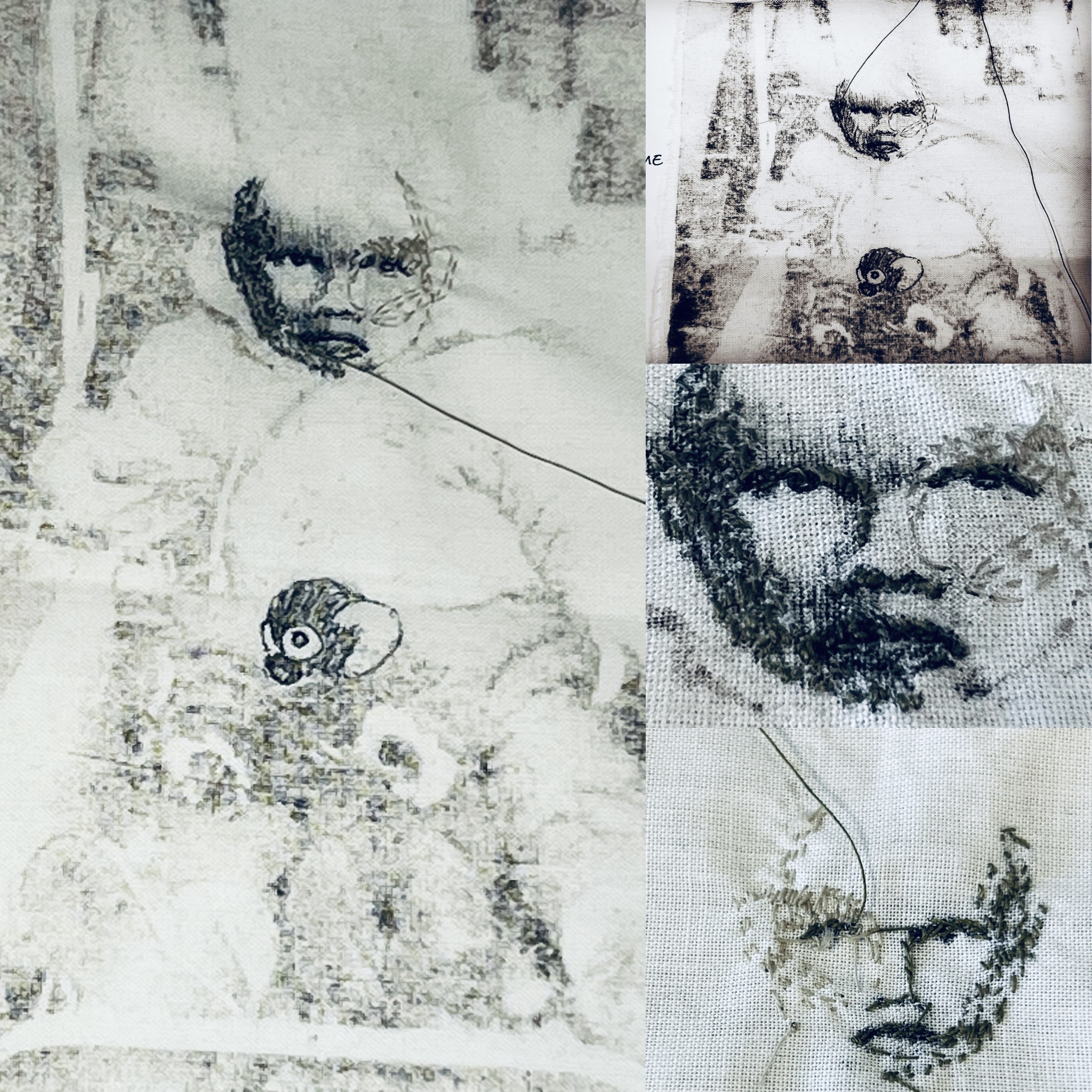
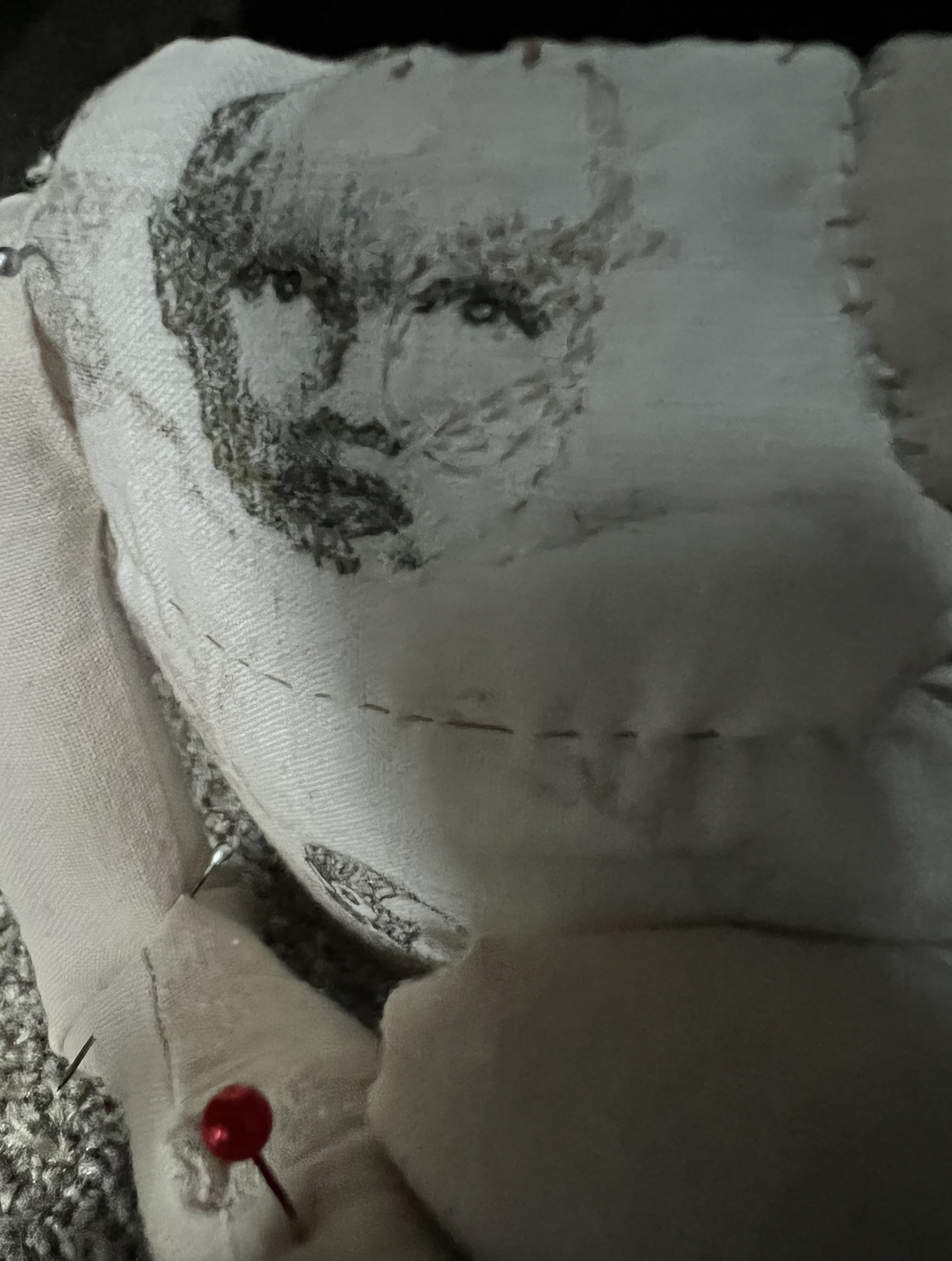
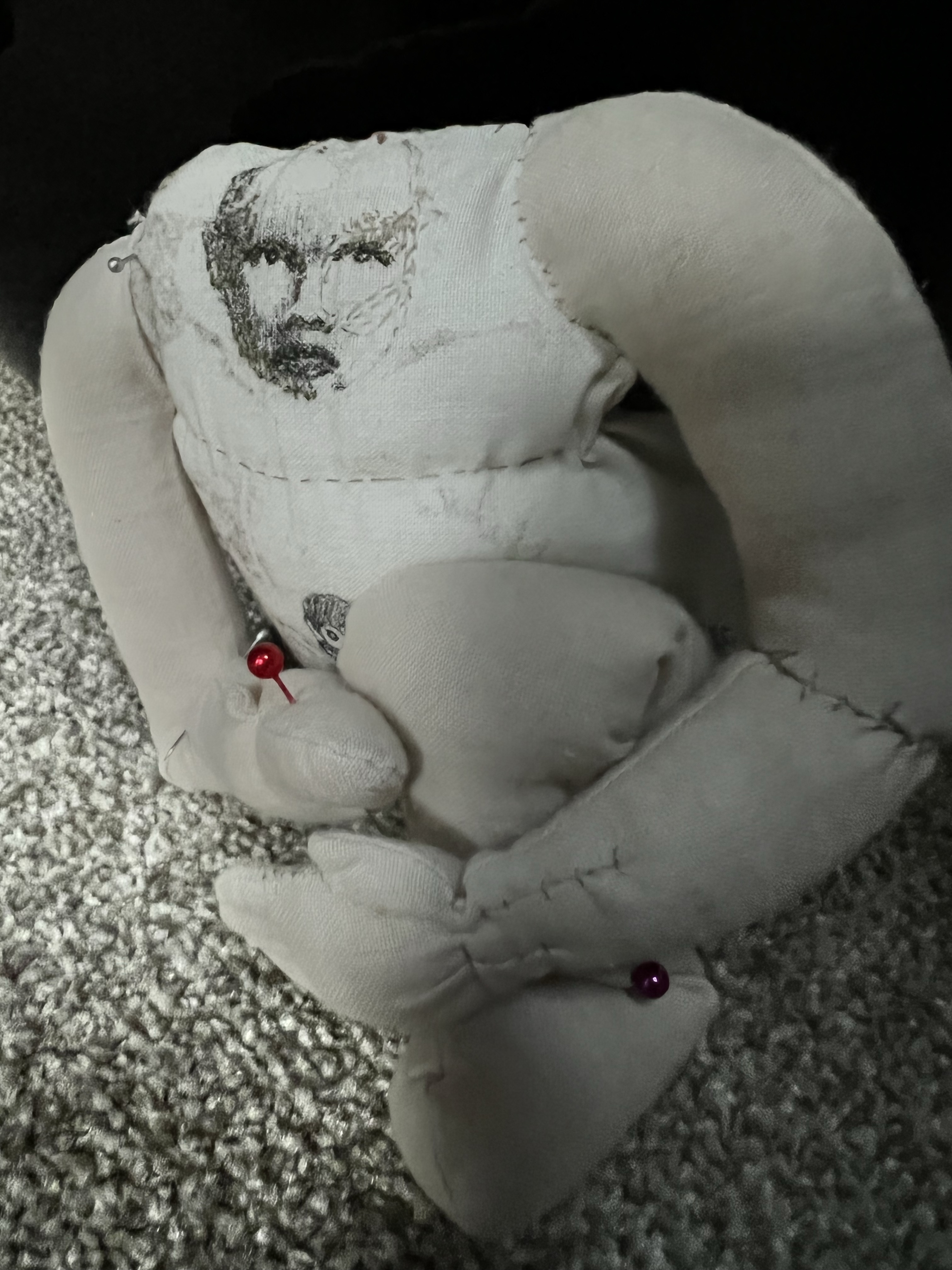
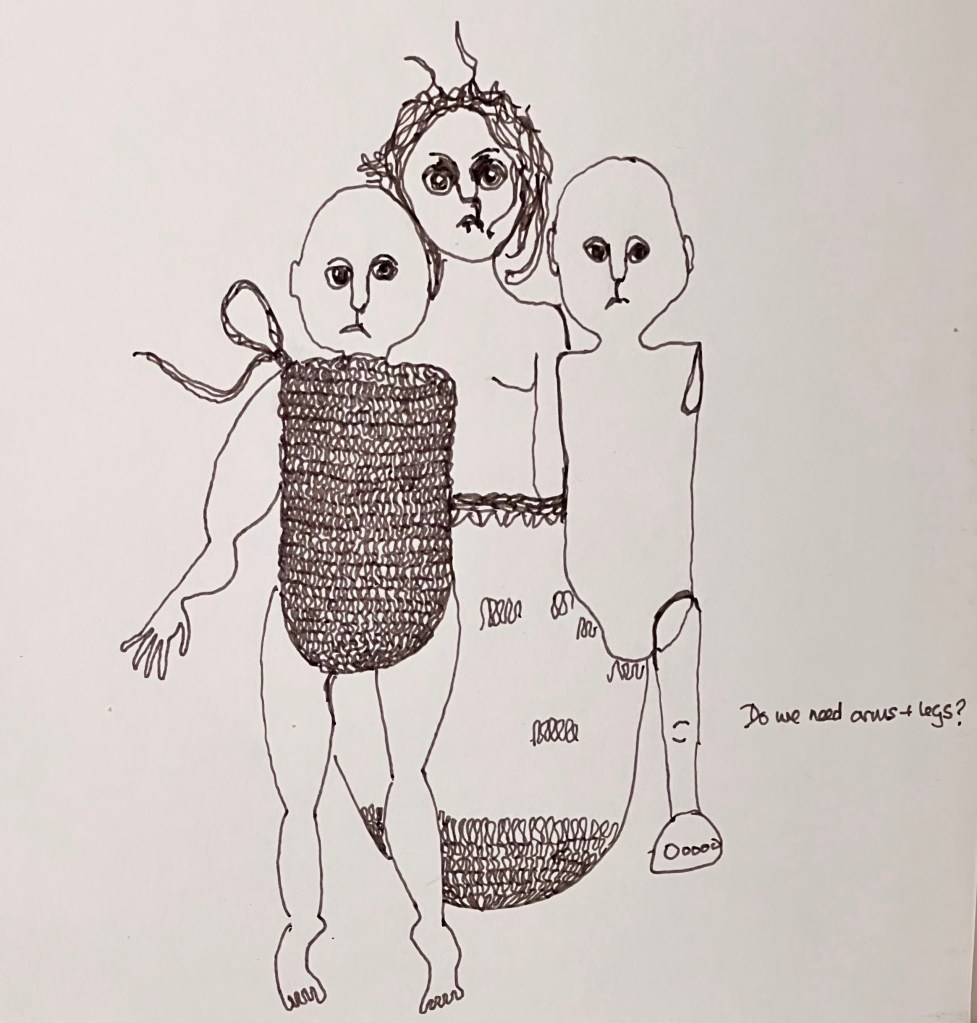
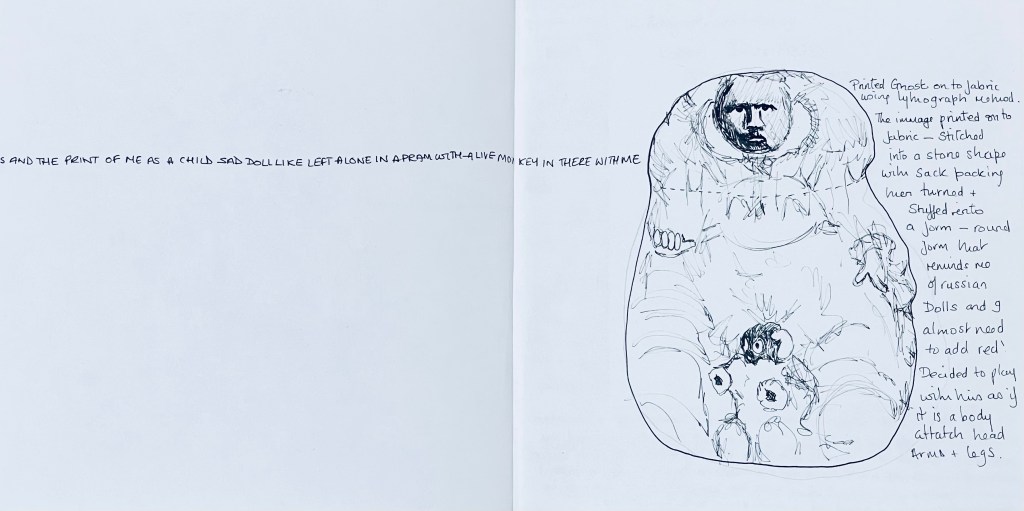
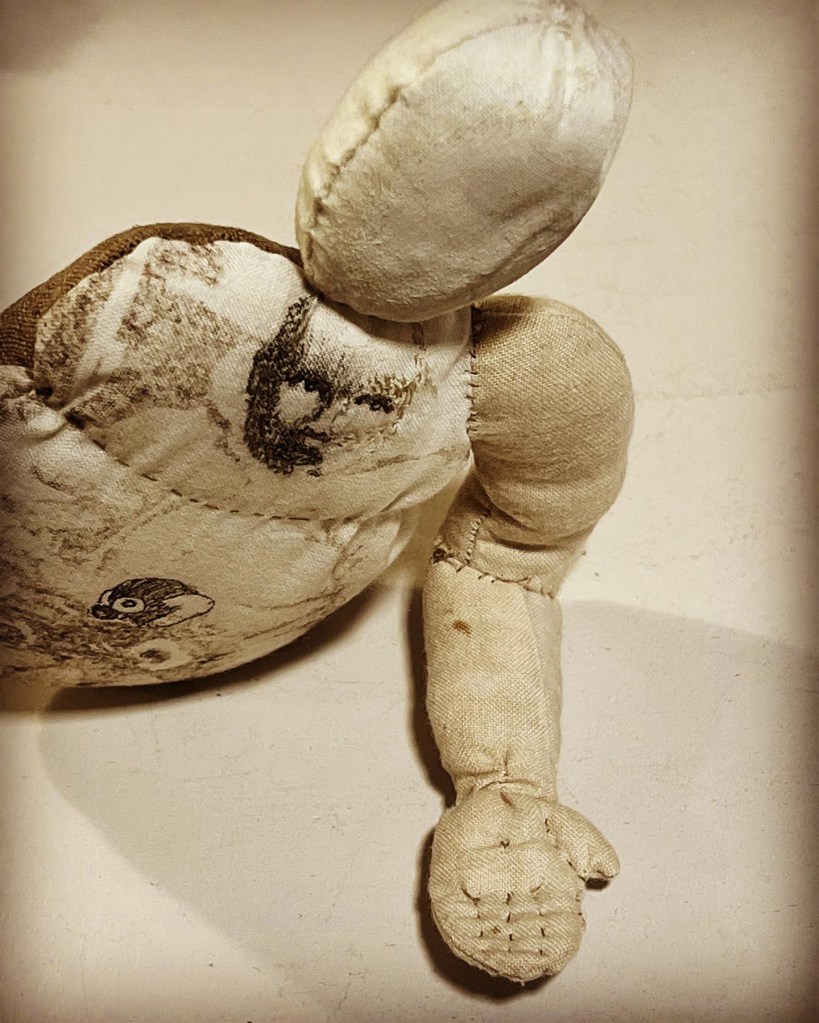
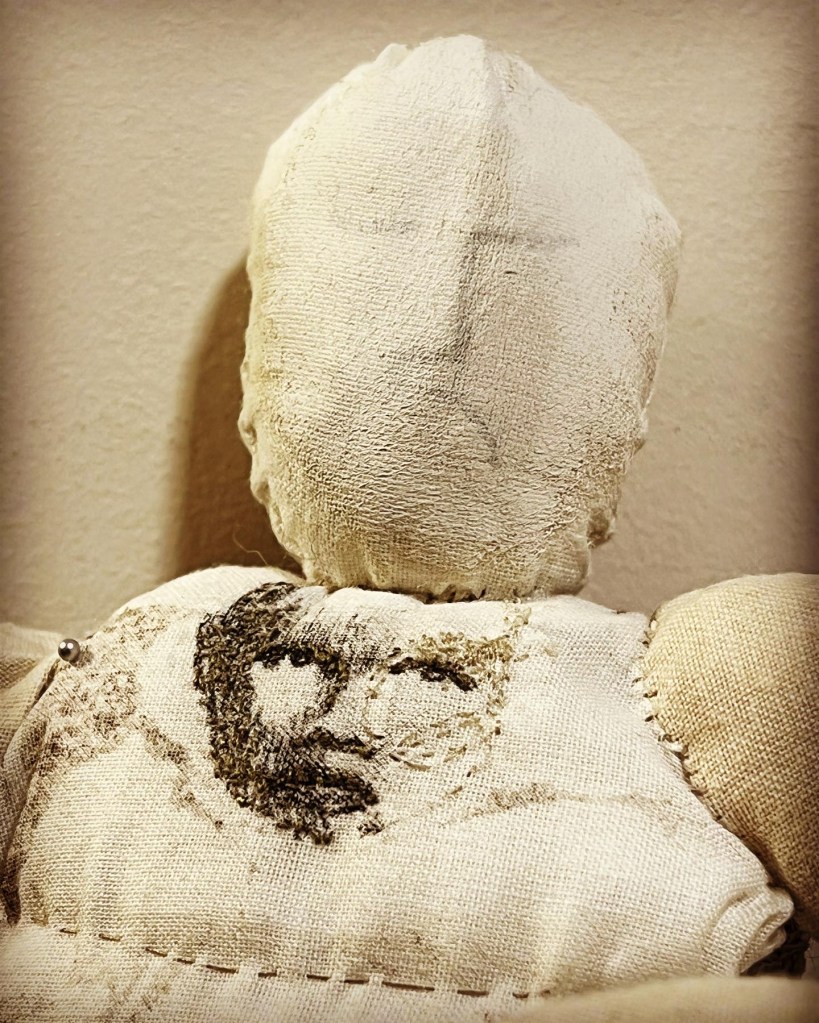
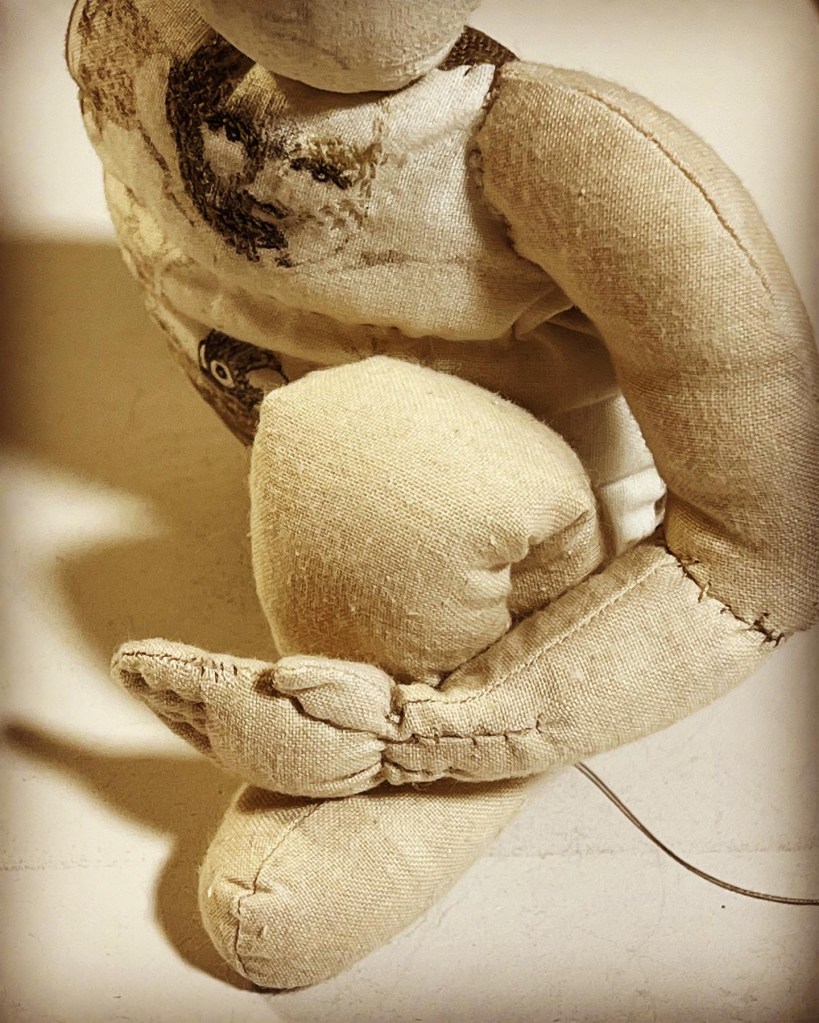
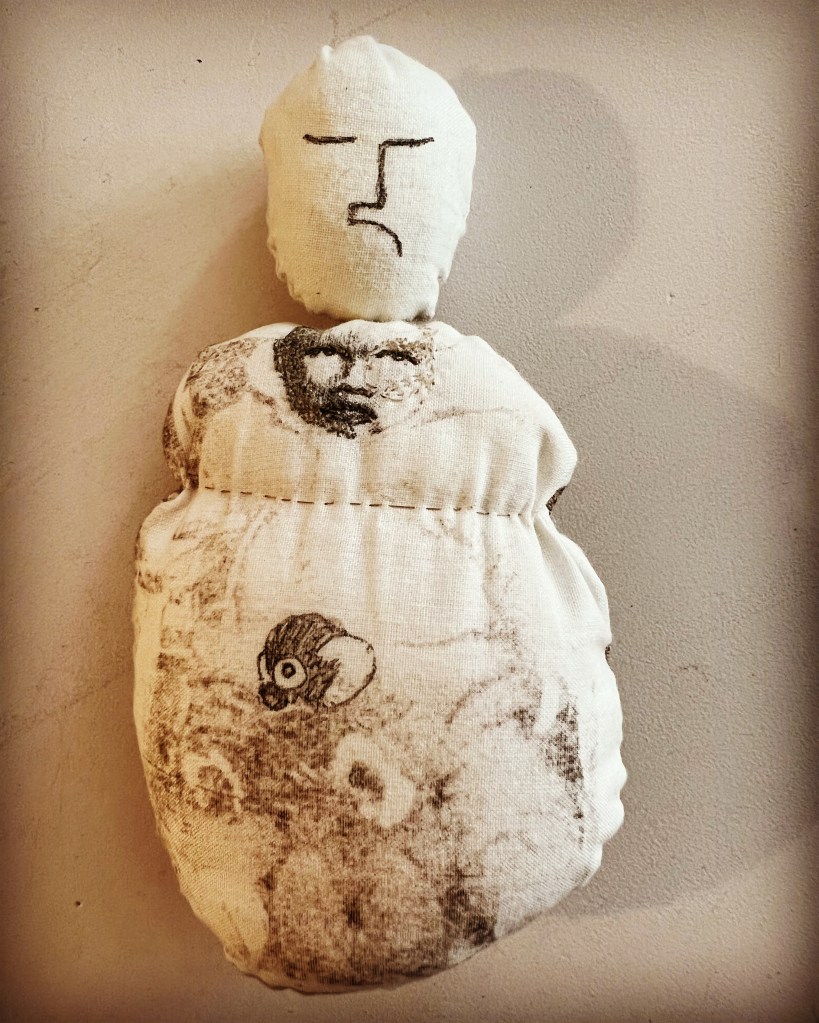
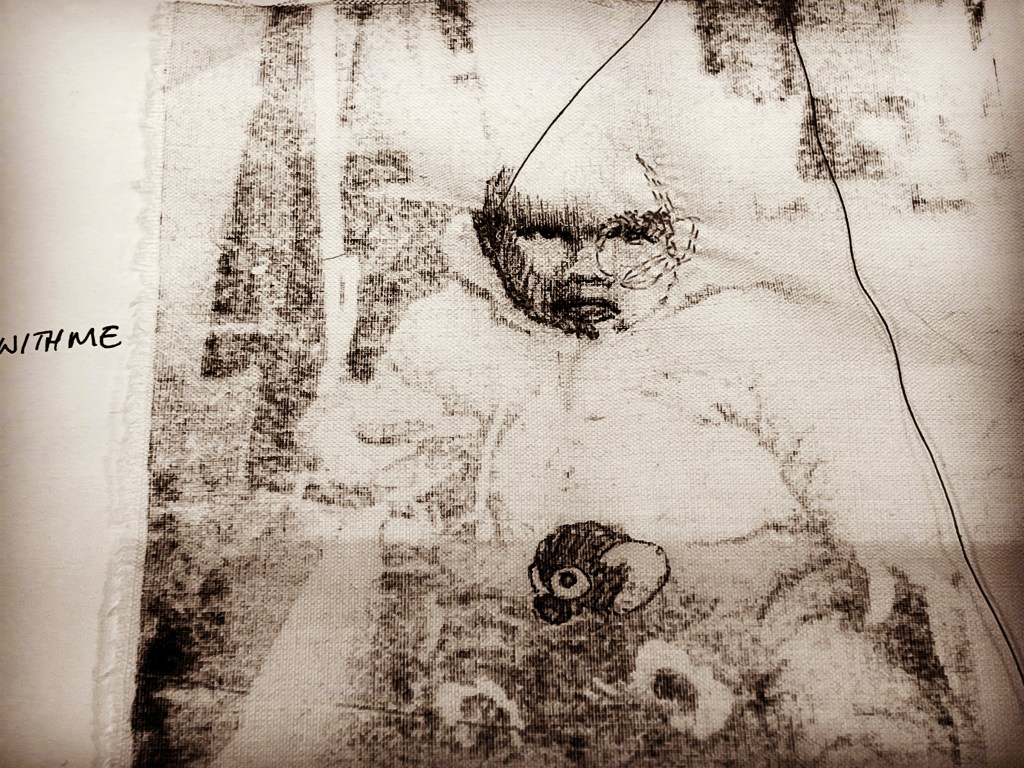
This piece was drawn from printed fabric using paper lithograph on to fabric technique I began to play with the shapes adding arms and legs different positions.
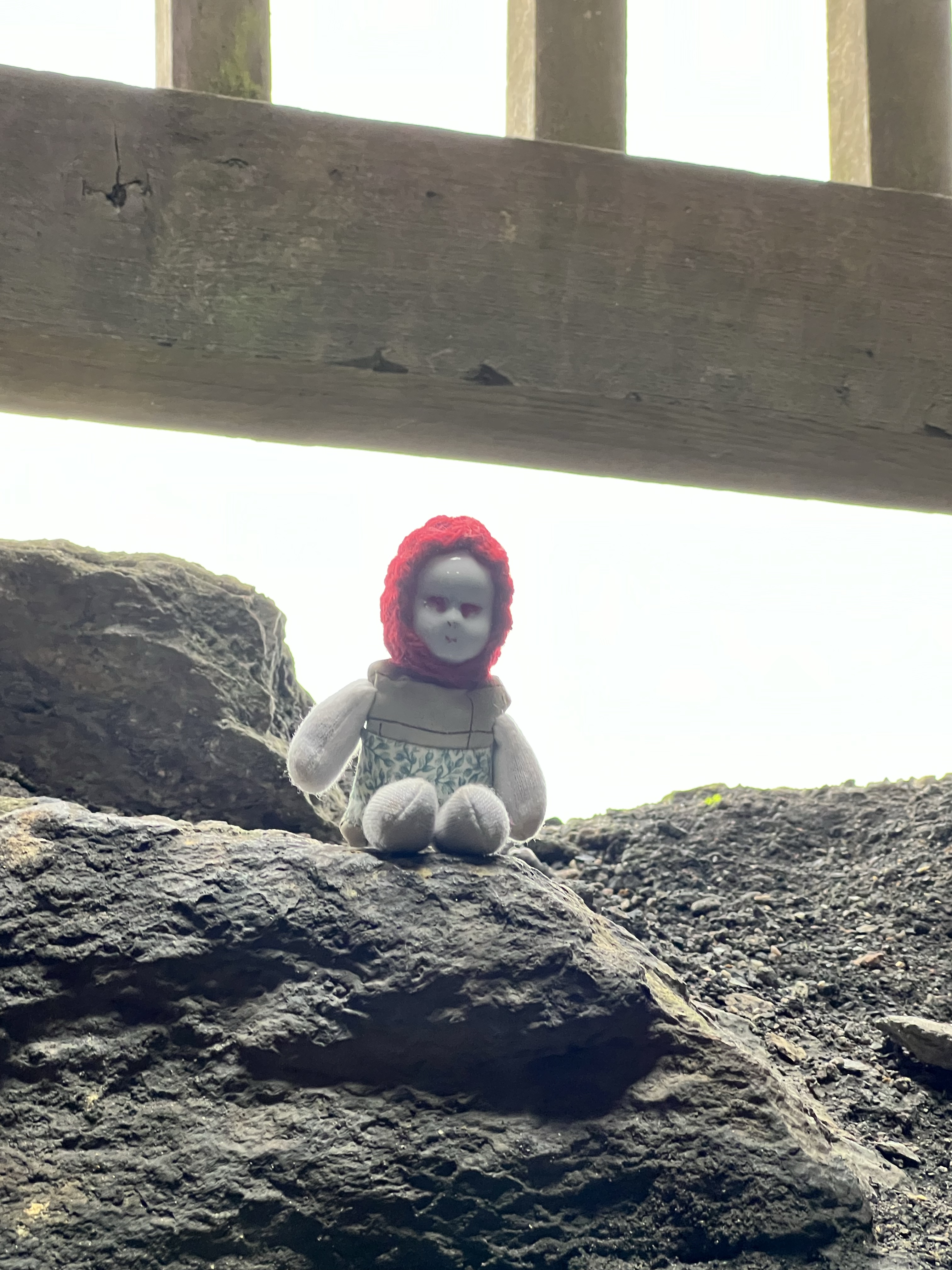
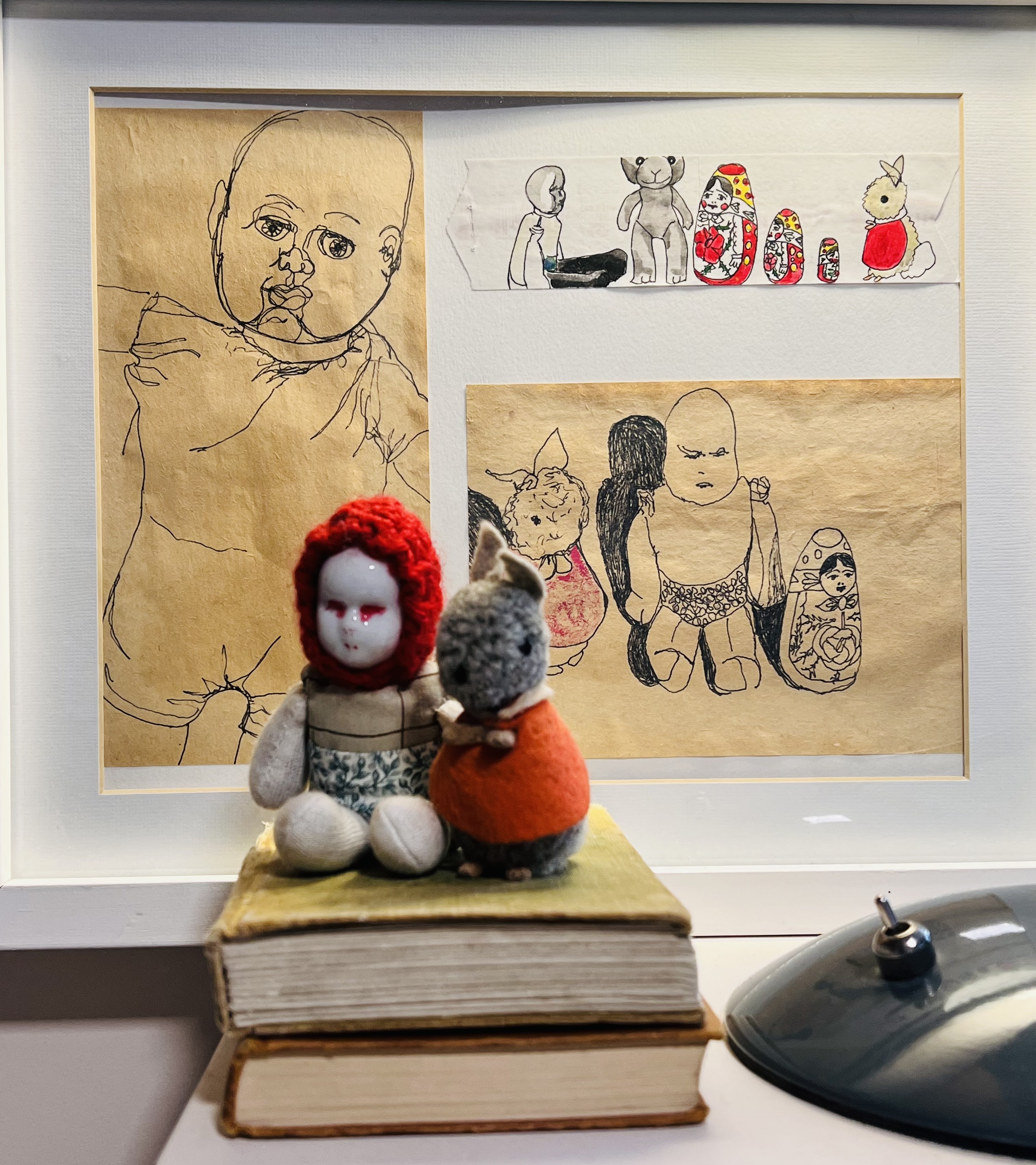
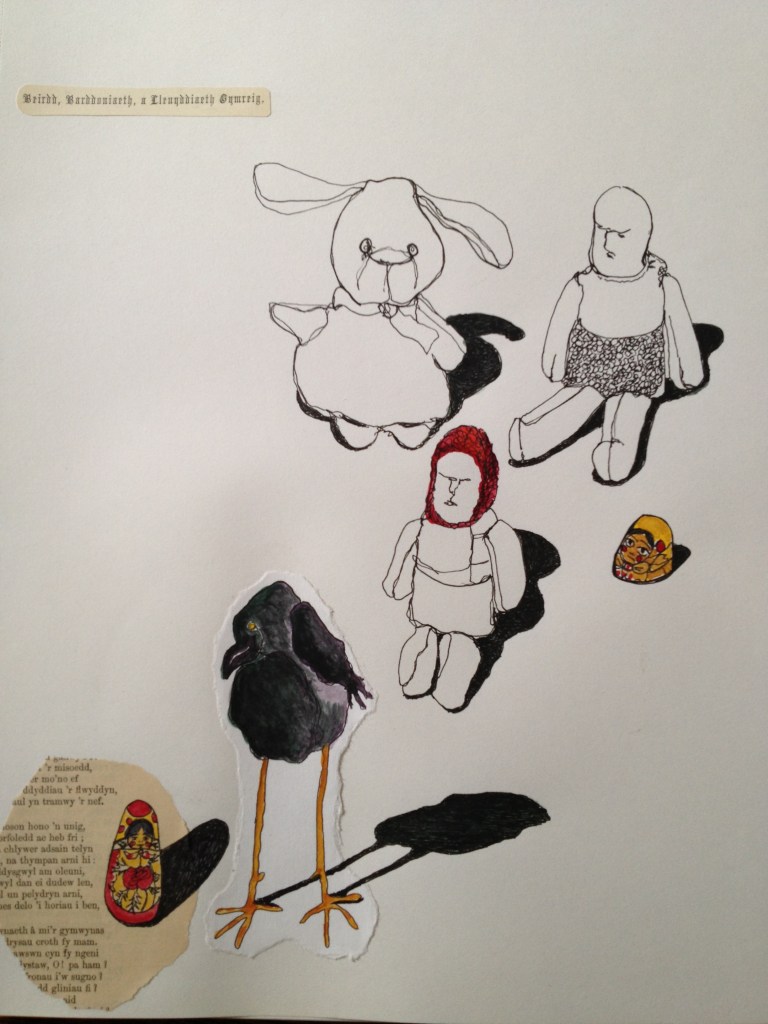
This drawing is from a piece that is partly made and had the red hooded sand doll with it.
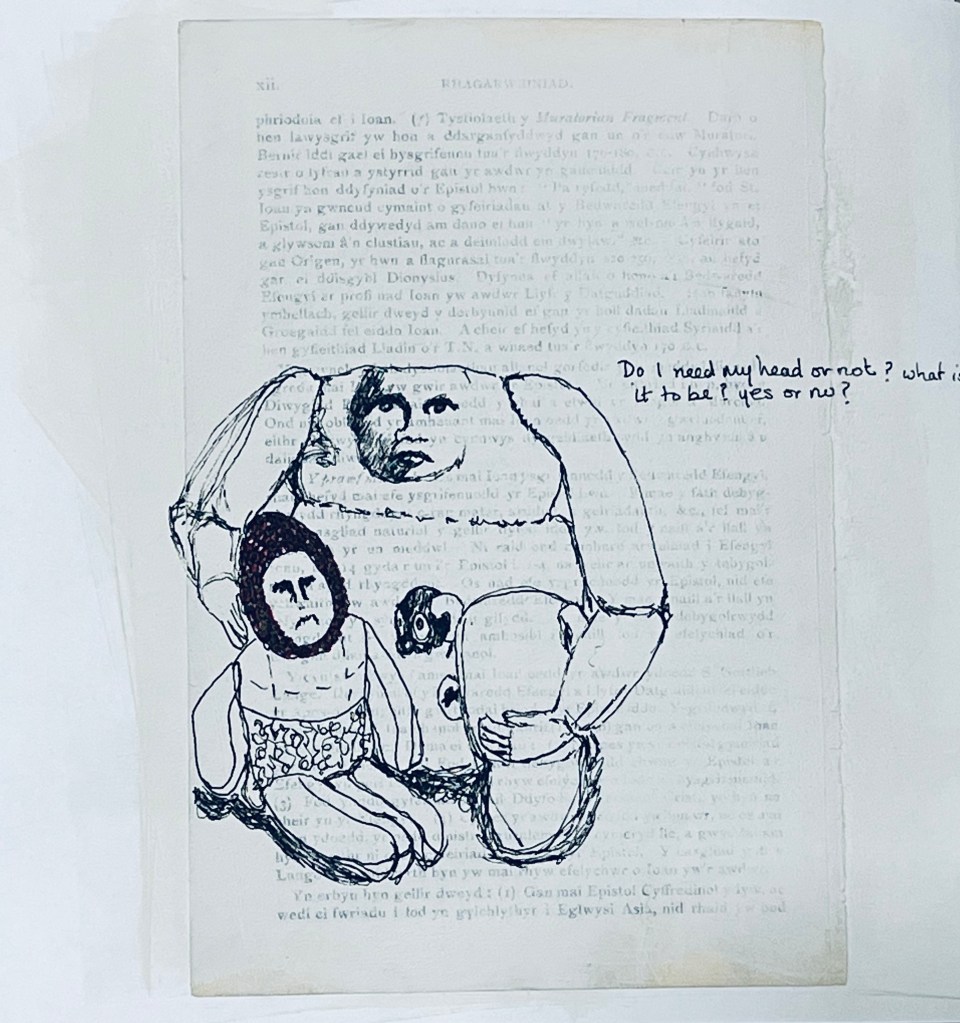
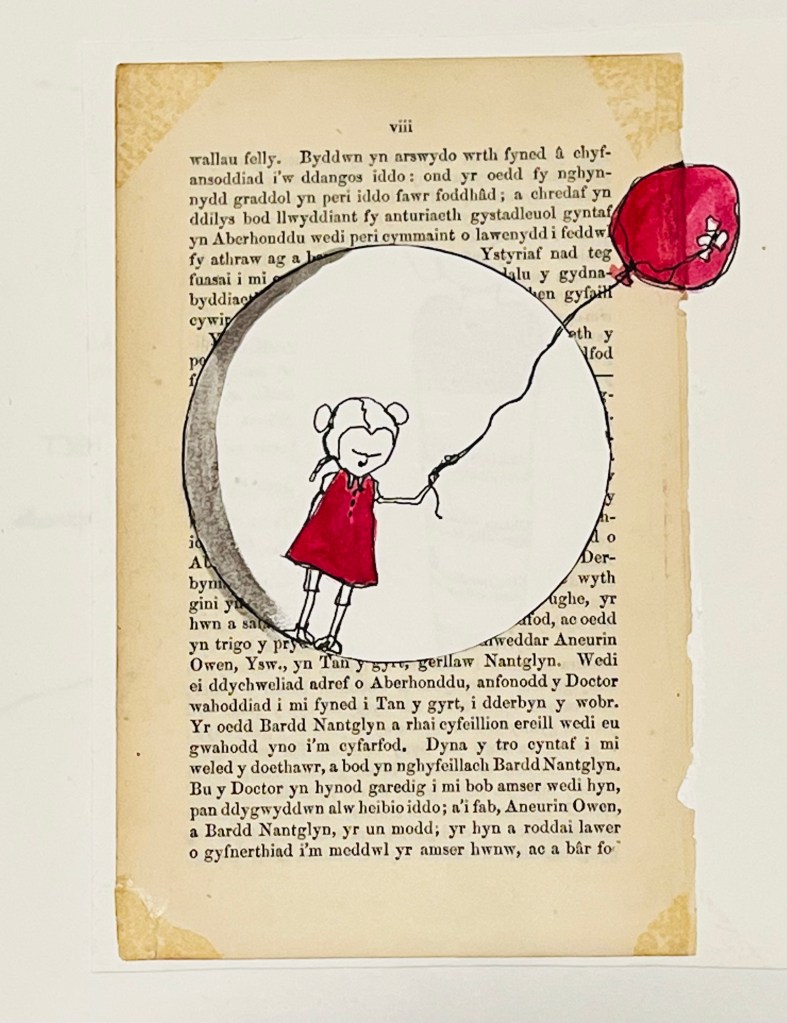
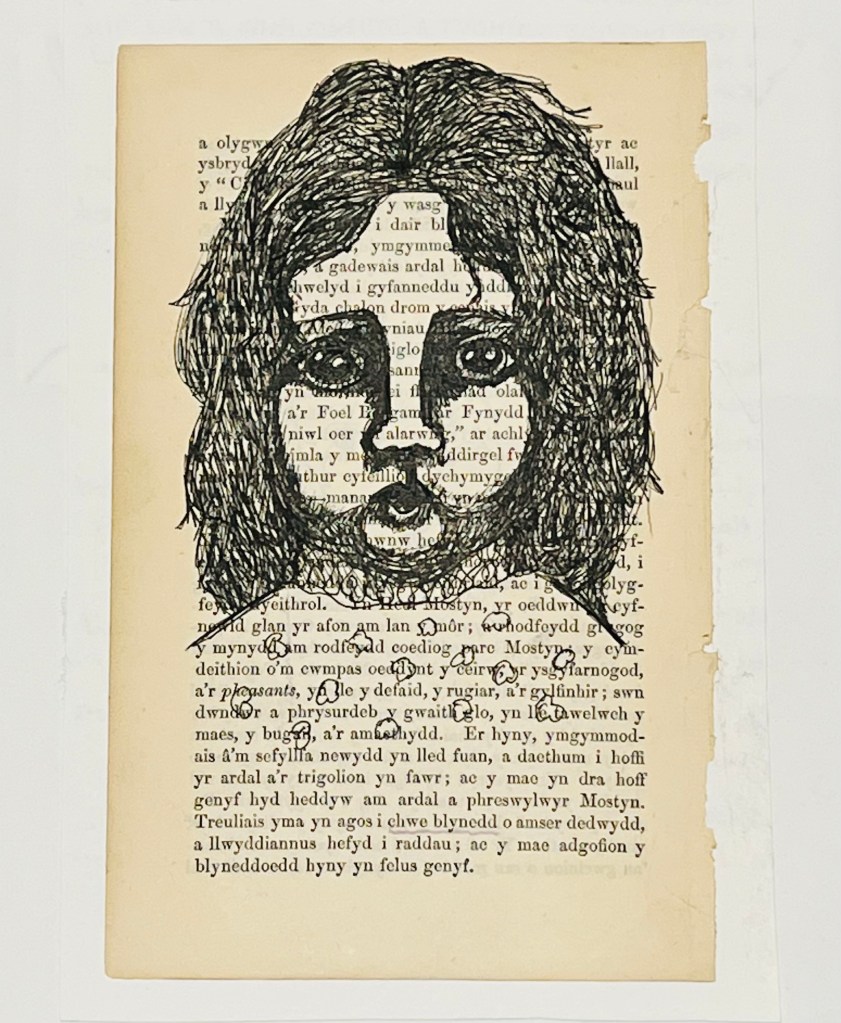
Inspired from a photograph I saw in an exhibition of photographs of a child in a run down poor area running with a balloon. I added the red paint this week as I tentatively try to add colour, unsure if it has added or taken away? I prefer it before but didn’t take images.Drawing on to old text, Welsh text
This is overworked and does not possess the qualities I want in my drawings, I wanted to work out how to draw Trauma this is where I am at the moment trying out different approaches, some won’t work and it’s part of the process.
Group Critique / Feedback (whilst starting an MA Interdisciplinary art practice in Wrexham Glyndwr Univeristy, Regent Street Art School campus).
The first critique was to discuss one piece that we wish to take further, my choice was a body a single body of work as I felt that one piece would not communicate what my work was about as these relate to each other.
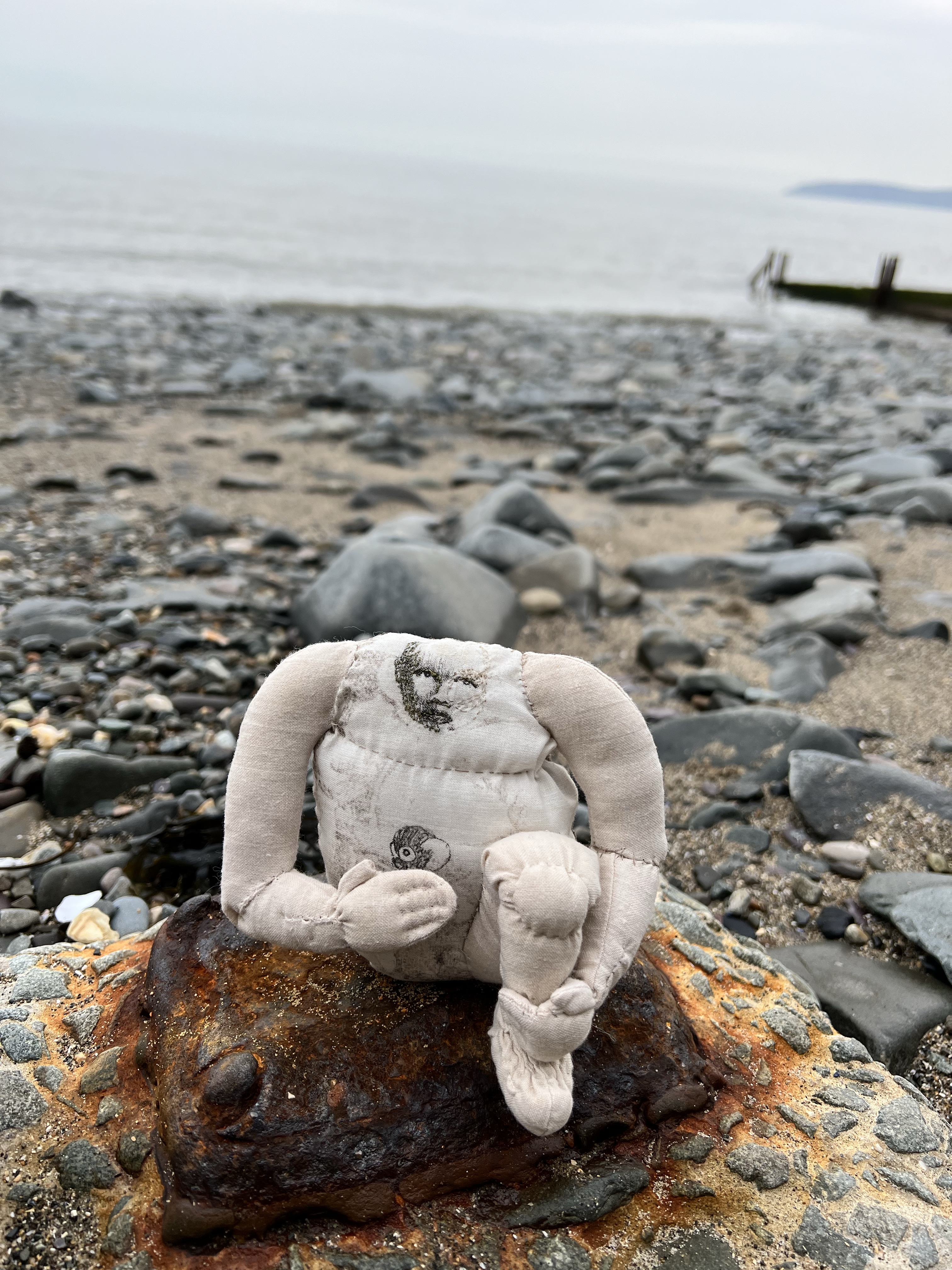
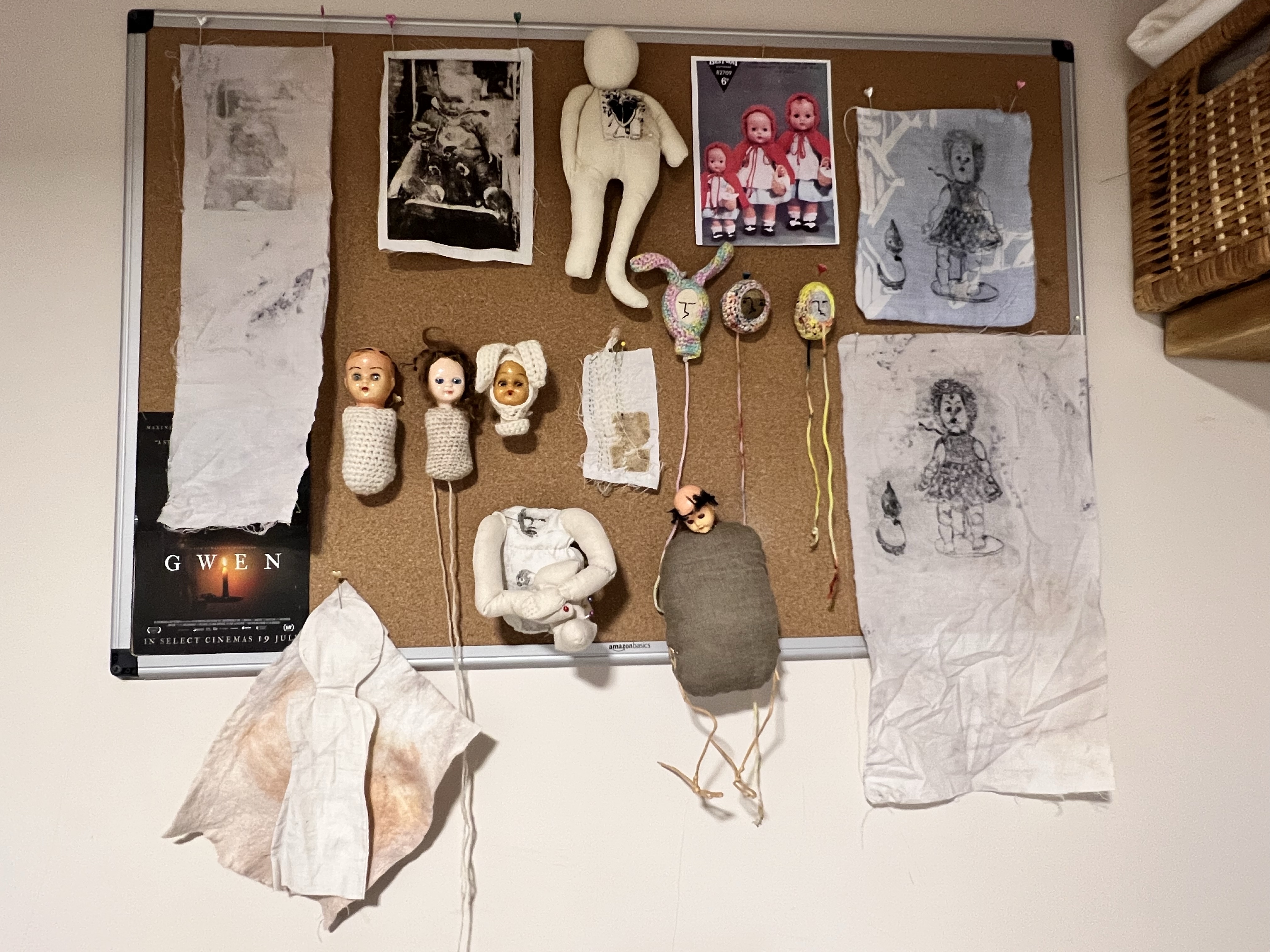
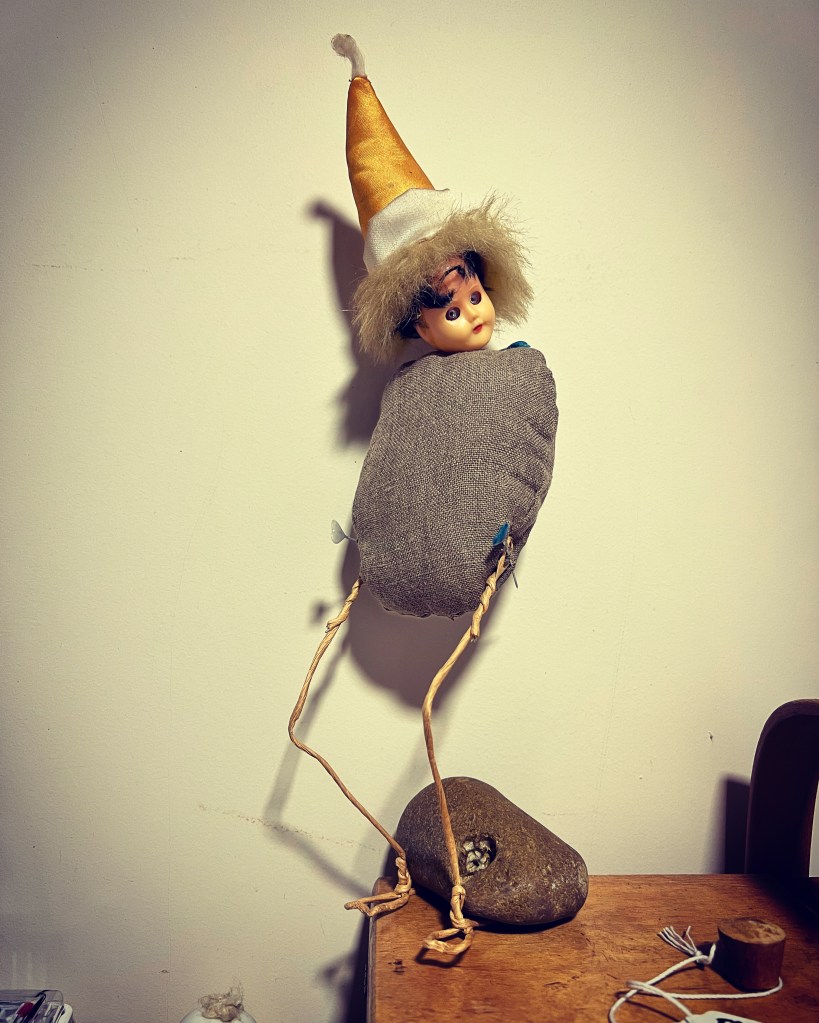
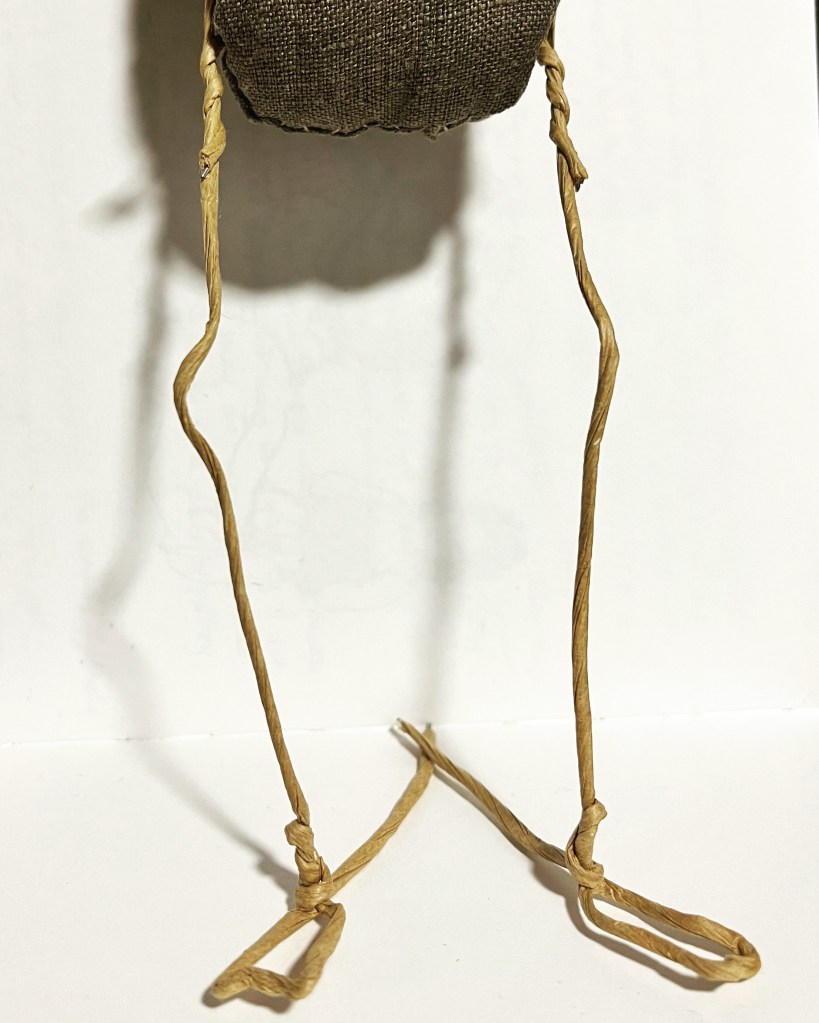
I showed the crocheted, embroidered head doll and talked about the significance of placement, the doll’s head is leaning sideways cradled in its arms in a body-hugging stance, I also took red riding hood, frowning patchwork doll and burnt blue rabbit. I have shown the drawing as well as photograph, the pieces inform the process I use to disassemble, change, build to communicate a narrative, these pieces are not one body but several different methods and this is what I was trying to convey.
I explained that I use inanimate objects found dolls, toys to tell stories, using narrative themes from my childhood, from trauma, from being left-handed not allowed to use my left hand, from undiagnosed dyslexia, and how these feed into my work. I also talked about the ‘Welsh Not’ and this is an area I wish to research and explore, The Foundling Hospital in London interests me, the abandonment of a child, Abjection from Julia Kristeva, Angela Carter, Brothers Quay, Jan Svankmajer are the areas that I am currently, or already a little familiar with.
I use the medium of wire, thread, fabric and print as well as found toys and dolls, I talked about my summer course with the Pale Rook and how this had influenced my practice. I feel that I could have been more precise, my ideas, my thoughts I felt were not really joined up at this stage but possibly didn’t need to be. Going through the process enabled me to see my own path and formulating a learning plan will articulate my intention further,
Feedback from the group was to look up the aesthetics of uncertainty by Janet Wolf, this was as a response to my depiction, that not all childhood experience, is the utopian ideal, peddled by a society who is often blind to its own problems, I will look this book up for further reading.
My second critique group discussion, at Ty Pawb, myself, two students and a tutor did a small group, I found this far less intimidating, I discussed how I have moved my work forward since the initial session and having completed my learning plan this has led me to be more concise in what my aims are, I want to channel my rage at what I see is injustice in our society, childhood trauma does play its part and will always feed into my work, but, my passion to make a difference with my art is to raise issues around disabilities, mental health, homelessness all three areas I have personal experience with. The feedback I receive when I discuss my work helps me to see the work from different perspective, and ideas that then raise questions for me, is my work communicating the narrative I have intended? Is the abject apparent or subtle? Am I being coherent?
My third Critique was with all the students, I felt this was more coherent, I have been able to reflect on my practice, and I am starting to see where the new experiments, testing out pieces, learning printing techniques to serve to print on to fabric, to inform new pieces as vehicles for expression. Please see my Instagram feed on the main page.







































 CarysAnne.Art